


Most translational labs track samples perfectly until they leave the freezer. Then documentation gets... creative.
Tissue samples moving from surgery to pathology. Blood draws going from bedside collection to research processing. Tumor biopsies transferring between clinical and research teams. Each handoff creates a documentation gap where audit trails disappear and regulatory compliance becomes guesswork.
The problem isn't that labs don't document handoffs. It's that they're documenting everything except what auditors actually check.
Why Traditional Chain-of-Custody Falls Apart in Translational Settings
Clinical labs have straightforward custody chains. Sample arrives, gets processed, results go out. Research labs track samples internally without much external scrutiny. Translational labs, though? You're juggling clinical requirements, research protocols, and regulatory frameworks that weren't designed to work together.
A breast cancer tissue sample might start in surgical pathology under CAP requirements, move to a research biobank under NIH guidelines, then transfer to a pharma partner following FDA regulations. Each transition has different documentation needs, different terminology, different audit expectations.
Traditional paper forms can't handle this complexity. Generic LIMS templates treat all samples the same. And those "comprehensive" chain-of-custody systems are usually designed for forensics or environmental testing, not translational research where a single sample might generate dozens of aliquots across multiple institutions.
The documentation burden multiplies with each handoff. Staff spend more time filling out forms than processing samples. Critical fields get missed. Timestamps conflict. When the audit comes, you're scrambling to piece together a coherent custody trail from fragments scattered across different systems.
The Audit Checkpoints Nobody Warns You About
Certain documentation gaps appear repeatedly across regulatory audits in translational settings. Not the obvious ones like missing signatures or dates — the subtle ones that turn routine audits into multi-day investigations.
Eliminate lab bottlenecks and errors.
Labioly helps you monitor, manage, and report lab activities efficiently and compliantly.
- Real-time sample tracking
- Inventory and supply alerts
- Staff workflow coordination
No credit card required
Temperature excursions during transport between buildings. Simple enough, except auditors want continuous monitoring data, not just departure and arrival temps. One cancer center got dinged because their 15-minute walk between the clinical lab and research facility had no temperature documentation. The samples never left dry ice, but without proof, the auditor flagged every affected specimen.
Sample volume verification at handoff creates another trap. Your clinical team documents collecting 10mL of blood. The research team receives and logs 10mL. Looks fine until the auditor asks about the 0.5mL used for clinical testing before transfer. Now you're explaining why volumes don't match and hoping a verbal explanation holds.
Identity confirmation methods matter more than most people expect. Having both parties sign isn't enough anymore. Auditors want to see how you verified the person receiving samples had authorization. One lab's entire tumor bank documentation got questioned because they couldn't prove the research assistant who signed for samples in 2019 had completed required training at that time.
The worst surprises come from time zone confusion. Your clinical site in Boston timestamps everything in EST. The research facility in San Diego uses PST. The electronic system defaults to UTC. A sample collected at "2:30 PM" appears to be processed at "11:30 AM" and suddenly you're explaining how samples traveled backward through time.
Building Templates That Actually Work
Forget comprehensive forms that try to capture everything. You need targeted templates for specific handoff scenarios.
Surgical Specimen to Research Processing:
-
Patient ID (de-identified research code)
-
Clinical accession number
-
Collection timestamp (specify timezone)
-
Tissue type and anatomical site
-
Preservative method (fresh, frozen, fixed)
-
Temperature at handoff (actual reading, not "on ice")
-
Visual specimen integrity check
-
Research protocol number
-
Receiving tech certification ID
Blood Collection to Biobanking:
-
Collection tube types and counts
-
Draw order documentation
-
Processing deadline timestamp
-
Centrifugation parameters if processed
-
Aliquot scheme (number, volume, storage)
-
Freeze time documentation
-
Storage location assignment
-
Chain break explanation if applicable
Multi-Site Transfer (Clinical to Research):
-
Originating site regulatory status
-
Material transfer agreement reference
-
Biosafety level confirmation
-
Package integrity verification
-
Courier tracking integration
-
Receiving site inspection notes
-
Discrepancy protocol triggered (yes/no)
-
Corrective action reference if needed
| Template | Fields |
|---|---|
| Surgical Specimen to Research Processing | Patient ID (de-identified research code); Clinical accession number; Collection timestamp (specify timezone); Tissue type and anatomical site; Preservative method (fresh, frozen, fixed); Temperature at handoff (actual reading, not "on ice"); Visual specimen integrity check; Research protocol number; Receiving tech certification ID |
| Blood Collection to Biobanking | Collection tube types and counts; Draw order documentation; Processing deadline timestamp; Centrifugation parameters if processed; Aliquot scheme (number, volume, storage); Freeze time documentation; Storage location assignment; Chain break explanation if applicable |
| Multi-Site Transfer (Clinical to Research) | Originating site regulatory status; Material transfer agreement reference; Biosafety level confirmation; Package integrity verification; Courier tracking integration; Receiving site inspection notes; Discrepancy protocol triggered (yes/no); Corrective action reference if needed |
Each template should take under 60 seconds to complete. Any field that requires thinking or looking something up will get skipped when things get busy.
Digital Timestamp Strategies That Satisfy Auditors
Paper timestamps mean nothing without corroboration. "3:47 PM" written in pen could mean anything. Digital timestamps tell a story, but only if you implement them correctly.
Start with synchronized time sources. Every system touching sample documentation needs to pull time from the same source — not approximately the same time, the exact same time server. One research hospital learned this after their building's badge readers ran 4 minutes fast, making it look like samples arrived before they left.
Layer your timestamp capture. Don't rely on a single system.
-
Badge reader shows tech entered biobank at 14
32:15
-
Freezer access log confirms door opened at 14
33:47
-
Sample management system records login at 14
34:02
-
Barcode scan registers sample receipt at 14
34:31
This creates an audit trail that's nearly impossible to falsify and catches errors before the auditor does. If timestamps don't align logically, you know something's wrong immediately.
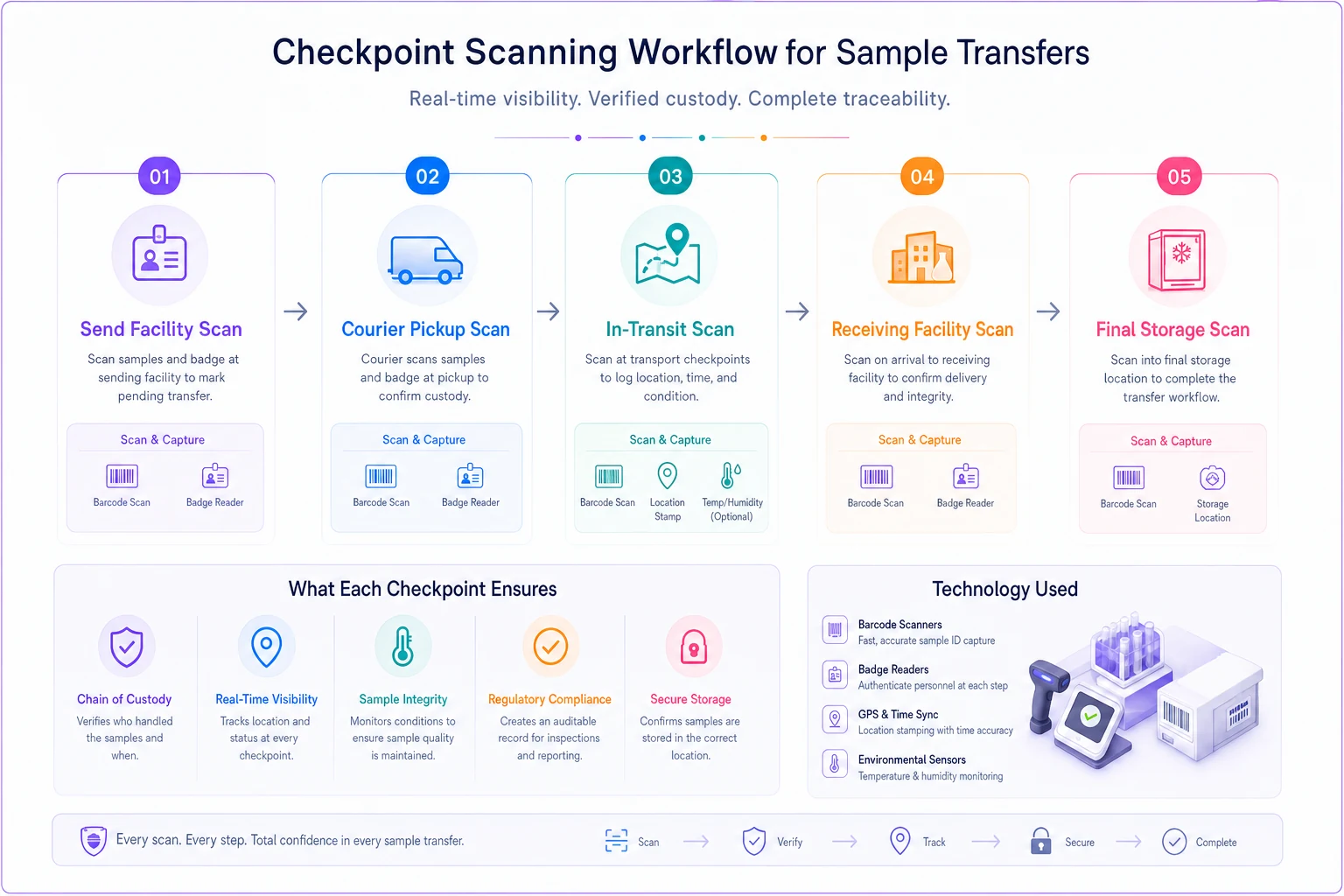
For samples crossing institutional boundaries, implement checkpoint scanning. The sending facility scans samples into a "pending transfer" status. The courier scans on pickup. The receiving facility scans on delivery. Each scan generates an immutable timestamp with location data.
Here's a simple checkpoint scanning workflow to visualize how each scan adds a verifiable timestamp and location.
Timestamp gaps need explanation. A 47-minute gap between freezer removal and processing? Document it. "Sample batch held in biosafety cabinet during staff shift change." Auditors don't expect perfect workflows. They expect honest documentation.
Real Handoff Scenarios and What Goes Wrong
Scenario 1: Weekend Tumor Collection
Saturday morning, liver tumor resection. OR team follows protocol perfectly — specimen photographed, measured, placed in sterile container with cold preservation medium. Surgical resident fills out the chain-of-custody form, noting collection at 08:45.
The specimen sits in the OR's specimen refrigerator because pathology doesn't have weekend research processing staff. Monday morning, the path tech retrieves the sample, notices the preservation medium has separated, and proceeds with sectioning anyway.
The audit finding? No documentation of storage conditions between Saturday and Monday. No temperature log for the OR specimen fridge. No verification that preservation medium separation didn't affect sample integrity. Three days of missing custody documentation.
Fix: Weekend samples get tagged with temperature loggers. Specimen refrigerators need daily check documentation, even on weekends. Preservation medium changes require photo documentation with timestamp.
Scenario 2: Collaborative Pharma Transfer
Academic medical center shares patient samples with a pharmaceutical partner for biomarker development. Both sides have solid documentation — until the samples reach the pharma loading dock.
Courier delivers at 16:45 on Thursday. Pharma's receiving lab is closed. Security signs for the package, stores it in the main office at room temperature overnight. Friday morning, a lab tech discovers thawed samples and assumes they can be refrozen since they're labeled "frozen specimen."
The audit trail shows proper custody until courier delivery. Then nothing for 14 hours. Then samples logged into pharma's system as "frozen on receipt."
Fix: Receiving protocols must specify who can accept samples and where they're stored until processing. After-hours deliveries need predetermined cold storage locations. Security staff need basic sample handling training.
The Minimal Documentation Set That Passes Every Time
Strip away everything that doesn't directly support audit requirements. You need exactly five elements documented at every handoff:
-
Identity verification - Both sample ID and person ID, verified against source documents
-
Physical state - Temperature, appearance, container integrity
-
Time accountability - No gaps longer than 15 minutes without explanation
-
Authority confirmation - Proof that person has training/permission for this sample type
-
Deviation documentation - Any variation from SOP noted in real-time
That's it. Everything else is overhead.
Volume discrepancies? Only document if greater than 10% or 0.5mL, whichever is smaller. Temperature variations? Only if outside specified range for more than documented acceptable duration. Processing delays? Only if they exceed protocol windows.
Consistency matters more than completeness. Every handoff uses the same five-element check. Every deviation gets documented the same way. Every timestamp follows the same format.
When Templates Become Automation Opportunities
Once you've stripped documentation down to essential elements, patterns start showing up. The same information gets transcribed multiple times. The same calculations happen at every handoff. The same decision trees determine next steps.
This is where operational software makes a real difference — not by adding complexity, but by removing the repetitive documentation burden that causes most errors in the first place.
Start automation with the highest-volume, most error-prone handoffs — usually clinical-to-research transfers to build confidence.
Barcode scanning automatically populates sample identity fields. Temperature probes feed directly into custody records. Badge readers confirm personnel authorization. Integration with freezer management systems tracks storage location changes. Each handoff generates a complete audit record without anyone filling out forms.
The most effective implementations don't try to automate everything at once. Start with the highest-volume, most error-prone handoffs — usually clinical-to-research transfers or multi-site collaborations. Build confidence with automation on routine samples before tackling complex specimens.
AI-assisted platforms help by flagging documentation gaps before they become audit findings. Missing temperature data for more than 30 minutes? The system alerts the quality team. Sample volumes don't match between facilities? An automatic discrepancy report generates. Timestamps suggest impossible travel time? The workflow pauses for verification.
The deeper value comes from pattern recognition across thousands of handoffs over time. The system learns that Wednesday afternoon transfers consistently run longer due to shift overlap. It knows samples from Building A need extra temperature monitoring because of the outdoor walkway. It surfaces targeted reminders to the right people rather than blanket retraining for everyone.
Making It Stick Without Adding Burden
Perfect documentation means nothing if staff won't use it consistently. The best chain-of-custody system is the one people actually follow when nobody's watching.
Keep forms at workstations, not in a central filing cabinet. Pre-print labels for common transfer scenarios. Use checklist cards that fit in lab coat pockets. Make documentation part of the physical workflow, not a separate step tacked on afterward.
Train staff on audit consequences using real examples. "Remember when we had to explain why 47 samples showed duplicate timestamps? That's why we scan individually now." Specific, personal examples stick better than abstract policy reminders.
Show staff how proper documentation protects them. When something goes wrong — and it will — good documentation proves who did what correctly. It's not about catching mistakes. It's about protecting everyone involved in sample handling.
The Patterns That Predict Problems
Certain warning signs consistently appear before major documentation failures.
Handoffs that happen at shift changes generate roughly three times more documentation errors. Not because staff are careless, but because verbal communication replaces written records. "I told the night tech about the temperature excursion" doesn't survive audit scrutiny.
Multi-building transfers without dedicated couriers create custody gaps. Using whoever's available seems efficient until you realize graduate students aren't trained on chain-of-custody requirements. One contamination event traced back to samples transported in a personal lunch cooler makes this painfully clear.
Retrospective documentation never matches reality. Labs that batch their entries — "I'll enter all today's transfers at end of shift" — consistently show timestamp patterns auditors flag immediately. Sequences too perfect. Intervals too regular. Obviously filled in after the fact.
The fix isn't more training or stricter policies. It's removing the friction that makes real-time documentation feel impossible in the first place.
Moving Forward
Clean chain-of-custody documentation for translational samples doesn't require complex systems or extensive training. It requires understanding what auditors actually check, building templates that capture exactly that information, and cutting every unnecessary field that slows people down.
Start with your highest-risk handoffs — usually anything crossing institutional boundaries or changing regulatory frameworks. Build a minimal template. Test it during actual transfers. Refine based on what gets missed or takes too long.
Once manual documentation is streamlined, look for automation opportunities. Not to replace human judgment, but to eliminate transcription errors and close documentation gaps. Let systems handle timestamps, calculations, and requirement checks while staff focus on sample integrity.
The goal isn't perfect documentation. It's sufficient documentation that stands up to scrutiny while letting your lab focus on actual science. When chain-of-custody becomes automatic rather than burdensome, compliance follows naturally — and your next audit becomes about the quality of your research, not the quality of your paperwork.
Ready to upgrade your lab operations?
Join 500+ labs using Labioly to save time, reduce errors, and enhance productivity and compliance.