


Most labs don't fail an audit because their data is wrong. They fail because nobody can explain how the data got where it is, who touched it, or which version is the real one. The science is fine. The governance around the science is a patchwork of tribal knowledge, half-updated SOPs, and one senior tech who "just knows" how the freezer inventory reconciles with the LIMS.
That's the actual problem a laboratory data governance framework solves. Not compliance theater — a system where policies, roles, validation checkpoints, and evidence bundles connect to the workflows people run every day. When it's built right, governance is invisible during normal operations and instantly retrievable when someone needs proof.
This piece is long because the topic is genuinely interconnected. You can't fix ownership without fixing validation, and you can't fix validation without fixing where evidence lives. So rather than a tips list, this walks through how the whole thing fits together — and where it quietly breaks as a lab grows.
Why governance breaks at labs that are doing everything "right"
Governance rarely collapses in one dramatic failure. It erodes.
A lab starts small — four or five people, one instrument set, one project lead who mentally holds the whole data flow. Everyone knows raw instrument files go into a shared drive folder, get cleaned in a spreadsheet, and land in the LIMS. No written policy because there doesn't need to be. The system fits in one person's head.
Then the lab grows. A second project comes in. A new tech joins who wasn't there when the informal rules got established. Someone starts a parallel folder structure because the old one felt messy. A grad student exports a dataset to their laptop for analysis and that becomes the working copy for three weeks. Now there are two versions of the truth, and nobody made a decision to allow that — it just happened because no policy said it couldn't.
The breaking point usually isn't headcount. It's handoff count. Every time data crosses a boundary — instrument to storage, storage to analysis, analysis to report, report to archive — you introduce a place where ownership can blur. A five-person lab with four handoffs is manageable. A twelve-person lab with fifteen handoffs and no defined owners at each boundary is one staff departure away from real trouble.
What most managers miss: governance isn't about documents. It's about assigning a specific human to every boundary where data changes hands or changes state. The documents just record those assignments.
The four layers that actually make up a governance framework
People conflate governance with "having SOPs." SOPs are one layer. A real framework has four, and they need to line up or the whole thing leaks.
Eliminate lab bottlenecks and errors.
Labioly helps you monitor, manage, and report lab activities efficiently and compliantly.
- Real-time sample tracking
- Inventory and supply alerts
- Staff workflow coordination
No credit card required
Layer 1 — Policies. The non-negotiable rules. Where raw data lives, how long it's retained, who can alter records, what "final" means. Policies should be short and boring. If your data policy is twelve pages, nobody reads it and it won't be enforced.
Layer 2 — Role responsibilities. Every policy needs a named owner, not a department. "The lab" doesn't own anything. A person owns it. This is where most frameworks are weakest — rules without anyone accountable for enforcing them.
Layer 3 — Validation checkpoints. The specific moments where data gets verified before it moves to the next state. Not continuous monitoring — discrete gates. Stop, confirm, then proceed.
Layer 4 — Evidence bundles. A pre-defined set of artifacts you'd hand an auditor for any given claim. If someone asks "prove this result came from a calibrated instrument on a validated method," you should have a named bundle that answers exactly that — not a scavenger hunt through shared drives.
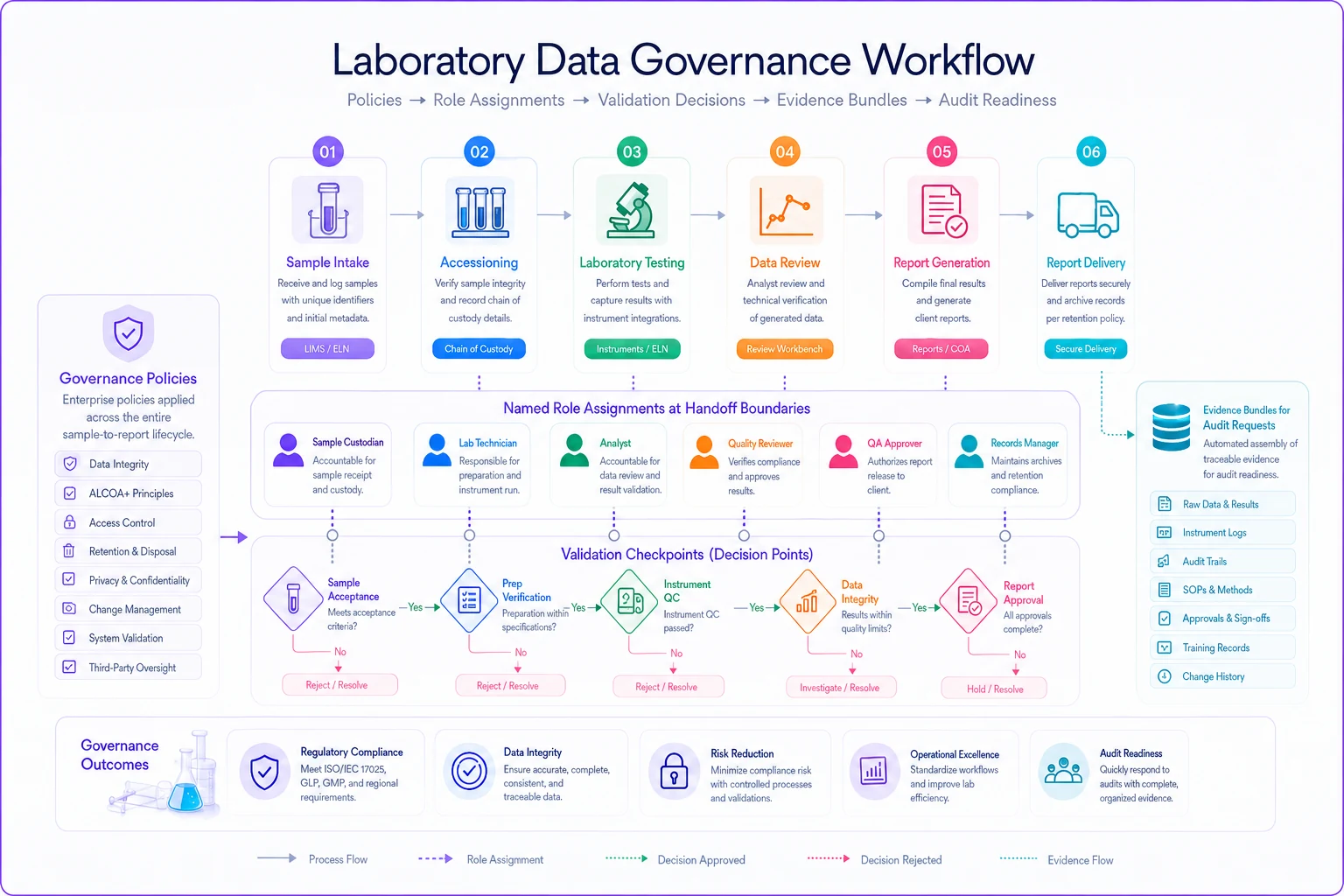
| Workflow step | Policy that applies | Role responsible | Validation checkpoint | Evidence bundle contents |
|---|---|---|---|---|
| Instrument generates raw file | Raw data is immutable; no edits to source | Instrument operator | Checksum + timestamp captured at capture | Raw file, checksum, capture log |
| File moves to storage | Single canonical location, no personal copies | Data steward | File-arrival reconciliation | Transfer log, reconciliation record |
| Data processed/analyzed | Analysis on canonical copy only | Analyst | Method version + parameter check | Analysis script/version, input hash |
| Result reviewed | Two-person review for reportable results | Reviewer (not the analyst) | Independent recalculation or spot-check | Review sign-off, review notes |
| Result reported | Report ties to method, instrument, operator | Project lead | Cross-reference to source records | Final report + traceability map |
| Record archived | Retention period enforced, access logged | Data steward | Archive integrity verification | Archive manifest, access log |
The column that trips people up most is role responsible. Every row has a different owner, and the reviewer is deliberately not the analyst. When one person owns three consecutive rows, you don't have validation — you have one person's judgment repeated three times.
Roles: the part everyone underinvests in
This is where frameworks look great on paper and fall apart in practice.
The common mistake is defining roles by job title. "The QC manager is responsible for data integrity." Fine — but what happens when the QC manager is out for six weeks? Or leaves and takes the undocumented workflow with them? Titles aren't durable. Responsibilities need to be defined as functions, then assigned to titles, so the function can be reassigned when the person changes.
-
Data owner — accountable for a dataset's lifecycle end to end. Usually a project lead. Doesn't do the day-to-day work but answers for it.
-
Data steward — the operational hands. Manages storage, enforces the single-canonical-copy rule, runs reconciliations. Most underappreciated role in most labs, and often the first casualty of budget cuts.
-
Validators/reviewers — people who check work they didn't produce. The independence is the whole point.
-
System custodian — owns the LIMS/ELN configuration, access controls, and integration health. In small labs this gets bolted onto someone's existing job, which is fine until the system grows and it silently becomes a half-time role nobody accounted for.
In labs under about ten people, one person often wears three of these hats. That's survivable — but you have to write down that they're wearing three hats, because the risk concentration is real. When that person is out sick during an audit window, you want the framework to tell someone else exactly what to pick up, not have them guessing.
Define role assignments as functions first, then map them to job titles so reassignment is straightforward when people change.
Role clarity degrades faster than any other part of governance. SOPs sit in a document and stay put. Role assignments drift every time someone joins, leaves, or gets pulled onto a hot project. If you audit only one layer quarterly, audit the role assignments.
Validation checkpoints as decision trees, not vibes
Checkpoints only work if they're deterministic. "Review the data for reasonableness" is not a checkpoint — it's a hope. A real checkpoint is a decision tree with defined outcomes: pass, fail, or escalate. No fourth option.
-
Does the result fall within the method's expected range? → If no, go to step 4.
-
Do the control samples for this batch pass acceptance criteria? → If no, go to step 4.
-
Does the independent recalculation match within tolerance? → If yes, PASS and record sign-off. If no, go to step 4.
-
ESCALATE — flag to data owner, do not report, log the reason and open an exception record.
The reason to write it as a tree rather than a paragraph: trees force a decision. A paragraph lets a tired reviewer at 6pm on a Friday hand-wave the ambiguous case. A tree with three exits doesn't.
What separates functional frameworks from decorative ones is what happens on fail. Most labs define pass conditions in exhaustive detail and leave "fail" as an implied "fix it and move on." That's a governance hole. Every fail needs to generate an exception record that becomes part of the evidence trail — because auditors don't just want to see that things passed. They want to see that when something failed, the lab caught it and handled it correctly.
A clean record showing zero exceptions over two years is a red flag, not a badge of honor. It usually means the checkpoints aren't real.
Evidence bundles: design them backwards from the question
The most useful shift is designing evidence around questions you'll be asked, not around documents you happen to have.
Auditors and reviewers don't ask "show me your files." They ask specific things: prove this result came from a properly calibrated instrument, show who had access to this dataset and when, demonstrate this method version was validated before you used it on this batch, reconcile the sample count between your inventory and your reported results.
-
[ ] Raw instrument file with capture checksum and timestamp
-
[ ] Instrument calibration status at time of run
-
[ ] Method version reference and its validation record
-
[ ] Analysis inputs, script/parameter version, and input hash
-
[ ] Independent review sign-off and any review notes
-
[ ] Exception records, if any checkpoint failed during the batch
-
[ ] Chain-of-custody trace from sample receipt to result
-
[ ] Access log showing who touched the dataset
If you can't assemble that in under an hour for any given result, your evidence isn't audit-ready — it's audit-eventually, which is a very different thing when a regulator is sitting in your conference room.
A real scenario: where this actually pays off
Consider a mid-sized academic core facility — around fourteen staff, three instrument platforms, running work for roughly twenty external research groups. Their governance was informal but "working." Raw files on a NAS, processing scattered across analysts' folders, results emailed to PIs, and a LIMS that captured maybe 70% of the workflow.
The problem surfaced during a grant-related audit. A reviewer asked them to reconstruct the full provenance of six results from about eighteen months earlier. It took roughly three weeks and pulled two senior staff nearly full-time — chasing down which analyst had the working copy, confirming the instrument was calibrated on the run date, finding the method version in use at the time. They got there, barely. One result had a version ambiguity they never fully resolved, and that kind of finding sits in a report and follows you.
After that, they rebuilt around a proper framework. Four layers defined, functional roles assigned, six validation checkpoints added across the sample-to-report workflow, and four evidence bundles pre-built for the questions they knew would recur.
The day-to-day change wasn't dramatic — batch processing time barely moved, which is exactly the point; governance shouldn't slow the science. But the next time a provenance request came in, they answered it in about half a day instead of three weeks. Exception records, which had effectively been zero before because nothing was being formally caught, started running at a small, healthy handful per month — meaning the checkpoints were actually working. And PIs stopped emailing "which version of my data is correct?" because there was now one canonical answer.
The framework didn't make them faster at doing science. It made them fast at proving the science — which is what audits, grants, and reputations actually turn on.
What changes as you scale
The framework you build at eight people is not the one you need at thirty. The pressure points shift at each stage.
Small (under ~10 people): One person holding multiple roles is fine. The main risk is undocumented concentration — everything living in one head. At this stage, the framework's job is mostly to write down what already works informally so it survives that person leaving.
Growing (~10–25): Handoff count explodes. Personal copies proliferate and canonical-source discipline breaks down. You need real separation between analyst and reviewer, and a clearly assigned data steward. This is also the point where a LIMS or ELN that enforces the single-source rule stops being optional.
Larger (25+): Multiple projects, multiple compliance regimes, external clients. The framework needs to handle different retention rules and access controls per project without becoming a maze. Manual reconciliation simply doesn't keep pace with the volume — automated validation and evidence assembly start to matter in a real way here.
The mistake at every stage is copying a framework built for a different size. A thirty-person lab's governance imposed on an eight-person operation creates bureaucratic overhead that everyone routes around. An eight-person lab's informality stretched over thirty people is the chaos scenario from the top of this article.
Where software fits — and where it doesn't
Software doesn't create governance. A framework built on unclear roles and vague checkpoints will fail faster with a LIMS bolted on top. Get the four layers right on paper first.
That said, once the framework is sound, the parts that genuinely benefit from an AI-assisted operational platform are the repetitive, error-prone handoffs — file reconciliation between capture and storage, flagging when a personal copy diverges from canonical, auto-assembling evidence bundles by pulling the right artifacts against a defined template, surfacing when a validation checkpoint was skipped rather than passed. Those are exactly the tasks humans do inconsistently at scale, and where automation reduces the drift that erodes governance over time.
The right role for software is enforcement and assembly, not decision-making. The decision trees still belong to people. The system's job is to confirm the checkpoint happened, log who did it, and have the evidence bundle ready before anyone asks.
Pulling it together
A laboratory data governance framework isn't a binder you produce for auditors. It's the connective tissue between your everyday workflows and your ability to trust — and prove — your own results.
The four layers only work when they line up: every policy has a named owner, every workflow boundary has a validation checkpoint with a real fail path, and every recurring question has a pre-built evidence bundle waiting. The labs that get this right aren't the ones with the thickest SOP manuals. They're the ones where any handoff can be traced, any result can be reconstructed in under an hour, and any staff departure doesn't take critical knowledge out the door.
Here's a simple workflow visualization.
Build it backward from the questions you'll be asked, assign every boundary to a specific human, and make sure "fail" is as well-defined as "pass." Everything else is cleanup.
Build it backward from the questions you'll be asked, assign every boundary to a specific human, and make sure "fail" is as well-defined as "pass." Everything else is cleanup.
Ready to upgrade your lab operations?
Join 500+ labs using Labioly to save time, reduce errors, and enhance productivity and compliance.