

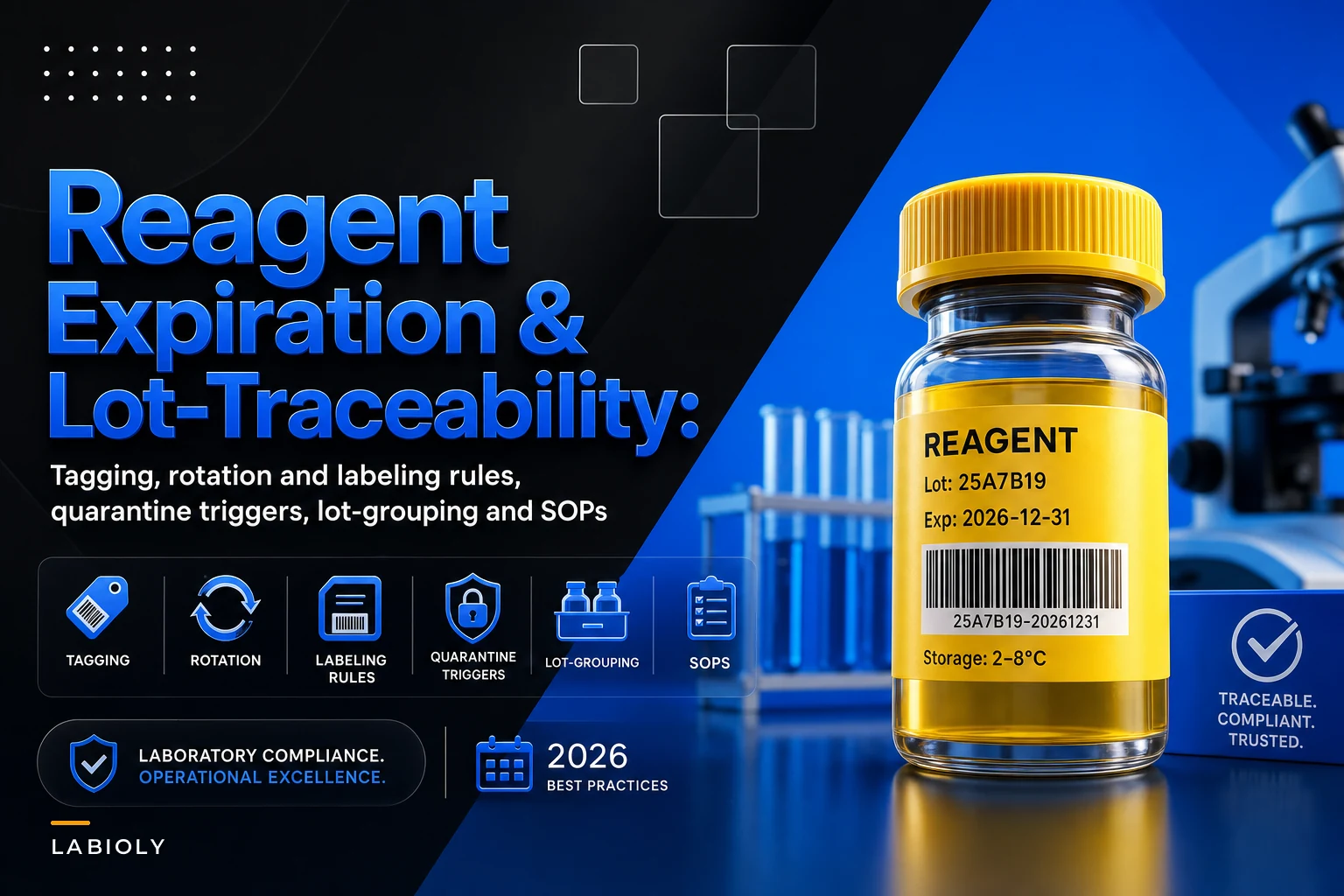

Most labs running multi-batch studies discover their reagent expiration and lot traceability system is broken when an auditor asks for lot genealogy on a failed batch from six months ago. By then, the damage has already spread across every study that touched those reagents.
The real problem isn't tracking expiration dates. It's managing the overlapping lifecycles of dozens of reagent lots across multiple concurrent studies while maintaining audit-ready documentation that proves no expired material contaminated your results.
The hidden complexity of multi-lot reagent management
Running parallel studies means your -20°C freezer holds multiple lots of the same reagent at different stages of their lifecycle. Each lot has its own expiration timeline, storage requirements, and usage history spread across different protocols.
A single PCR study might pull from three different Taq polymerase lots depending on when technicians prepared samples. Without rigid tagging rules, you end up with situations where Monday's samples used Lot A (expires next week), Tuesday's used Lot B (already expired, nobody caught it), and Wednesday's used Lot C (new shipment, different storage conditions).
-
Initial receipt and qualification
-
Multiple freeze-thaw cycles
-
Partial aliquoting events
-
Cross-study usage patterns
-
Temperature excursions
-
Expiration countdown timelines
Traditional LIMS systems handle single-lot tracking reasonably well. They fall apart when managing overlapping lots with different expiration velocities across multiple studies. Those gaps create contamination risks that only surface during batch investigations months later.
Why standard FIFO rules break down
Labs default to first-in-first-out rotation assuming it prevents expiration issues. But FIFO ignores the reality of research operations where different studies have different reagent stability requirements.
Eliminate lab bottlenecks and errors.
Labioly helps you monitor, manage, and report lab activities efficiently and compliantly.
- Real-time sample tracking
- Inventory and supply alerts
- Staff workflow coordination
No credit card required
Consider a genomics lab running both short-read sequencing (2-day turnaround) and long-read protocols (2-week process). The long-read study needs reagents stable for the entire run duration plus buffer time. Using FIFO, you might assign reagents expiring in 10 days to a 14-day protocol.
-
Technician starts long-read prep with Reagent Lot X (12 days to expiration)
-
Day 8
Lot X expires mid-protocol
-
Protocol continues with expired reagent — nobody notices
-
Day 14
Sequencing completes with a mix of expired and fresh reagents
-
A month later
QC investigation traces failures back to expired reagent use
What makes this worse — the short-read studies running simultaneously could have consumed Lot X without issue, while the long-read study could have used newer lots with longer stability windows. FIFO sounds logical until you map it against actual protocol timelines.
Concrete tagging architecture that works
Effective tagging moves beyond simple lot numbers to encode operational context directly into physical labels. Every reagent container needs a tag showing:
Primary Label Elements:
-
Lot number + sublot identifier for aliquots
-
Absolute expiration date (not relative)
-
Days remaining at current date
-
Study allocation status
-
Quarantine/release status
-
Temperature excursion indicator
Color-Coding System:
-
Green border
>30 days remaining
-
Yellow border
7–30 days remaining
-
Red border
<7 days remaining
-
Black diagonal stripe
Quarantined pending investigation
-
Blue dot
Qualified for GLP studies only
Physical tag updates happen at three checkpoints:
-
Receipt tagging Initial label with all fields except study allocation
-
Weekly rotation audit Update days-remaining field and color border
-
Study assignment Add study ID to allocation field
Update the 'days remaining' field during the weekly rotation audit to prevent mid-protocol expirations.
This makes expiration status visible at the moment of use. A technician reaching for reagents immediately sees the color-coded warning without needing to check a database first. That friction reduction matters — people under deadline pressure skip database checks. They don't ignore a red-bordered label sitting right in front of them.
Quarantine triggers and isolation protocols
Quarantine decisions need binary triggers, not judgment calls. Defining exact conditions that automatically trigger isolation removes the ambiguity that causes problems.
Automatic Quarantine Triggers:
| Trigger Event | Quarantine Scope | Release Requirements |
|---|---|---|
| Temperature excursion >2°C for >15 minutes | Affected lot only | Stability testing certificate |
| Failed incoming QC | Entire shipment | Vendor investigation + retest |
| Contamination in downstream assay | All lots in storage unit | Environmental testing clearance |
| Expiration within 48 hours | Specific lot | Disposition decision documented |
| Broken cold chain during transport | Entire shipment | Qualified person review |
| User reports unusual appearance | Specific container | QC retest comparison |
The physical quarantine process needs real teeth:
-
Immediate isolation Move to designated quarantine freezer/shelf within 1 hour
-
Physical barrier Red tape across regular storage location
-
System lock LIMS prevents allocation to new studies
-
Email cascade Automatic notification to lab manager, QC, and affected study leads
Quarantine release requires documented evidence, not just supervisor approval. A temperature excursion needs stability data showing the reagent maintains potency after exposure. A contamination event needs environmental testing proving the storage unit is clean. "It looks fine" isn't documentation.
Lot-grouping strategies for study consistency
Multi-batch studies need consistent reagent sourcing across all samples. Random lot switching mid-study introduces variability that confounds results.
The solution is pre-allocating lot groups at study initiation.
Study Reagent Allocation Matrix:
-
Calculate total reagent consumption
50 samples × 12 weeks × 1.2 safety factor = 720 sample-equivalents
-
Identify available lots with >16 weeks of stability (12 weeks + 4-week buffer)
-
Allocate specific lots exclusively to this study
-
Create a "study kit" in a segregated storage section
This prevents accidental lot-mixing but introduces new problems. What happens when allocated lots fail QC? When consumption runs higher than estimated? When studies stretch past planned timelines?
Build flexibility through substitution rules:
Primary allocation: Lots A, B, C assigned to Study 001
Backup allocation: Lots D, E qualified but unassigned
Substitution trigger: Primary lot fails QC or quantity is insufficient
-
Document reason for substitution
-
Run bridging study comparing primary vs backup lot
-
Update study documentation with lot genealogy change
-
Notify data management team for cohort analysis flags
Lot consistency matters more within sample cohorts than across the entire study. A 12-week study might tolerate lot switches between week 4 and week 5 if both weeks represent different treatment cohorts. But switching lots within week 4 samples creates unacceptable variability.
SOP for rotation and documentation
Standard operating procedures for reagent rotation can't function as suggestions. They need specific actions with measurable outputs.
Weekly Rotation Procedure:
-
Every Monday at 9 AM
-
Print expiration report for the next 14 days
-
Physically inspect each soon-to-expire reagent
-
Update physical tags with new color coding
-
Move <7-day reagents to the "Use First" shelf section
-
Photograph updated storage layout
-
Generate lot disposition plan
-
Email disposition plan to all technicians
-
Archive photos and reports in study folder
-
Lots expiring this week
assign to short protocols
-
Lots expiring next week
standard allocation
-
Lots past 75% of life
restrict from new long studies
Documentation Requirements:
-
Timestamped photos of reorganized storage
-
Lot movement log (from-location, to-location, reason)
-
Updated allocation matrix showing study assignments
-
Expiration forecast for the next 30 days
-
Sign-off sheet with technician initials
The documentation seems excessive until an audit asks you to prove Lot 2023-847B wasn't expired when used in pivotal Study CTR-001 six months ago. The weekly photos and logs provide that proof. Without them, you're reconstructing history from memory.
Visual workflow of the weekly rotation procedure can make training and compliance easier.
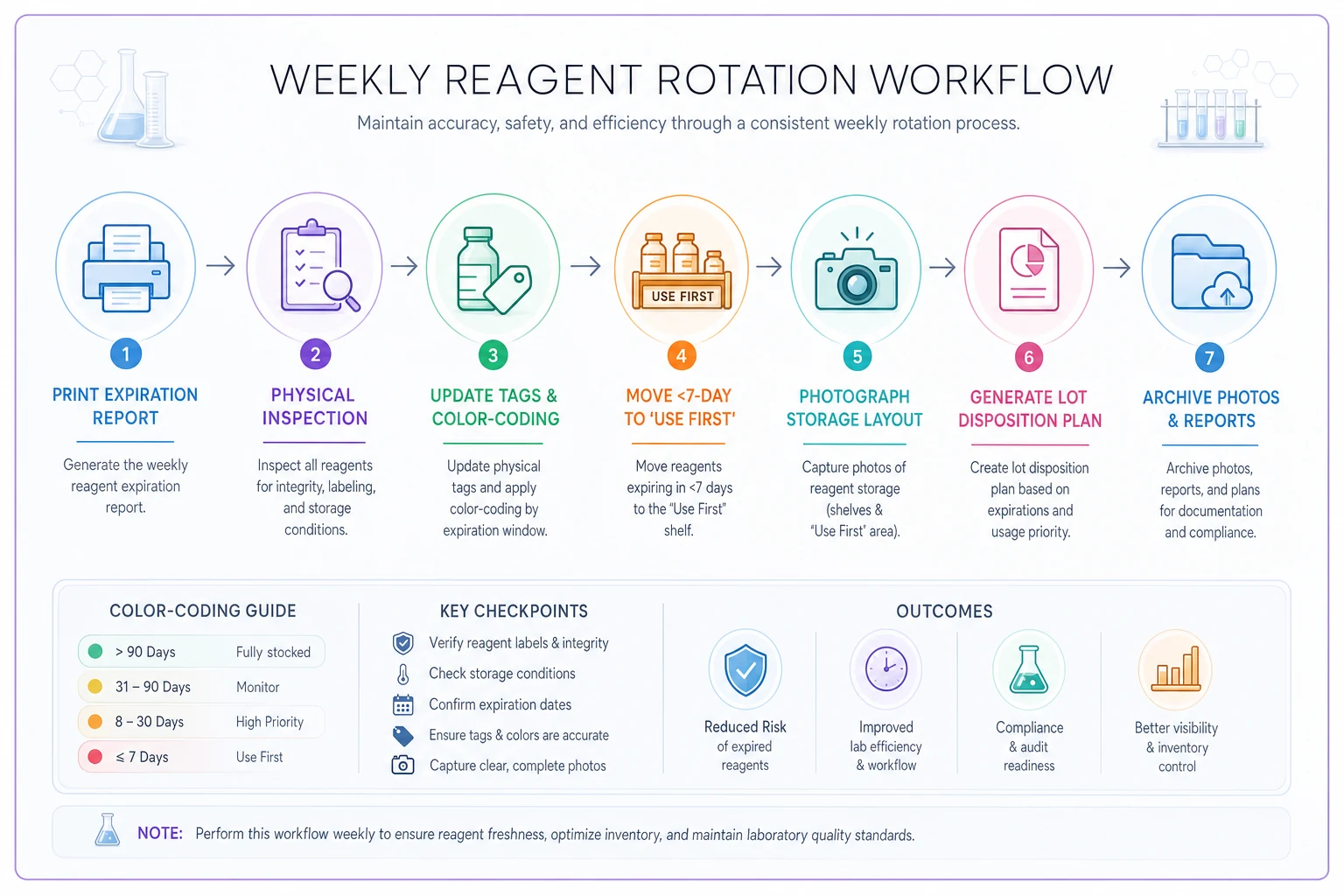
A simple diagram aligns expectations for each step and clarifies responsibilities during the Monday rotation.
Multi-channel notification workflows
Email notifications about expiring reagents get ignored. Effective workflows use escalating channels based on urgency.
Notification Escalation Matrix:
| Days to Expiration | Channel | Recipients | Message Frequency |
|---|---|---|---|
| 30 days | Lab manager | Once at threshold | |
| 14 days | Email + Teams/Slack | Manager + leads | Daily at 8 AM |
| 7 days | Email + SMS | Manager + techs | Twice daily |
| 3 days | SMS + Phone call | All staff | Every 4 hours |
| 24 hours | Strobe light in lab | Everyone | Continuous |
Yes, the strobe light seems extreme. But it works. Mount a red LED beacon above the freezer that activates when any reagent has under 24 hours remaining. The visual alarm eliminates the "I didn't see the email" excuse.
Beyond basic expiration warnings, configure notifications for:
-
"Study CTR-001 switching from Lot A to Lot B tomorrow"
-
"New reagent Lot C qualified and available for allocation"
-
"Quarantined Lot D released back to inventory"
-
"Study 001 consuming reagents 40% faster than planned"
-
"Lot X will deplete before study completion at current rate"
-
"Backup lot activation required within 48 hours"
-
"Freezer 3 door open >2 minutes"
-
"Temperature excursion in Unit B — automatic quarantine initiated"
-
"Weekly rotation audit overdue by 24 hours"
The notification system needs acknowledgment tracking. Every alert requires recipient confirmation within defined timeframes. No response triggers escalation to supervisors.
Real scenario: How rotation rules prevented a $400K study failure
A contract research organization running three parallel immunology studies learned this lesson the expensive way — almost.
They were managing 12 different antibody lots across three studies, each consuming reagents at different rates. Their tracking system at the time: a shared Excel spreadsheet with manual updates.
Week 6: A technician noticed antibody Lot M-2019 looked slightly cloudy. Investigation revealed it had expired 3 days earlier. The panic — Lot M-2019 had been used across all three studies in the previous week, potentially invalidating 150 samples worth roughly $400K in direct costs plus 6 weeks of delays.
-
Pulled freezer logs showing exact times technicians accessed reagents
-
Cross-referenced with batch records showing which samples used which lots
-
Identified 23 samples potentially affected
-
Ran stability analysis on retained samples from Lot M-2019
-
Proved degradation was minimal and results were valid
They got lucky. The near-miss triggered a complete overhaul.
New rules implemented:
-
Physical color-coded tags updated every Monday
-
Lot-specific allocation to studies (no sharing)
-
SMS alerts at 7, 3, and 1 day before expiration
-
Quarantine freezer for <48-hour reagents
-
Weekly photography of storage organization
-
Automated LIMS locks on expired lots
Six months later: zero expiration events across 8 concurrent studies. The photography archive proved critical during an FDA inspection when investigators asked about lot genealogy for a questionable result. The photos showed exact storage organization on the sample prep date, proving only qualified lots were accessible.
Integration with quality systems
Reagent expiration and lot traceability can't exist in isolation from broader quality systems. The connections need explicit definition.
Change Control Integration:
-
Minor change
Same vendor, same catalog number, different lot
-
Major change
Different vendor or formulation
-
Critical change
Expired lot discovered in completed samples
Each level triggers different documentation and approval requirements. Minor changes might need just lab manager sign-off. Critical changes require quality notification, impact assessment, and potentially regulatory filing amendments.
Deviation Management:
-
Immediate documentation of the event
-
Impact assessment on affected studies
-
Root cause analysis (usually inadequate rotation procedures)
-
CAPA implementation
-
Effectiveness check after 30 days
Training Integration:
-
Mock rotation exercise with training reagents
-
Quarantine decision scenarios
-
Notification acknowledgment practice
-
Photo documentation standards
-
Lot genealogy tracing exercise
Don't assume technicians understand the downstream impact of rotation failures. Show them real examples of studies invalidated by expired reagents. Make the consequences tangible before they're working on live studies.
Technology stack for traceability
Manual tracking breaks down at scale. The technology stack for effective reagent expiration and lot traceability needs three layers:
Base layer — LIMS with lot-tracking module:
Core database tracking lot numbers, expiration dates, and study allocations. Should support barcode scanning and automated expiration calculations.
Middle layer — Integration hub:
Connects LIMS to temperature monitoring, access control, and notification systems. When freezer temperature spikes, automatically quarantine affected lots. When someone badges into storage, log potential reagent access.
Top layer — Workflow automation:
AI-powered operational software that orchestrates the rotation process. Instead of manual weekly audits, the system continuously monitors expiration timelines, generates rotation schedules, and triggers notifications based on actual consumption patterns versus planned usage.
This is where modern labs pick up real efficiency. The software can predict lot depletion based on historical consumption, pre-allocate replacement lots, and generate purchase orders before stockouts occur — turning reactive expiration management into proactive reagent lifecycle management.
For smaller labs, even basic automation helps: simple scripts parsing LIMS exports and generating color-coded storage maps, automated emails pulling from expiration databases, SMS gateways triggered from database queries. The specific tools matter less than consistent implementation.
Audit-ready evidence package
When auditors investigate failed batches, they want comprehensive lot genealogy within hours, not days. Pre-build the evidence package structure:
Standard Lot History Package:
-
Certificate of analysis from vendor
-
Incoming inspection records
-
Storage temperature logs for entire lifecycle
-
Lot allocation history (which studies, when)
-
Consumption records (quantity used per study)
-
Expiration timeline with key events marked
-
Any deviation reports involving this lot
-
Final disposition documentation
Store these packages digitally with consistent naming: LOT-2024-XXX-HISTORY.pdf
The packages should auto-generate monthly for all active lots. When auditors ask about Lot 2024-847, you hand them the complete package immediately instead of scrambling to compile records across three different systems.
Making it sustainable
The best reagent expiration and lot traceability system means nothing if technicians abandon it under deadline pressure.
Make rotation audits visible. Post the weekly rotation completion chart somewhere everyone sees it — green checkmark for on-time completion, red X for missed audits. Peer accountability drives compliance better than most policies.
Rotate responsibility. Don't assign rotation to one person permanently. Cycling the duty monthly means everyone understands the process, and it eliminates single points of failure when someone takes vacation.
Track and share metrics:
-
Percentage of reagents expiring unused (target <5%)
-
Number of quarantine events per month
-
Average days-to-expiration at point of use
-
Rotation audit completion rate
Share these in lab meetings. When metrics slip, investigate systematically rather than blame individuals. It usually points back to a process gap, not a people problem.
The investment in proper reagent expiration and lot traceability pays off through avoided disasters. One contaminated study can cost millions in direct losses plus regulatory delays. One failed audit can shut down operations for weeks.
But beyond avoiding disasters, there's a quieter benefit. When technicians trust that every reagent they touch is qualified and tracked, they focus on science instead of worrying about documentation. When study directors know lot genealogy is solid, FDA meetings are less stressful.
The failures in this area almost always come from partial implementation — using the tagging system but skipping notifications, or tracking lots without quarantine procedures. The system only works when all the pieces are in place. Reagent expiration and lot traceability requires systematic implementation of concrete rules, physical controls, and automated workflows operating together. The labs that treat it as critical operational infrastructure rather than administrative overhead are the ones that don't have contamination stories to tell.
Build these systems before your first major contamination event, not after.
Ready to upgrade your lab operations?
Join 500+ labs using Labioly to save time, reduce errors, and enhance productivity and compliance.