



Three months ago, a diagnostic lab director showed me their dashboard. Beautiful graphs everywhere—equipment utilization at 87%, sample turnaround time averaging 14.3 hours, technician productivity scores, customer satisfaction at 4.2 stars. The works.
Then I asked one question: "Based on these metrics, would you hire another tech right now?" Dead silence. Despite tracking 47 different metrics across three different platforms, they had zero actual decision-making capability. The lab was drowning in data but starving for decisions. This problem is everywhere. Research facilities, diagnostic centers, testing laboratories—impressive dashboards that tell you everything except what you actually need to know to run the operation.
The Fundamental Disconnect Between Lab Metrics and Lab Decisions
Most lab operational KPIs fail because they're built backwards. They start with what's easy to measure (machine runtime, sample counts, error rates) instead of what decisions need to be made.
Think about what a lab manager actually decides monthly:
-
Do we need another tech for the evening shift?
-
Should we upgrade the centrifuge or add a second basic model?
-
Can we take on that new contract without breaking our SLAs?
-
Which experiments should we defer to next quarter?
-
Do we need to renegotiate turnaround times with clients?
Your dashboard probably doesn't answer any of these directly. The typical lab tracks operational efficiency metrics that sound important but don't map to real decisions. You know your HPLC runs 72% of the time, but that doesn't tell you whether you need a second one. You know average sample processing time is 18 hours, but that doesn't tell you if you're about to hit capacity constraints next month.
This creates a weird situation where labs feel data-rich and insight-poor. Managers spend hours discussing numbers that don't drive decisions, while real capacity planning happens on gut feel and crisis management.
Building a Decision-First KPI Architecture
The labs that actually use their data effectively don't track more metrics—they track different ones. They track decision triggers.
Eliminate lab bottlenecks and errors.
Labioly helps you monitor, manage, and report lab activities efficiently and compliantly.
- Real-time sample tracking
- Inventory and supply alerts
- Staff workflow coordination
No credit card required
Instead of "equipment utilization," they track "days until equipment bottleneck at current growth rate." Instead of "average turnaround time," they track "percentage of samples at risk of SLA breach in next 48 hours." Instead of "technician productivity," they track "overtime hours required to maintain current TAT."
Traditional metrics tell you what happened. Decision-focused metrics tell you what's about to happen and what you need to do about it.
| Traditional Dashboard | Decision-Focused Dashboard |
|---|---|
| PCR Machine Utilization: 68% | Capacity Runway: 47 days until PCR bottleneck |
| Average TAT: 16.5 hours | SLA Risk: 12% of samples within 2 hours of breach |
| Daily Sample Volume: 340 | Hiring Trigger: Need 1 FTE in 3 weeks at current growth |
| Tech Efficiency: 92% | Deferrable Work: 8 research projects (140 hours) can shift |
One tells you what's happening. The other tells you what to do.
The Three-Layer System That Actually Works
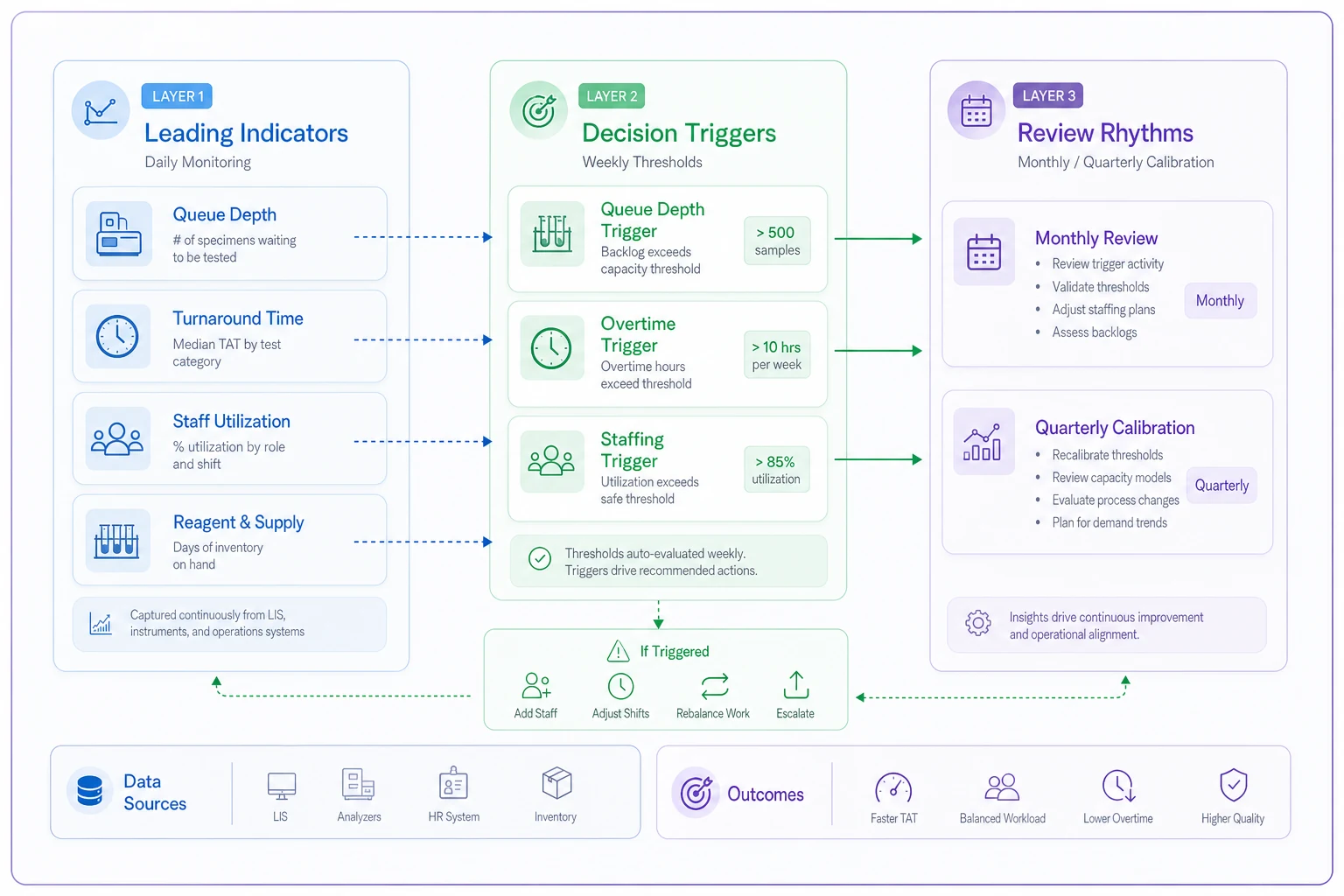
Successful labs use a three-layer approach: leading indicators, decision triggers, and review rhythms.
Layer 1: Leading Indicators (Daily Monitoring)
These metrics predict capacity crunches before they happen. A research lab running protein analysis might track:
-
Queue depth at each processing stage
-
Variance in daily sample arrival patterns
-
Technician schedule gaps for next 7 days
-
Equipment maintenance windows upcoming
These metrics don't require interpretation. When queue depth at the mass spec exceeds 48 samples, that's an automatic trigger to assess overtime needs. No meetings, no discussion.
Layer 2: Decision Triggers (Weekly Thresholds)
-
When TAT variance exceeds 4 hours for 3 consecutive days → Implement surge protocol
-
When equipment queue exceeds 72 hours of work → Approve overtime or defer research projects
-
When tech overtime exceeds 15% for 2 weeks → Initiate hiring process
-
When sample rejection rate exceeds 8% → Pause new client onboarding
These aren't suggestions—they're explicit if-then rules that remove guesswork from capacity planning.
Layer 3: Review Rhythms (Monthly/Quarterly Calibration)
Monthly reviews calibrate your triggers. Did you hire too early? Defer experiments unnecessarily? The review process adjusts thresholds based on actual outcomes. Most labs use monthly reviews to make decisions that should have been automatic triggers two weeks ago.
Here's a simple depiction of the three-layer decision workflow.
Monthly reviews calibrate your triggers. Did you hire too early? Defer experiments unnecessarily? The review process adjusts thresholds based on actual outcomes. Most labs use monthly reviews to make decisions that should have been automatic triggers two weeks ago.
Why Standard Lab KPI Systems Break at Scale
Around 50-60 samples per day, something breaks. The lab manager who could mentally track capacity by walking the floor can't anymore. The tech lead who knew exactly when to call in extra help loses that intuition.
This is when labs implement their first "real" KPI system. And this is exactly when they make the fatal mistake of tracking activity instead of capacity.
The Complexity Multiplication Problem
At 30 samples/day, you can eyeball bottlenecks. At 80 samples/day with varying test types and different TAT requirements, the interaction effects explode. A delayed reagent delivery that wouldn't matter two months ago now cascades through the entire operation.
The Averaging Trap
Labs love averages. Average turnaround time, average utilization, average daily volume. But capacity planning breaks on peaks, not averages. Your average 65% equipment utilization means nothing when Monday and Tuesday run at 95% and create a backlog that cascades through the week.
Decision-focused KPIs track peak load patterns and capacity buffers, not averages. Every growing lab accumulates operational technical debt—deferred maintenance, postponed training, delayed process improvements. Standard KPIs don't capture this accumulation until it explodes into a crisis.
A proper system tracks technical debt explicitly: hours of deferred maintenance, number of postponed experiments, training backlog for new equipment. These become visible capacity constraints rather than hidden time bombs.
Mapping Your Data Sources to Decision Rules
Labs waste enormous energy trying to pull data from eight different systems to create unified dashboards that still don't drive decisions. The solution isn't better data integration. It's fewer, more focused data points mapped to explicit decisions.
LIMS (Sample Tracking)
-
Traditional metric
Total samples processed
-
Decision metric
Samples approaching SLA breach
-
Decision rule
>10% within 4 hours of SLA = implement surge protocol
-
Review frequency
Every 4 hours during business hours
Equipment Logs
-
Traditional metric
Utilization percentage
-
Decision metric
Sequential hours at >85% utilization
-
Decision rule
>6 hours sequential = defer Category C tests
-
Review frequency
Twice daily
Staff Scheduling System
-
Traditional metric
Labor hours used
-
Decision metric
Projected overtime for next 7 days
-
Decision rule
>20 overtime hours projected = approve additional shift
-
Review frequency
Every Monday and Thursday
Each data source maps to specific operational decisions with clear thresholds. No interpretation needed, no meetings required.
The Monthly Review That Actually Drives Decisions
Most lab monthly reviews are retrospective report-outs that change nothing. A functional monthly review calibrates your decision system for the upcoming month.
Structure around three questions:
-
Which automatic triggers fired incorrectly last month?
-
What capacity constraints will we hit in the next 30 days?
-
Which experiments or projects should we explicitly defer?
A real example from a molecular diagnostics lab:
Triggers That Misfired:
-
Hired contractor when overtime trigger hit, but volume dropped the next week
-
Action
Adjust overtime trigger from 15% to 20% for single weeks
Upcoming Constraints:
-
Thermocycler capacity maxes out in ~18 days at current growth
-
Tech capacity fine for 45+ days
-
Data storage hits 80% in 22 days
-
Action
Order second thermocycler, defer storage upgrade
Explicit Deferrals:
-
Research project on variant analysis (40 hours of equipment time)
-
Method development for new assay (60 hours across two weeks)
-
Action
Push both to next quarter, communicate to stakeholders
This isn't a performance review—it's operational capacity planning with clear decisions and outcomes.
Quarterly Calibration: When to Restructure vs. Refine
Every quarter, labs need to check whether their decision system still matches their operational reality.
Signs your system needs restructuring:
You're consistently overriding automatic triggers. If you regularly ignore your "hire new tech" trigger because you know volume is about to drop, the trigger threshold is wrong or you need seasonal adjustments.
Decisions happen outside the system. When major capacity decisions get made in hallway conversations instead of from your KPIs, you're tracking the wrong things.
Your constraints have fundamentally shifted. Six months ago, equipment was your bottleneck. Now it's specialized technical skills. Your KPIs might still focus on equipment utilization while missing the real constraint.
An environmental testing lab that scaled from 400 to 900 samples/month demonstrates this: Old System (Q1): Primary constraint was GCMS time, key trigger was queue depth at GCMS, hiring focused on general lab techs. New System (Q3): Primary constraint became sample prep expertise, key trigger shifted to backlog in complex sample preparation, hiring focused on specialized prep technicians. Same lab, same tests, but completely different operational reality requiring different decision triggers.
Common Failure Modes in Lab KPI Implementation
The "Track Everything" Spiral
It starts innocently. You add one more metric because someone asked about it in a meeting. Within six months, you're tracking 73 different metrics and making zero decisions from any of them.
For every metric you add, remove two. Force the trade-off.
A clinical lab I worked with had separate dashboards for operations, quality, finance, and customer service. Four different views of the same operation, none of which actually drove daily decisions. They spent more time maintaining dashboards than using them. For every metric you add, remove two. Force the trade-off.
The Threshold Paralysis
Labs know they need trigger thresholds but get stuck on setting them. "What if 85% utilization is too high? What if 15% overtime is too low?" So they track the metrics without thresholds, defeating the entire purpose.
Start with deliberately aggressive thresholds. Set them to trigger more often than necessary, then adjust based on real outcomes. A too-sensitive trigger you can calibrate. A missing trigger helps nobody.
The Integration Nightmare
"Once we get all our systems talking to each other, then we'll have real KPIs." This integration project never ends. Meanwhile, operational decisions happen on gut feel. Skip the integration. Pull three numbers manually every morning if that's what it takes. A simple system you actually use beats a perfect system you're still building.
Building Your Lab-Specific Decision System
Start with one critical decision you make repeatedly. Maybe it's when to approve overtime, when to defer research work, or when to outsource overflow testing. Map that single decision:
-
What data predicts this decision need 3-5 days early?
-
What threshold should automatically trigger the decision?
-
How often should you calibrate the threshold?
Build that one decision flow completely before adding others. A single automated decision beats a dozen tracked metrics.
For a genomics lab:
-
Decision
When to outsource sequencing overflow
-
Leading indicator
Queue depth at sequencers
-
Trigger
>120 samples in queue = outsource next 40 samples
-
Calibration
Weekly review of outsourcing costs vs. overtime
For a quality control lab:
-
Decision
When to pull technicians from development to testing
-
Leading indicator
Testing backlog in hours
-
Trigger
>30 hours backlog = reassign two technicians
-
Calibration
Monthly review of development delays
You're building a system that makes decisions, not just tracks numbers.
The Difference When Decision Systems Actually Work
When labs successfully implement decision-focused KPIs, the entire operational rhythm changes. Meetings get shorter because decisions are already made. Fire drills disappear because you see capacity crunches weeks in advance. Growth becomes manageable because you know exactly when to add resources.
The biggest change is psychological. Lab managers stop feeling constantly behind, constantly reacting. The system handles routine decisions, freeing them to focus on strategic improvements.
A pharmaceutical QC lab example: Before: Weekly operations meetings ran 90 minutes, mostly debating whether to approve overtime or hire contractors. Decisions changed based on who argued most convincingly. TAT compliance hovered around 82%. After: Overtime and contractor decisions happen automatically based on triggers. Weekly meetings dropped to 30 minutes focused on threshold calibration and process improvements. TAT compliance rose to 94% and stayed there.
The lab didn't work harder or add resources. They just started making decisions based on data triggers instead of meetings and emotions.
Moving From Tracking to Deciding
The path from vanity metrics to decision systems requires letting go of the traditional KPI mindset. Stop asking "what should we measure?" Start asking "what decisions do we need to make?"
Your lab already has most of the data it needs. LIMS tracks samples, equipment logs track usage, scheduling systems track labor. The gap isn't in data collection—it's in connecting that data to specific operational decisions with clear trigger points.
Modern AI-powered operational software makes this connection easier by automatically surfacing decision points from your existing data streams. Instead of building complex integrations, these platforms identify patterns that predict capacity constraints and suggest trigger thresholds based on your historical decisions. But even a simple spreadsheet with clear decision rules beats a complex dashboard that doesn't drive action.
The labs that thrive over the next few years won't be the ones with the most metrics or the prettiest dashboards. They'll be the ones that built systems to make operational decisions automatically, freeing their teams to focus on science instead of scheduling, innovation instead of overtime approval, and growth instead of firefighting.
Start with one decision. Map it to data. Set a trigger. Then actually follow it. That's how you build a lab operation that scales without breaking—one automated decision at a time.
Ready to upgrade your lab operations?
Join 500+ labs using Labioly to save time, reduce errors, and enhance productivity and compliance.