

If you run or support a mid‑sized university lab, the problem isn't finding sample‑tracking software — it's finding one that survives procurement, satisfies your IT security review, actually talks to the ELN your PIs refuse to give up, and fits a pricing model that works for how universities actually buy things (site licenses, consortia, grant‑funded seats). This guide is built for that exact situation: a defensible shortlist, an evaluation checklist tuned for academic buying, an RFI/RFP question set you can send tomorrow, and the red flags that tend to blow up deals six months in.
One quick note before the shortlist: nothing here endorses a single "best" platform. Fit depends entirely on your scenario — a three‑PI lab buys differently than a shared genomics core, which buys differently than a campuswide deployment. We'll get to those scenarios.
The shortlist at a glance
These six platforms (plus a note on enterprise LIMS) cover the realistic range for mid‑sized academic labs. Each has a different center of gravity — ELN‑first, inventory‑first, LIMS‑first — and that difference matters more than feature‑count comparisons.
| Platform | Center of gravity | Typical academic fit | Pricing model you'll usually see |
|---|---|---|---|
| Benchling | ELN + sample/inventory + strong APIs | Molecular/synthetic bio labs that want one system of record | Per‑seat, academic tiers, enterprise site deals for cores |
| Quartzy | Inventory & ordering | Labs where the real pain is reagents, orders, and freezer chaos | Free core tier + paid inventory/ordering upgrades |
| CloudLIMS | SaaS LIMS with academic programs | Labs needing LIMS structure without IT building it | Subscription, academic/startup programs |
| Labguru | ELN + inventory + LIMS modules | Multi‑PI labs wanting ELN and sample management together | Per‑user, institutional packages |
| Labstep | Protocols + sample tracking + integrations | Protocol‑heavy labs wanting provenance tied to samples | Per‑user, academic pricing, free tiers |
| LabArchives | ELN with institutional licensing | Campuses buying ELN centrally, often via the library | Institutional site license (big advantage) |
| LabVantage / LabWare | Enterprise LIMS | Campuswide or regulated multi‑core deployments | Enterprise license + implementation services |
One‑paragraph vendor notes
Benchling is the default answer for molecular and synthetic biology groups because the registry, inventory, and ELN share one data model — a sample you register shows up everywhere without re‑keying. The API is genuinely good, which matters if you plan to connect instruments or a downstream LIMS. Watch the pricing conversation carefully: per‑seat costs climb fast once you add casual users like undergrads or rotation students, and the enterprise features cores actually need often sit behind the higher tier.
Quartzy solves a narrower problem extremely well — inventory, ordering, and "who took the last vial." For a lot of academic labs the acute pain isn't a formal LIMS; it's reagent visibility and freezer chaos, and Quartzy's free tier gets you surprisingly far. It is not a full sample‑lifecycle or audit‑trail system, so don't buy it expecting chain‑of‑custody rigor.
CloudLIMS gives you real LIMS structure (sample accessioning, storage mapping, audit logs) as SaaS, with programs aimed at academic and startup budgets. Good fit when you need LIMS discipline but have no appetite for a six‑figure enterprise implementation.
Labguru sits in the middle — ELN plus inventory plus optional LIMS modules — which makes it attractive for multi‑PI labs that want notebook and sample management under one login. Evaluate how deep the LIMS modules actually go for your specific workflow; "has a module" and "handles your edge cases" are different things.
Labstep is strong where protocols and provenance are the point: it links what you did (protocol version, conditions) to the physical sample. Labs doing method‑heavy work value that traceability. Confirm its integration list covers your ELN/LIMS before assuming connectivity.
LabArchives wins on institutional licensing more than features. Many universities already have a campus agreement through the library or research office — which means your "procurement" might just be a request form. If ELN is the core need and the campus license exists, this is often the path of least resistance.
LabVantage / LabWare are the enterprise LIMS options. You consider these for campuswide deployments or regulated environments, not for a single lab. Powerful, configurable, and expensive — both in license cost and in the implementation project you're signing up for.
Why ELN/LIMS integration is the whole ballgame
Most sample‑tracking failures in academic labs aren't really tracking failures — they're integration failures. The sample exists in three places (someone's ELN, a shared spreadsheet, a freezer label) and none of them agree. If your new platform can't sync cleanly with the ELN your PIs already live in, you've just added a fourth source of truth.
Eliminate lab bottlenecks and errors.
Labioly helps you monitor, manage, and report lab activities efficiently and compliantly.
- Real-time sample tracking
- Inventory and supply alerts
- Staff workflow coordination
No credit card required
A few integration patterns you'll encounter:
-
Native same‑vendor sync (e.g., Benchling ELN ↔ Benchling inventory). Cleanest option — one data model, no mapping. The catch is lock‑in and per‑seat cost.
-
REST API connectors between an ELN and a separate LIMS/inventory tool. Flexible, but someone owns the field mapping and versioning forever. This is where projects quietly rot when the one person who understood the connector leaves.
-
File/CSV bridges as a stopgap. Fine for a pilot, dangerous as a permanent plan — no real provenance, and easy to break silently.
The common pitfall is treating the connector as a one‑time setup. API versions change, metadata schemas drift, and a field rename on one side orphans records on the other. If you're planning this seriously, our ELN‑to‑LIMS pilot and reconciliation approach is worth reviewing for how chain‑of‑custody and field integrity hold up under real conditions — the same discipline applies when you're vetting a vendor's integration claims.
A practical rule: during evaluation, define the minimal set of sample metadata fields that must round‑trip between systems without loss — sample ID, type, parent/lineage, storage location, owner, status, timestamps. If a vendor can't demonstrate that specific round‑trip with your actual field names, the slick demo doesn't matter.
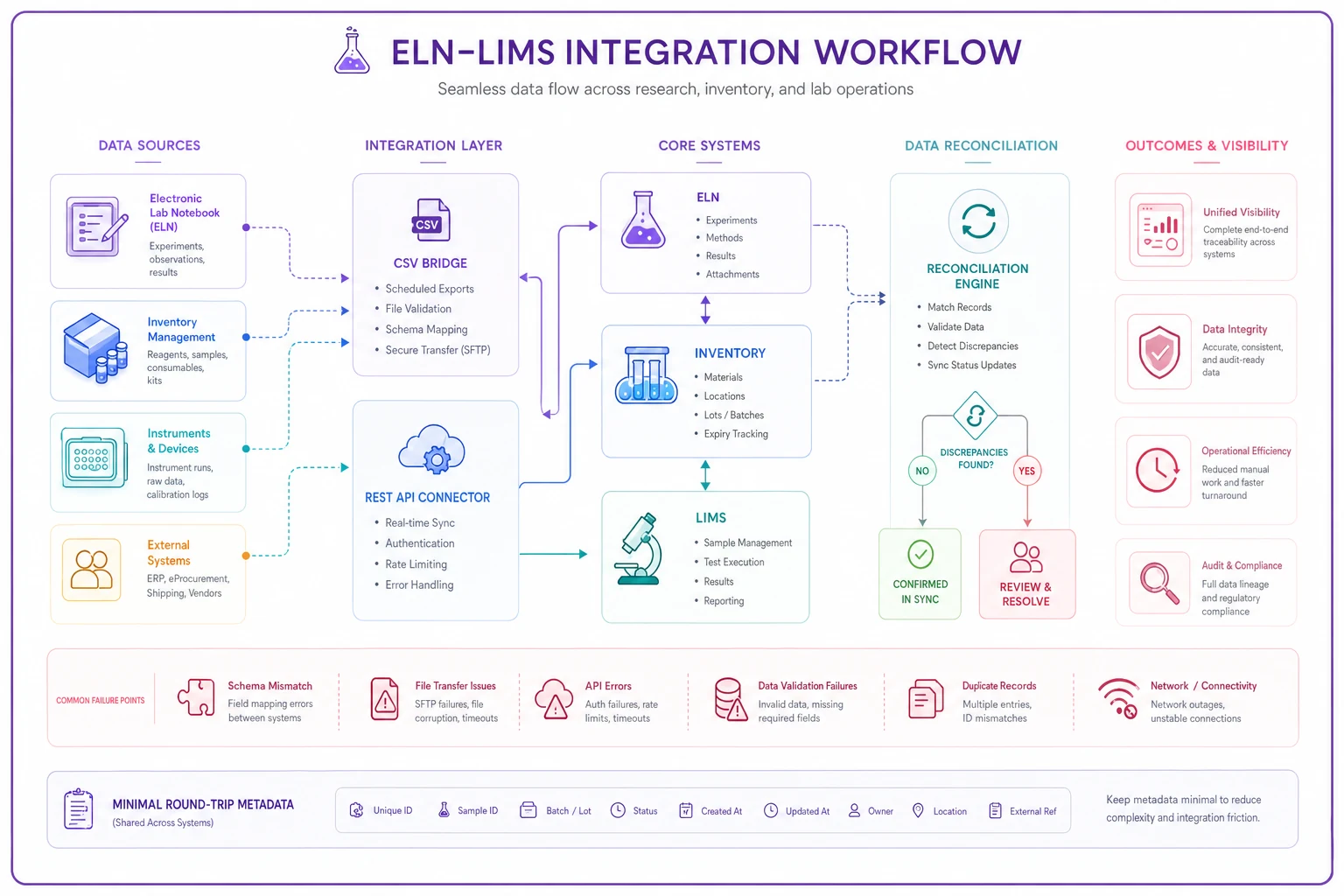
Quick sketch of the integration workflow to keep in mind.
Evaluation checklist (functional)
Walk through this with each shortlisted vendor. Don't accept "yes we support that" — ask them to show it with your field names.
Before you start comparing vendor demos, it helps to anchor on what you actually need verified. A lot of evaluation processes go sideways because labs accept a verbal "yes" on a feature and then discover post-implementation that the reality is more limited. This checklist is meant to prevent that.
-
Real‑time sample status visible across labs/PIs (not nightly batch updates)
-
Barcode and RFID support, with mobile scanning on devices your staff actually carry
-
Configurable inventory alerts (low stock, expiry, min/max) routed to the right person, not a shared inbox nobody reads
-
Multi‑lab / multi‑PI access with real tenant separation, not just folders
-
Role‑based permissions granular enough for PI vs. staff scientist vs. rotation student vs. core‑facility operator
-
Audit logs that are complete, tamper‑evident, and exportable in a format your auditors accept
-
Audit‑friendly reports you can generate without calling a consultant
-
Offsite/geo‑redundant backups with a stated restore time
-
Provenance metadata and sample lineage (parent/child, aliquots)
-
Chain‑of‑custody workflows with defensible handoff records
-
API / REST (and HL7 if you touch clinical) connectors to the specific ELN/LIMS you run
When a vendor fails this checklist but you still want them
Sometimes the inventory‑first tool wins on usability and your team will actually use it, even though it's weak on chain‑of‑custody. That's a legitimate choice — for a reagent‑heavy lab with no regulatory exposure. The mistake is buying a usability‑first tool and then pretending it gives you audit rigor it doesn't have. Match the tool to your actual compliance exposure, not an aspirational one.
Security & compliance checklist
Your IT/security review will hit these points regardless, so get the answers before you fall in love with a demo.
-
SOC 2 Type II or ISO 27001 — ask for the current report under NDA, check the date, read the exceptions section
-
Encryption at rest and in transit (and which standards)
-
SSO / SAML against your campus IdP (Shibboleth, Azure AD, Okta) — often a hard requirement
-
MFA enforcement options
-
Data residency — where the data physically lives matters for some grants and international collaborators
-
Contractual uptime SLA with credits, not a marketing "99.9%"
-
Validation / CSV deliverables if any of your work is regulated (IQ/OQ/PQ documentation)
-
Data ownership and export spelled out in the contract — your data, your format, on exit
Export‑control awareness if you handle controlled research A straight answer on cryptography roadmap — labs planning ahead for migration should read our post‑quantum readiness guidance for LIMS and chain‑of‑custody and ask vendors how they'll handle that transition rather than accepting a vague "we take security seriously"
The RFI/RFP question set
Group your questions. Vendors respond faster and you compare apples to apples. These are the ones that actually separate serious vendors from the ones that will disappoint you six months post-signature.
Procurement & pricing
-
Do you offer institutional site licenses vs. per‑seat? Show both prices for our headcount.
-
What academic/nonprofit discount applies, and is it documented or discretionary?
-
Do you have consortium or system‑wide pricing if other departments join later?
-
How are casual/temporary users (rotation students, undergrads) priced?
-
What happens to cost at renewal — is there a cap on annual increases?
Integration
-
Which ELN/LIMS systems do you have production connectors for today?
-
Can you demonstrate round‑trip of our specific sample metadata fields?
-
Is your API documented publicly, and is it versioned?
-
What happens to integrations when you release a breaking API change?
-
Who owns and maintains the connector after go‑live — you, us, or a third party?
Operations & support
-
What is your contractual uptime SLA and the credit structure?
-
What does onboarding include, and over what timeline?
-
Is training included, and is it live or self‑serve?
-
What's your support response time by severity?
Security & compliance
-
Provide your current SOC 2 Type II / ISO 27001 report.
-
Do you support SAML SSO against our campus IdP?
-
Describe your incident‑response process and breach‑notification timeline.
-
Where is our data hosted and stored?
-
Do you provide validation/CSV documentation for regulated workflows?
Audit & reporting
-
How long are audit trails retained, and are they tamper‑evident?
-
What export formats do audit logs and reports support?
-
Can we build custom reports without professional‑services fees?
-
Can auditors be given read‑only scoped access?
Data ownership & exit
-
On termination, in what format and timeframe do we get our data?
-
Do you retain any copy after exit, and for how long?
-
Are there export fees? (If yes, that's a negotiation item — flag it now.)
These questions will let you compare answers side by side and spot vendors who hedge or avoid specifics.
Procurement scenarios and what actually fits
Small multi‑PI lab (10–25 researchers, 2–4 PIs)
The real need here is usually shared inventory visibility and lightweight sample tracking, not enterprise LIMS. A tool like Quartzy for ordering/inventory, or Labstep/Labguru if protocol and sample linkage matters, tends to fit. Per‑seat pricing is manageable at this size, and you can often start on a free or low tier and expand. Avoid signing an enterprise LIMS implementation — you'll spend more on the project than the problem is worth.
Pricing tradeoff: per‑seat is cheaper upfront but scales badly if headcount grows or you add a lot of casual users. Model the three‑year cost, not year one.
Shared core facility (genomics, imaging, flow — serving many labs)
Now you need real access control, chargeback‑friendly reporting, and audit trails, because you're accountable to every lab you serve. CloudLIMS or Labguru's LIMS modules fit well. The decision hinges on how well the platform handles multi‑tenant separation and usage reporting. A core that can't produce clean per‑lab usage records ends up doing chargebacks in a spreadsheet, which defeats the purpose.
Campuswide deployment
This is where LabArchives (if the campus license route exists) or enterprise LIMS (LabVantage/LabWare) enter. The buying center shifts from the lab to central IT and the research office, procurement runs a formal RFP, and implementation becomes a project with a timeline measured in quarters. The tradeoff is real: enterprise capability and central support versus cost, rigidity, and a longer road to value.
A pattern worth flagging: campuses frequently over‑buy here. A full enterprise LIMS gets selected for "the whole campus," then a large chunk of labs never adopt it because it's too heavy for their workflow, and they keep using Quartzy on the side anyway. If you're driving a central decision, survey actual lab workflows first — a tiered approach (enterprise LIMS for cores, lightweight tools for small labs) usually beats one mandated platform.
A real scenario with numbers
A mid‑sized university immunology lab — around 30 researchers across three PIs sharing two −80 freezers — was losing a handful of samples a month to mislabeling and "I thought you logged it." Their ELN was fine; their sample tracking was a shared spreadsheet plus freezer labels that didn't match.
They evaluated three platforms using a checklist like the one above and ran a two‑month pilot scoped to one freezer and one PI's samples. The deciding factor wasn't features — two vendors matched on paper. It came down to the metadata round‑trip test: only one could sync their ELN sample IDs into inventory without manual re‑keying, and only one gave read‑only audit access their biobank compliance person would accept.
Post‑rollout, over the first two quarters, lost/unaccounted samples dropped to near zero, and the hours spent each week reconciling the spreadsheet basically disappeared. The platform cost landed in the low thousands per year after the academic discount — easy to justify against even one lost patient‑derived sample. Nothing dramatic, just a workflow that stopped leaking.
The takeaway: the winning vendor won on integration fit and audit access, not on the feature matrix. That's the pattern more often than not.
Negotiation and implementation tips
A few things worth insisting on before you sign:
-
Run a time‑boxed pilot (6–8 weeks) scoped to one freezer, one PI, or one core workflow — with written success metrics agreed up front. "We'll see how it goes" produces no decision.
-
Define success metrics before the pilot samples reconciled without manual fixes, metadata round‑trip loss rate, time saved per week, audit export accepted by your compliance reviewer.
-
Lock data ownership and export in the contract, including format and timeline, with no export fees. This is the clause that bites labs at renewal when a vendor has leverage.
-
Cap annual price increases. Academic budgets don't flex to surprise renewal jumps.
-
Require SSO and the SOC 2 report as deal gates, not post‑signature discoveries — looping IT/security in during the pilot, not after, prevents a signed contract from stalling at security review.
-
Name the integration owner. Decide now whether the vendor, your team, or a third party maintains the connector, and put support terms around it.
Run the pilot with written success metrics and include IT/security in the pilot phase.
When to walk away
Walk if a vendor won't share their SOC 2 under NDA, won't demonstrate your metadata round‑trip, charges export fees, or gets vague on data ownership. Any one of those is a renewal trap or a security‑review dead end. Better to find out during evaluation than eighteen months in with your samples locked inside their format.
Next steps
Start with the scenario that matches you, pull three or four vendors from the shortlist, and send the RFI questions above — grouped exactly as written so you can compare answers side by side. Weight integration fit and audit access heavily; those decide more deployments than feature counts do.
If your selection is tied to broader modernization or cryptography‑migration planning, our guidance on preparing LIMS, instruments, and chain‑of‑custody for post‑quantum deadlines gives you the questions to put to vendors about their cryptography roadmap — so you're not re‑procuring in two years. And if you want a second set of eyes on a shortlist or an RFP, that's exactly the kind of thing SoftWorks helps labs scope — reach out and we'll help you pressure‑test the fit before you sign.
Ready to upgrade your lab operations?
Join 500+ labs using Labioly to save time, reduce errors, and enhance productivity and compliance.