

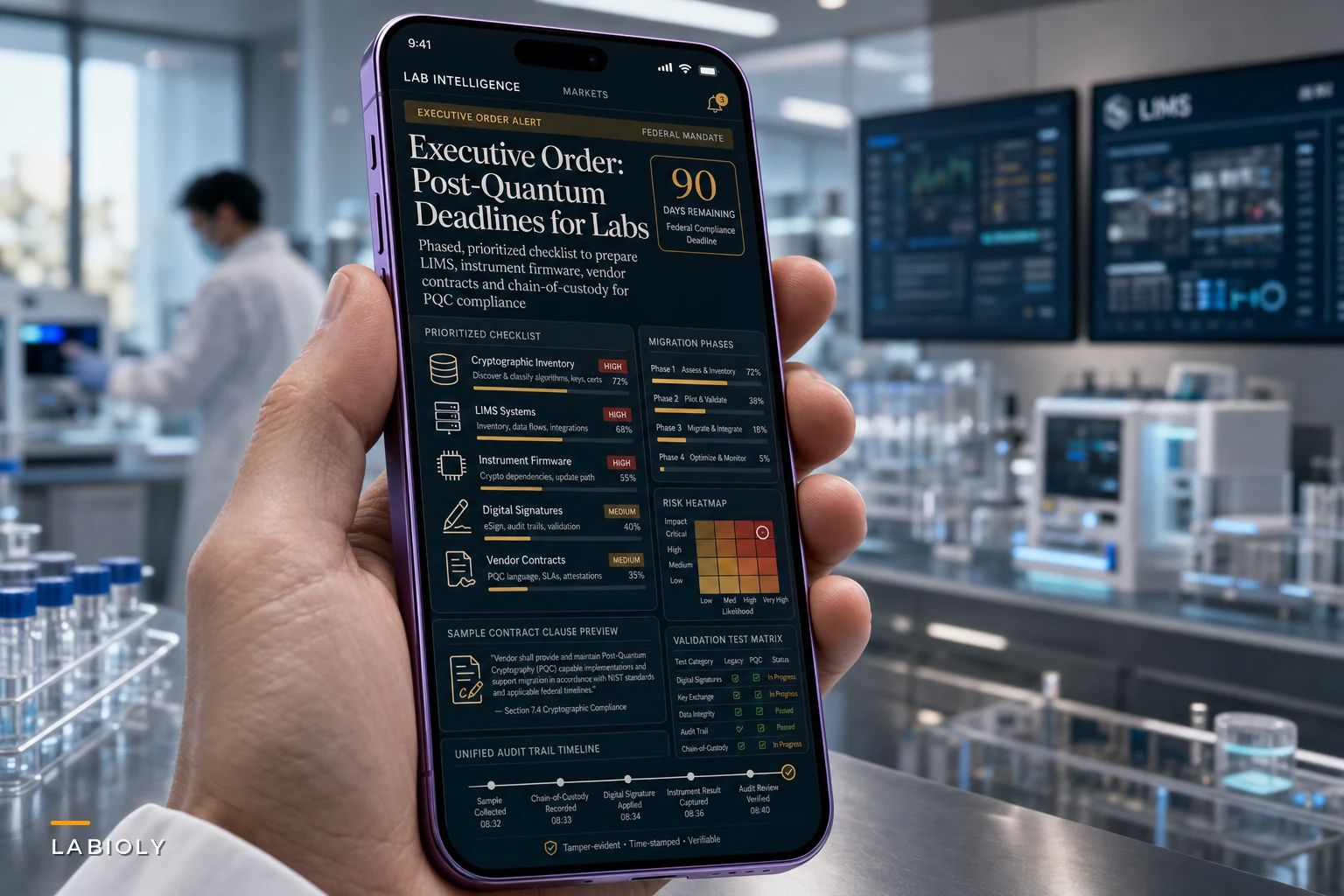

Last week's White House Executive Order on post-quantum cryptography just created a compliance problem for research labs that most people haven't fully processed yet. Federal agencies and contractors now have hard deadlines: pilot testing by December 2027, key establishment migration by 2030, digital signatures by 2031.
For labs operating under federal grants or contracts, that means every piece of equipment generating, storing, or transmitting data needs a cryptographic inventory—and potentially replacement. Not just your LIMS. Think mass spectrometers running firmware from 2018, thermal cyclers with embedded certificates, cloud backup systems using RSA-2048. The operational chaos starts well before those final deadlines. Instrument vendors typically need 18–24 months to develop and validate firmware updates. Your IT team needs another year to test integrations without breaking workflows. Budget committees want cost estimates now. Meanwhile, your current chain-of-custody signatures could become legally questionable before you've even finished planning.
The hidden cryptography running through your lab infrastructure
Most lab managers find out about their cryptographic dependencies during an audit or a system failure—not during a calm planning session. Walk into any molecular diagnostics lab and you'll find RSA certificates buried in places nobody thought to check. The qPCR instrument authenticating to your network. The liquid handler encrypting batch files. The freezer monitoring system signing temperature logs.
One genomics core facility had 47 different cryptographic implementations spread across their infrastructure. Their LIMS alone had twelve: database encryption, API authentication, audit log signatures, backup encryption, user certificates, instrument handshakes, cloud storage keys, email notifications, report signatures, web interface SSL, mobile app tokens, and third-party integrations.
Half of those were hardcoded into vendor software nobody could touch. The other half were so embedded in workflows that changing them meant validating entire processes from scratch.
Where cryptography actually lives in lab operations
Your instruments are basically computers with specialized sensors, and they're loaded with cryptographic assumptions baked in at the factory. A typical LC-MS system uses certificates for authenticating to your network domain, encrypting data transfers to analysis workstations, signing run logs for audit trails, securing remote access for vendor support, and validating software updates.
Your data infrastructure adds more layers. Every modern LIMS relies on TLS for web interfaces, but the cryptography runs deeper—database encryption at rest, encrypted connections between application servers, digital signatures on electronic lab notebooks, certificate-based single sign-on, API keys for instrument integration.
The compliance layer piles on further. FDA 21 CFR Part 11 requires electronic signatures that can't be repudiated. CLIA mandates secure transmission of patient results. HIPAA demands encryption for any system touching patient data. Each regulation assumes cryptographic standards that post-quantum migration will disrupt.
Why standard IT migration approaches fail in lab environments
Labs aren't corporate IT environments where you push updates on a Saturday night and call it done. Every change to an analytical instrument requires verification that results are still accurate. Every software update needs documentation. Every workflow modification touches SOPs.
Eliminate lab bottlenecks and errors.
Labioly helps you monitor, manage, and report lab activities efficiently and compliantly.
- Real-time sample tracking
- Inventory and supply alerts
- Staff workflow coordination
No credit card required
A pharmaceutical QC lab learned this the hard way when they tried upgrading their LIMS encryption. What IT estimated as a two-week project turned into a nine-month validation marathon. Each instrument integration broke in its own unique way. Historical data needed re-signing with new algorithms while maintaining legal validity of the original signatures. Audit trails had to prove both cryptographic methods were valid during the transition.
Vendor coordination alone consumed three full-time employees for months. Some manufacturers had PQC-ready firmware. Others wouldn't commit to development roadmaps. A few smaller vendors didn't really understand what was being asked of them.
Technical debt compounds the migration challenge
Laboratory software accumulates technical debt differently than business applications. That custom LIMS module written in 2014? It probably uses deprecated cryptographic libraries nobody wants to touch because it handles critical sample workflows. The integration between your mass spec and data analysis pipeline? Built on assumptions about key lengths that PQC algorithms will violate.
Research labs also face unique challenges around data longevity. Clinical trial data must be retained for decades. Genomic sequences need permanent storage. Environmental monitoring requires unbroken chain-of-custody across years of measurements. Those datasets were encrypted and signed with algorithms that quantum computers will eventually break.
Consider a translational research lab with ten years of patient samples. Their minimal chain-of-custody documentation includes digital signatures proving sample integrity from collection through analysis. Migrating to post-quantum signatures means either re-signing millions of records—which opens legal questions about tampering—or maintaining parallel validation for legacy and modern signatures indefinitely. Neither option is clean.
Building your cryptographic inventory without disrupting operations
Start with network traffic analysis rather than system documentation. Set up packet capture during normal operations and identify every TLS handshake, certificate exchange, and encrypted connection. This surfaces dependencies your documentation missed—like the freezer alarm system that emails encrypted alerts, or the badge reader using certificates for access control.
Start with network traffic analysis rather than system documentation.
Map three categories of cryptographic usage:
Category 1: Direct control — Systems where you manage certificates and encryption settings directly. Your LIMS administration console, database encryption keys, backup system configuration. These offer relatively straightforward migration paths but still require careful change management.
Category 2: Vendor-dependent — Instrument firmware, commercial software packages, cloud services. You'll need vendor roadmaps and potentially budget for upgrades or replacements. Start these conversations now—vendors need customer pressure to prioritize PQC development.
Category 3: Legacy lockdown — Systems that can't be modified without replacing entire workflows. Old thermocyclers running Windows XP. Custom interfaces built by grad students who left years ago. FDA-validated processes where any change triggers full revalidation. These need risk assessment and potential exemption strategies.
Creating actionable migration priorities
Not every system needs immediate attention. Use these criteria to focus your efforts:
Compliance exposure: Systems directly mentioned in federal contracts or handling data covered by specific regulations face the highest scrutiny. NIH grant-funded research data takes priority over internal training records.
Quantum vulnerability: Long-term secrets face immediate risk from "harvest now, decrypt later" attacks. Genomic data, clinical trial results, and proprietary research need protection even before quantum computers are widely available. Session keys for instrument communication are lower priority.
Operational criticality: Core workflows that can't tolerate downtime need longer migration runways. The one mass spectrometer running all your clinical samples requires more planning than the conference room scheduling system.
Integration complexity: Highly connected systems create cascading changes. Your LIMS touches everything—instruments, analysis software, reporting tools, backup systems. Plan these migrations carefully to minimize disruption.
Vendor management strategies for PQC readiness
According to Cybersecurity Dive's analysis, federal contractors must demonstrate PQC migration plans by 2027. Your instrument vendors are contractors too if they maintain systems processing federal research data. That's leverage worth using.
Send formal requests for information to every vendor. Ask specific questions:
-
Which cryptographic algorithms does your system currently implement?
-
What's your roadmap for NIST-approved PQC algorithm support?
-
Will upgrades require hardware replacement or just firmware updates?
-
How will you handle backward compatibility during transition periods?
-
What validation documentation will you provide for regulated environments?
Document their responses—or their silence—as part of your risk assessment. Vendors who can't articulate PQC plans become replacement candidates. Those with clear roadmaps become migration partners.
Negotiating support for legacy systems
Some vendors will try forcing expensive upgrades by declaring older systems unsupported for PQC migration. Push back with specific requirements. If the instrument still meets analytical specifications, demand transitional support options: extended maintenance contracts with security patches, hybrid solutions using external encryption appliances, compensating controls that satisfy compliance without full migration, or source code escrow for critical unsupported systems.
A proteomics lab faced exactly this with a $2M mass spectrometer where the vendor wanted $400k for a PQC-compatible replacement. They negotiated a $50k solution using network segmentation and external encryption gateways, maintaining compliance while planning a more gradual replacement timeline.
Implementation roadmap with realistic timelines
Your migration needs phases that actually account for laboratory validation requirements. Below is a realistic breakdown:
| Phase | Timeframe | Primary Focus |
|---|---|---|
| Discovery and Planning | Months 1–6 | Cryptographic inventory, regulatory mapping, vendor assessment, budget estimates |
| Pilot Preparation | Months 7–12 | Test environments, validation protocols, staff training, baseline metrics |
| Pilot Implementation | Months 13–18 | PQC deployment in test systems, integration testing, workflow documentation |
| Production Migration | Months 19–30 | Phased rollout, parallel algorithms, validation documentation, monitoring |
| Compliance Verification | Months 31–36 | Internal audits, gap remediation, external review prep, maintenance procedures |
The phasing matters more than the exact calendar. Labs that try to compress phases 2 and 3 together consistently run into validation failures that cost them more time than the shortcut saved.
Budget considerations beyond software licenses
The obvious costs—software upgrades, consulting fees, staff time—are just the beginning. Hidden expenses are what actually wreck lab budgets.
Validation costs: Each changed system needs verification. Figure $15k–$30k per major instrument, $5k–$10k per software system, plus internal staff time. A medium-sized lab with around 20 instruments and 10 software systems is realistically looking at $400k or more in validation expenses alone.
Downtime impact: Production stops during migration windows. For a clinical lab processing 500 samples daily at $50 per sample, a one-week window means roughly $175k in lost revenue or delayed results.
Training and documentation: Staff need education on new procedures. SOPs require updates. Competency assessments need documentation. Budget at least 100 hours of staff time per affected workflow.
Compatibility fixes: Integration points break in unexpected ways. That custom script pulling data from your spectrophotometer might need a complete rewrite. Budget 20–40% above vendor estimates for integration remediation.
That last point is worth emphasizing—vendor estimates almost always undercount integration work in lab environments. Build in the buffer before you take a number to finance, not after.
Maintaining compliance during the transition period
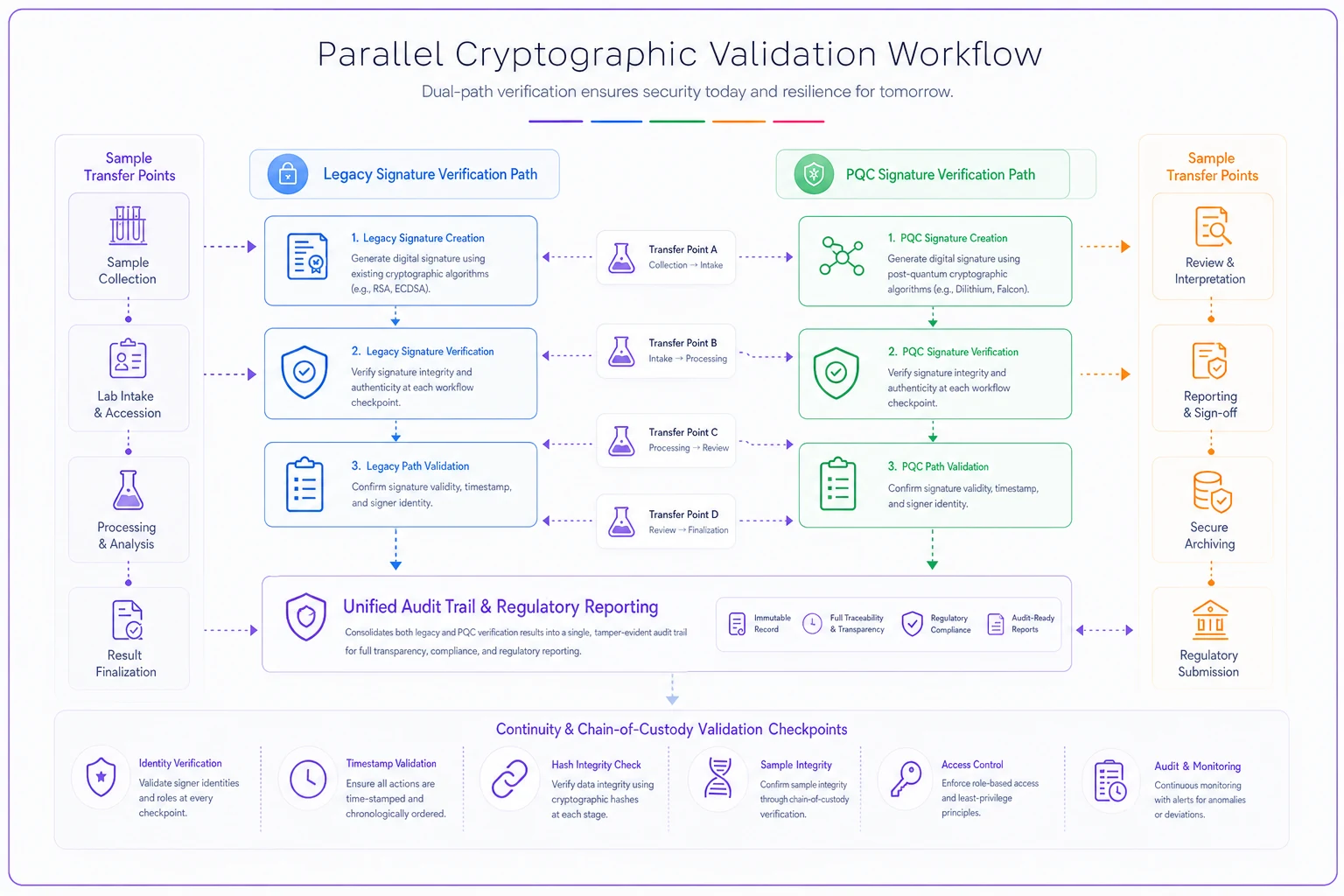
The messiest part isn't the technical migration—it's keeping valid operations running while parallel systems coexist. Your lab needs to prove both old and new cryptographic methods remain valid during the transition. That means duplicate validation, parallel documentation, and careful change control.
The workflow below captures how this typically runs in practice: legacy signature verification continues operating alongside PQC signature verification, and both feed into a unified audit trail that regulators can actually read without confusion.
Four areas tend to create the most headaches:
Dual signature validation: Documents signed with legacy algorithms remain legally valid while new signatures use PQC algorithms. Implement verification procedures that check both signature types and flag discrepancies.
Chain-of-custody continuity: Samples moving between legacy and upgraded systems need unbroken documentation. Design transfer protocols that maintain integrity across cryptographic boundaries.
Audit trail bridging: Historical audit logs use old algorithms while new entries use PQC. Build reporting tools that present unified audit trails to regulators without confusion about algorithmic changes.
Performance monitoring: PQC algorithms have different performance characteristics than what you're running now. Track system metrics to catch bottlenecks before they impact operations. A LIMS query that takes 2 seconds might take 10 seconds with new encryption—that adds up fast in high-throughput environments.
Getting these four areas documented early matters. When regulators eventually ask questions, you want a paper trail showing you thought through each one deliberately.
Managing regulatory uncertainty
Regulators haven't fully worked out PQC requirements either. FDA guidance remains vague. CLIA hasn't addressed laboratory implications. International standards lag behind U.S. requirements. This uncertainty is its own compliance risk.
Document your decision process extensively. When regulators eventually provide specific guidance, you need to show you made reasonable choices based on what was available at the time. That record should include risk assessments for each system, rationale for migration priorities, vendor communications and commitments, industry best practices referenced, and internal review and approval processes.
Building relationships with regulatory contacts now is worth the effort. Send courtesy notifications about your PQC migration plans. Ask for informal feedback. When formal audits arrive, inspectors respond much better to proactive compliance than reactive scrambling.
Practical steps to start this week
Stop waiting for perfect guidance that won't arrive in time anyway. Start with these concrete actions:
-
Monday — Run a network scan to identify all TLS connections in your lab. Every HTTPS connection, every encrypted file transfer, every secure API call needs cataloging. Free tools like Wireshark or commercial solutions like Nessus can map your cryptographic footprint in a few hours.
-
Tuesday — Contact your three most critical vendors. Send formal letters requesting their PQC migration roadmaps. Include specific deadlines from the federal mandate. Document their responses—or their silence—as part of your risk assessment.
-
Wednesday — Review your federal contracts for cryptographic requirements. Look for phrases like "FIPS 140-2 validated" or "encryption at rest and in transit." These clauses will likely update to require PQC compliance. Start conversations with contracting officers about modification timelines now.
-
Thursday — Establish a PQC working group with representatives from IT, quality, regulatory, and operations. Meet weekly at first to maintain momentum. Assign specific discovery tasks to keep things moving.
-
Friday — Create a preliminary budget estimate for your finance team. Include software upgrades, validation costs, potential hardware replacements, and consulting support. Early budget visibility prevents painful surprises later.
Building internal expertise without hiring consultants
Your team can develop PQC competency without expensive external consultants. NIST provides free resources including algorithm specifications, implementation guidance, and testing tools. Assign someone to become your internal subject matter expert—typically someone from IT with laboratory experience, or a technically-minded lab supervisor.
Focus their learning on practical application rather than cryptographic theory. They need to understand how to identify current algorithms in use, which NIST-approved algorithms replace current ones, basic performance implications of algorithm changes, validation requirements for regulatory compliance, and vendor evaluation criteria for PQC readiness.
Connecting with peer institutions navigating the same challenges is underrated. Academic research cores, hospital laboratories, and pharmaceutical QC labs are all working through this simultaneously. Share experiences, vendor feedback, and what's actually working through professional organizations or informal networks. You'll learn faster and spend less on consultants.
The path forward requires action today
The 2027 pilot deadline seems distant until you map out what laboratory operations actually require. Vendor development cycles, validation requirements, and budget approvals mean starting now barely provides enough runway for compliant migration.
Labs that wait for complete guidance or a perfect solution will find themselves in crisis mode—paying premium prices for rushed implementations that disrupt critical research. Those that start systematic preparation now can migrate methodically, keeping operations running while building real post-quantum security.
Start your inventory this week. Open conversations with vendors. Build internal expertise. The labs that treat PQC migration as an operational challenge rather than just an IT project will come out of this more secure and better positioned for what's coming.
Your instruments will keep generating data either way. The question is whether that data remains trustworthy and legally valid when quantum computers arrive—and the answer depends on what you decide to do in the next six months.
The 2027 pilot deadline seems distant until you map out what laboratory operations actually require. Vendor development cycles, validation requirements, and budget approvals mean starting now barely provides enough runway for compliant migration.
Ready to upgrade your lab operations?
Join 500+ labs using Labioly to save time, reduce errors, and enhance productivity and compliance.