


Most lab managers don't fail at buying software because they picked a bad vendor. They fail because they never built a decision structure, so by demo number four everything blurs together and the choice gets made on vibes, a slick sales rep, or whichever platform the PI's old postdoc used at their last institution. That's how you end up locked into a 3‑year contract for a platform nobody opens by month eight.
This guide is about the shortlisting phase specifically — the messy middle between "we need something better than spreadsheets and a whiteboard" and "we've signed." It's built for mid‑sized university research labs: too big for pure manual tracking, too small to have a dedicated procurement team doing the heavy lifting. The scoring matrix, RFI template, and negotiation notes below are the parts people usually skip and later regret skipping.
Define your "non‑negotiable five" before you look at a single vendor
The biggest time-sink in evaluating platforms is letting vendors define the criteria for you. Every demo introduces a feature you didn't know existed, it suddenly feels essential, and your requirements balloon. Three weeks in you're comparing platforms on 40 dimensions, most of which don't actually matter for your work.
-
Real‑time sample status that updates without someone manually re‑scanning or re‑keying
-
Inventory alerts that trigger on thresholds you set, not generic low‑stock defaults
-
A documented, supported integration path with your existing ELN and/or LIMS (not "we have an API")
-
Audit‑ready export that produces a complete chain‑of‑custody record without manual assembly
-
Institutional pricing that actually fits your procurement model (named‑seat vs. site license vs. usage)
Write these down and share them with your whole team before the first call. When a demo wanders into AI‑powered dashboards and predictive analytics nobody asked for, the list pulls you back. Something worth noticing: vendors most eager to show features outside your five are often weakest inside them.
A quick note on "we have an API"
"We have an API" is probably the most misleading phrase in lab software sales. Everyone has an API. What you actually need to know is whether they have a supported, documented, field‑mapped integration with your specific ELN or LIMS — ideally with a reference customer running it in production. The gap between "an API exists" and "a maintained connector your IT team won't have to rebuild every version release" is where six‑figure integration projects quietly live.
If you're already thinking about how integrations get versioned and secured over time, the groundwork around preparing LIMS, instruments and chain‑of‑custody for new cryptography deadlines is worth reading before you commit to anyone's connector roadmap.
Prioritized evaluation criteria (and why weighting matters more than the list)
Everybody publishes feature checklists. The checklist isn't the hard part — weighting it is. Two labs can care about the identical ten criteria and still correctly pick different platforms because their weights differ. A clinical translational lab weights chain‑of‑custody and consent metadata heavily. A materials science lab weights reagent lot traceability and instrument data capture. Same list, different math.
Eliminate lab bottlenecks and errors.
Labioly helps you monitor, manage, and report lab activities efficiently and compliantly.
- Real-time sample tracking
- Inventory and supply alerts
- Staff workflow coordination
No credit card required
| Criterion | Suggested Weight | What actually separates vendors |
|---|---|---|
| ELN/LIMS integration depth | 20% | Supported connector + reference customer vs. raw API + "professional services engagement" |
| Real‑time sample tracking accuracy | 15% | Event‑driven updates vs. batch sync every 15–60 min |
| Inventory alerts & thresholds | 12% | Per‑item configurable rules vs. one global low‑stock number |
| Audit & chain‑of‑custody reporting | 15% | One‑click defensible export vs. manual stitching across screens |
| Staff coordination / task handoffs | 10% | Role‑based queues and reassignment vs. shared email/calendar |
| Institutional pricing fit | 10% | Site/usage licensing vs. per‑seat that punishes rotating students |
| Security & access controls | 8% | SSO, granular roles, data residency vs. shared logins |
| Implementation & data migration support | 6% | Structured onboarding vs. "here's the docs" |
| Vendor stability & roadmap | 4% | Transparent release cadence vs. feature promises in slides |
Two things people consistently get wrong with a matrix like this. First, they let integration and reporting sit at a comfortable middle weight when, for most audit-exposed labs, those two should genuinely dominate — a platform that tracks beautifully but can't produce a defensible record has solved the wrong problem. Second, they treat pricing fit as a final gate rather than a real criterion. Academic labs churn students and rotating staff constantly; a per‑seat model that looks cheap at 8 users gets painful at 25 when half of them are only active for three months.
A customizable RFI template you can send next week
An RFI isn't a formality — it's your filter before you spend hours in live demos. The goal is written, comparable answers so you're not reconstructing who said what from memory. Keep it short enough that vendors actually complete it; a 60‑question RFI gets you boilerplate or silence.
Here's a lean version organized to map directly onto your scoring matrix:
Section 1 — Integration
-
Which ELN and LIMS products do you have production integrations with today? Name customers we can reference.
-
Is the integration maintained by you, by a partner, or built per‑customer? Who owns breakage after a version update?
-
Which fields sync bidirectionally vs. one‑way? Provide a sample field map.
Section 2 — Sample tracking & inventory
-
Are status updates event‑driven or batch? If batch, what's the interval?
-
Can alert thresholds be set per item, per location, and per project? Describe the rule engine.
-
How are location moves (freezer, rack, box, position) recorded and timestamped?
Section 3 — Audit & reporting
-
Can we export a complete chain‑of‑custody record for a single sample in one action? Provide a sample output.
-
Are records immutable / versioned? How are edits logged?
-
What retention and legal‑hold controls exist?
Section 4 — Access, security, staff
-
Do you support institutional SSO? Which providers?
-
How are roles and permissions scoped (project, lab, PI group)?
-
How do you handle high‑turnover users (students, rotating staff) in licensing and access?
Section 5 — Commercial
-
Describe your licensing models available to universities (site, named‑seat, usage, consortium).
-
What's included in base pricing vs. add‑on (integrations, support tier, storage, extra modules)?
-
What does implementation cost and how long does a comparable lab typically take to go live?
Add your five non‑negotiables as a cover page requirement: "Confirm yes/no that your platform meets each of the following." Any vendor who can't give five clean yes/no answers is already telling you something.
Scoring: keeping it objective when demos start to blur
Score during each demo, not after all of them. The recency effect is brutal — the last vendor you saw always feels best. Give every evaluator a one‑page sheet with your weighted criteria and have them score 1–5 immediately, individually, before the group talks. Discussing first pulls everyone's scores toward whoever speaks loudest.
A simple, defensible process:
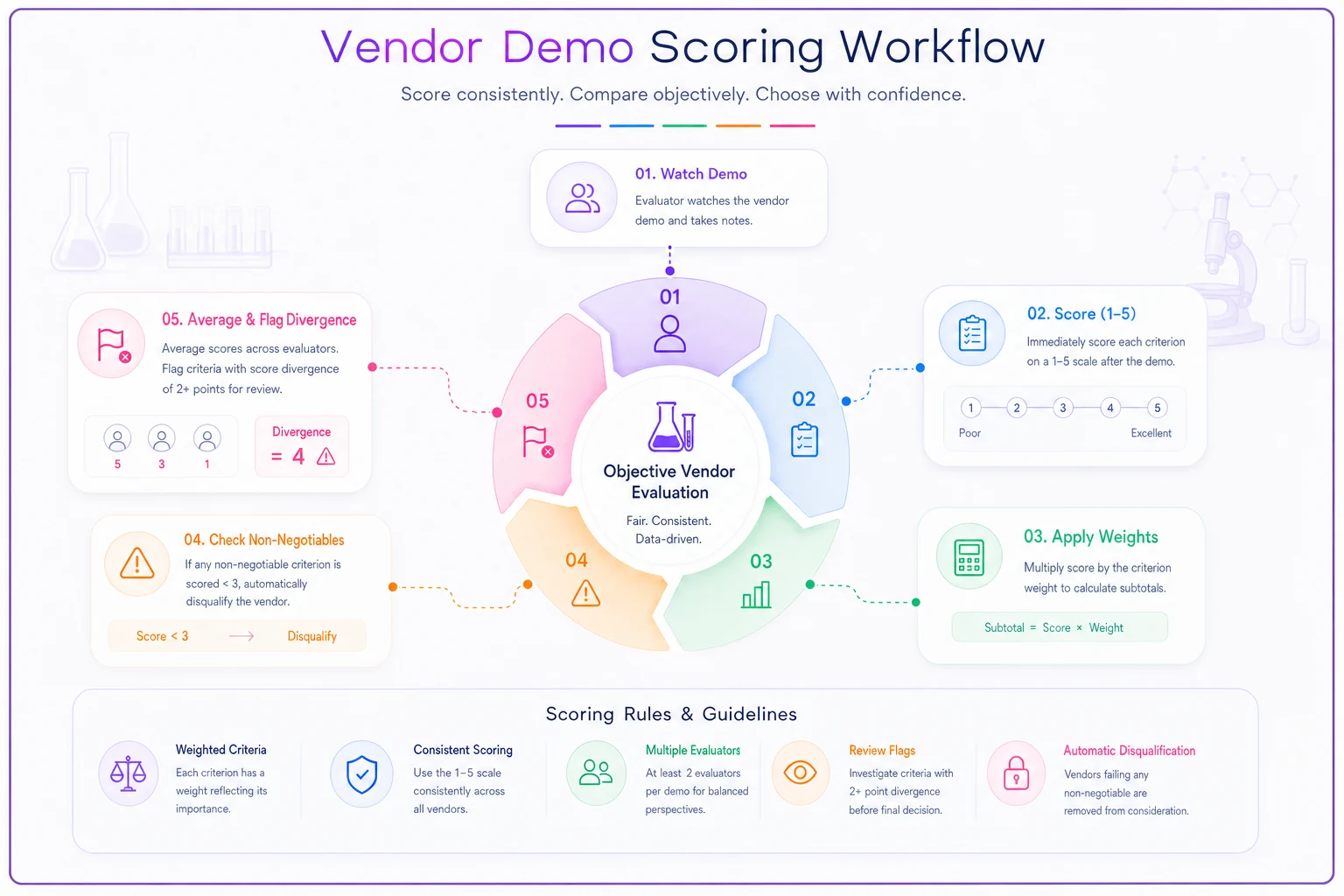
A quick visual of the scoring steps follows.
-
Each evaluator scores each criterion 1–5 right after the demo, independently.
-
Multiply by the criterion weight for a weighted subtotal.
-
Average across evaluators — but flag any criterion where scores diverge by 2+ points, because that disagreement usually reveals a misunderstanding worth resolving, not just a difference of taste.
-
Any vendor scoring below 3 on a non‑negotiable is out, regardless of their total. The total is a tiebreaker among qualified vendors, not a rescue mechanism for a disqualified one.
-
Keep the scoresheets. When a PI or department head later asks "why not Vendor X," you have a documented, non-personal answer.
That last point matters more than it sounds in an academic environment. Procurement decisions get re‑litigated when senior faculty had a preference. A paper trail of weighted, multi‑evaluator scores turns "I didn't like their rep" into "here's the gap on integration and audit export." One of those is defensible to a department committee; the other isn't.
Negotiation and procurement tips specific to universities
Time the purchase against your fiscal calendar, not theirs. Vendors push end‑of‑quarter urgency. Universities have their own fiscal year‑end and grant‑spend deadlines — that's your leverage. A vendor would rather discount during your crunch than lose the deal to a lapsing budget line.
Ask whether your institution already has a master agreement. Many universities have negotiated terms through consortia or system‑wide purchasing offices. Buying under an existing master agreement can save weeks of legal review and sometimes unlocks pricing you'd never reach as a single lab. Your sponsored programs or procurement office knows; most PIs never ask.
Cap the per‑user pain. If you can't get a site license, negotiate a user band (e.g., up to 30 active users) rather than per‑seat, so rotating students and summer staff don't trigger overage invoices. Also negotiate what happens to inactive accounts — you shouldn't pay full freight for a student who left in April.
Separate integration cost from the subscription line. Bundle it and you can't tell if your renewal increase is for the software or for work already delivered. Get integration quoted as a defined, deliverable‑based engagement with acceptance criteria.
Lock renewal caps now. The real cost isn't year one — it's the uncapped increase at renewal once you've migrated years of data and can't easily leave. Put a renewal cap (CPI or a fixed percentage) in the original contract while you still have walk‑away power.
Get your exit terms in writing. Specifically: data export format, export assistance, and the retention window after termination. A platform you can't cleanly leave is one that can raise prices freely.
Negotiate a user band (e.g., up to 30 active users) instead of per‑seat to avoid surprise overage charges from rotating students.
A vendor would rather give you concessions on integration timing or renewal caps than on the headline price once you've invested time in pilots and migrations. Use your internal deadlines and legal resources as negotiating levers.
Vendor archetypes to speed up your outreach
Rather than naming specific vendors — which goes stale fast and depends heavily on your existing stack — it's more useful to recognize the archetypes. Most platforms you encounter are a version of one of these, and knowing the archetype tells you where the hidden costs and strengths tend to sit.
-
The LIMS‑adjacent extension. Started as a LIMS add‑on or lives inside a larger suite. Integration is seamless if you run their LIMS, painful otherwise. Strong on reporting, often weaker on lightweight staff coordination. Watch for lock‑in.
-
The sample‑tracking specialist. Purpose‑built for freezers, racks, chain‑of‑custody, and barcode/scanning workflows. Usually excellent at the tracking core, variable on inventory‑reorder logic and ELN integration depth. Best fit when sample location integrity is your top pain.
-
The inventory‑first platform. Grew out of reagent and consumables management — great auto‑reorder, lot/expiry, and spend analytics. Sample lifecycle and chain‑of‑custody can be thinner. Good for labs where stockouts and spend control hurt more than sample‑location errors.
-
The all‑in‑one operations suite. Tries to cover tracking, inventory, scheduling, and reporting in one platform. Convenient and often well‑priced for mid‑sized labs, but check that no single module is so shallow it becomes the weak link your whole team routes around.
-
The academic/open‑source‑leaning option. Lower license cost, strong in some research niches, but weigh the real total cost: self‑hosting, maintenance, and whoever on your team becomes the de facto admin. Cheap licensing isn't cheap if it costs you a grad student's time every week.
When you reach out, tell each vendor which archetype problem you're actually trying to solve. It filters the sales conversation quickly — a sample‑tracking specialist will happily tell you they're thin on reorder logic if you ask directly, and that honesty is itself a signal.
When a new platform makes sense — and when it doesn't
When it clearly makes sense: you're losing samples or re‑keying data across disconnected systems; audit prep takes days of manual assembly; you can't produce a chain‑of‑custody record on demand; inventory surprises are costing you reagent money and run delays. If two or more of those are true and growing, the switch pays for itself.
When it's premature: your core problem is actually undefined SOPs or inconsistent labeling discipline. Software built on a chaotic process just gives you faster chaos with better dashboards. Fix the process first, then buy the tool that enforces it.
Who should hold off entirely: very small single‑PI labs with a few hundred samples and stable staff. The administrative overhead of a full platform can exceed the benefit, and a well‑structured shared system with clear ownership may serve you better until you grow into the complexity.
A realistic shortlisting scenario
A mid‑sized university immunology lab — around 18 people, heavy rotation of grad students and a couple of core‑facility collaborators — kept losing time two ways: roughly a day and a half each quarter assembling audit‑ready records by hand, and a handful of mislabeled or misplaced freezer samples per month that triggered repeat collections. They started with a list of 14 possible platforms.
By applying the non‑negotiable five on the cover page of the RFI, they cut to 6 before a single live demo — four were eliminated purely on "no production integration with our ELN" and "no single‑action chain‑of‑custody export." Weighted scoring across three evaluators brought it to a top 3, and the final choice came down to pricing fit: two offered only per‑seat licensing that would have ballooned with rotating students, while the third offered a 30‑user band.
After implementation, quarterly audit assembly dropped from a day and a half to a couple of hours, and misplaced‑sample incidents fell to roughly one every other month. Nothing dramatic or overnight — but a steady, measurable recovery of time and reagents that paid back the subscription within the first year.
The point isn't the numbers. They didn't pick a better vendor than everyone else — they built a filter that made the right vendor obvious and the decision defensible.
Bringing it together
Shortlisting is where good procurement is won or lost. Define your non‑negotiable five before outreach so vendors don't redefine your needs for you. Weight your criteria honestly, with integration and audit reporting pulling real weight if you're exposed to compliance. Use a lean RFI to get written, comparable answers. Score live, independently, and keep the paper trail. Negotiate on your fiscal calendar, cap your renewals, and lock your exit terms before you've handed over years of data.
Do that, and the platform you end up with isn't just the one that demoed best — it's the one that actually fits how your lab runs, how it's funded, and how it has to prove its work to an auditor. That's the difference between software your team logs into every day and a contract you're quietly embarrassed about by the next budget review.
Ready to upgrade your lab operations?
Join 500+ labs using Labioly to save time, reduce errors, and enhance productivity and compliance.