

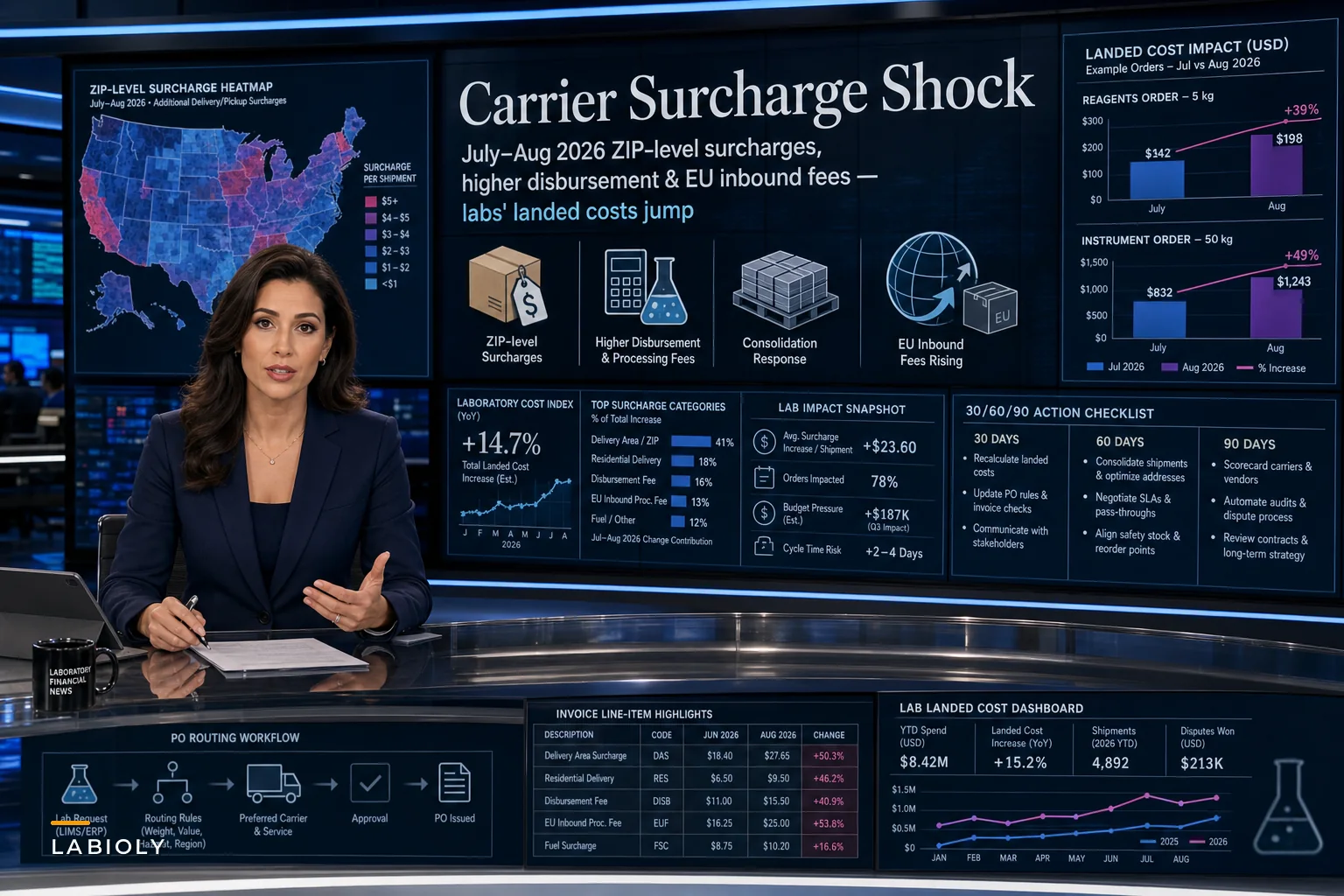

Last Monday morning, a university lab manager in North Carolina opened a FedEx invoice and found an extra $427 in delivery surcharges for their monthly reagent shipments. Nothing had changed about their ordering patterns. Same vendors, same volumes, same ZIP code. Their location had just been quietly reclassified into a higher surcharge tier.
This wasn't a one-off. According to FreightWaves, FedEx reclassified 102 U.S. ZIP codes into higher delivery and pickup surcharge categories on July 20, while simultaneously raising disbursement fees to the greater of $17.50 or 2.5% for cross-border shipments. For labs ordering from European suppliers, the timing is rough—inbound EU processing fees jumped in early August too.
The immediate hit lands hardest on procurement teams. A typical academic research lab ordering around $12,000 in reagents monthly from mixed domestic and international suppliers could see landed costs jump by $200–$350 per month just from these parcel surcharge changes. For contract research organizations running higher volumes, that number climbs into the thousands.
What makes this especially frustrating is that these charges usually surface weeks after the original purchase order, buried in carrier invoices that don't reconcile cleanly against vendor statements. Your procurement system shows one cost, the vendor invoice shows another, and the carrier adds a third layer nobody budgeted for.
The hidden complexity of lab shipping economics
Laboratory supply chains don't work like standard B2B shipping. Most labs can't consolidate orders the way a retail operation might. When you need specific antibodies for tomorrow's experiment, or a -80°C freezer alarm goes off at 2 AM, you order what you need. That's just how it works.
This creates a perfect storm for surcharge accumulation. Labs typically place:
-
Multiple small orders weekly (median order value somewhere around $400–$800)
-
Emergency overnight shipments for time-sensitive experiments
-
International orders for specialized reagents only available from European suppliers
-
Temperature-controlled shipments requiring special handling
Each order type triggers different surcharge categories, and the recent FedEx changes pile additional fees on top of an already messy structure. A single international reagent order might now include: base shipping, fuel surcharge, residential delivery fee (many research parks qualify for this one), extended area surcharge, and the newly increased disbursement fee.
The operational challenge isn't just higher costs. These charges create downstream problems most labs aren't set up to handle. Purchase orders get approved based on quoted prices, but landed costs exceed budgeted amounts. Finance flags discrepancies. Principal investigators start wondering why their grant money isn't going as far. Procurement teams spend hours reconciling invoices instead of doing anything that actually moves things forward.
Why traditional lab procurement systems break under surcharge pressure
Most laboratory procurement runs on a familiar model: get a few quotes, pick the cheapest, create a PO, receive goods, pay invoice. That worked fine when shipping was predictable. Modern carrier pricing is something else—algorithmically complex, with charges varying by ZIP code, package dimensions, delivery speed, and sometimes even day of the week.
Eliminate lab bottlenecks and errors.
Labioly helps you monitor, manage, and report lab activities efficiently and compliantly.
- Real-time sample tracking
- Inventory and supply alerts
- Staff workflow coordination
No credit card required
Labs running older procurement approaches tend to hit a few specific breaking points:
Quoted prices become meaningless. Vendors quote product prices and estimated shipping, but actual carrier charges often exceed estimates by 15–25%. What looked like the cheapest option ends up the most expensive after surcharges stack up.
Budget forecasting falls apart. When you build next year's reagent budget from this year's spending, you're working from shipping cost data that's already stale. Recent surcharge increases make historical numbers unreliable for any real forecasting.
Vendor comparisons get impossible. Supplier A ships from New Jersey, Supplier B from California, Supplier C from Germany. Each triggers different surcharge combinations depending on your lab's location. The lowest product price might come attached to the highest shipping burden.
Audit trails fragment. Regulated labs need clean cost documentation for grant reporting or GxP compliance. But when charges appear across multiple invoices from vendors and carriers, assembling a clear audit trail becomes a multi-hour reconciliation project every single month.
The obvious fix—negotiating carrier contracts—doesn't work well for most research labs. Unless you're shipping hundreds of packages a month, carriers aren't going to offer meaningful discounts. Even large academic medical centers struggle to get surcharge exemptions.
Building a surcharge mitigation framework
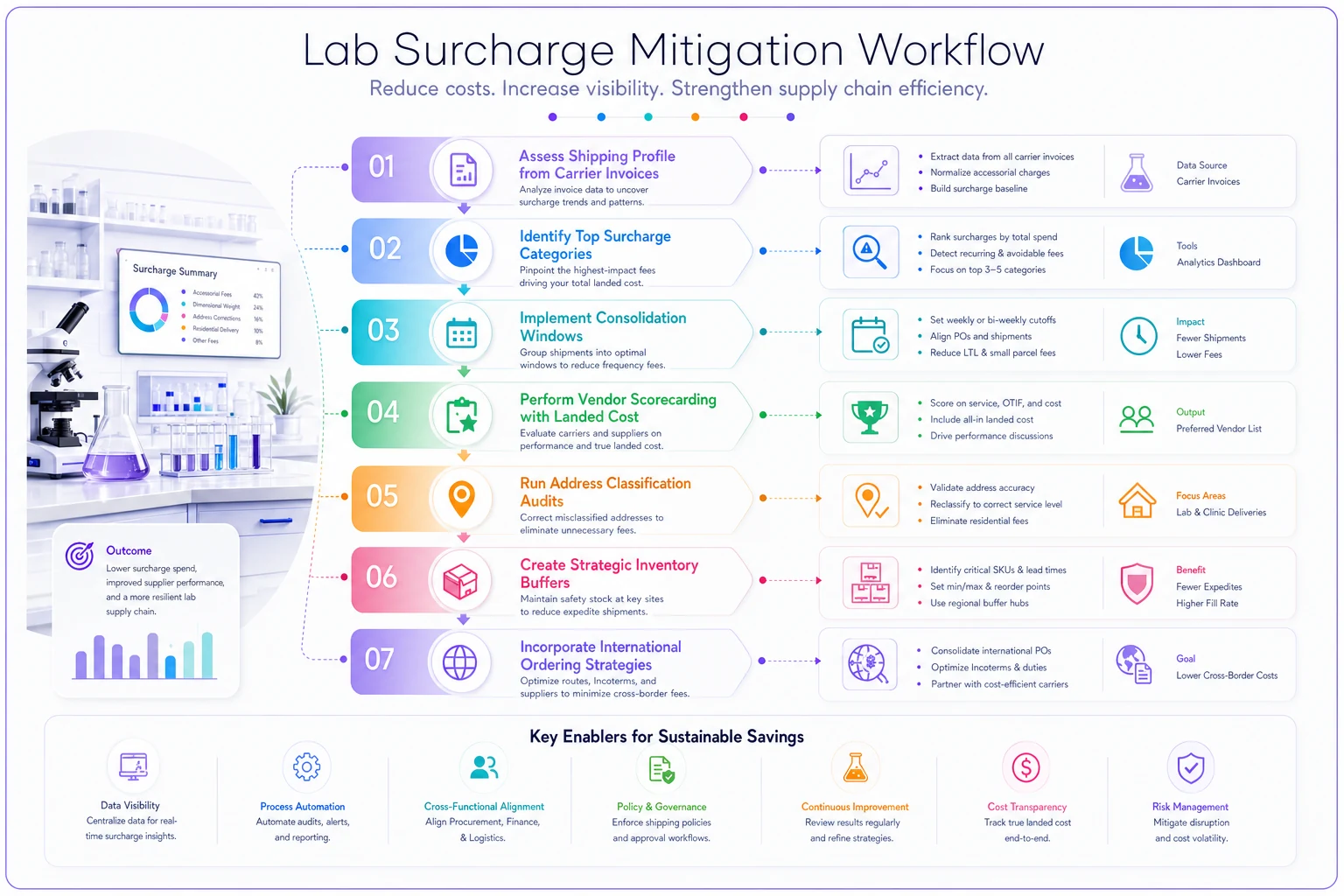
The first step isn't negotiating with carriers. It's understanding your actual shipping profile, which most labs have never done. Pull three months of carrier invoices and categorize every charge. You'll probably find that 60–70% of surcharges come from two–three categories you can actually do something about.
Immediate mitigation tactics
Consolidation windows. Instead of ordering reagents throughout the week as needs pop up, set twice-weekly order windows. Monday orders ship together, Thursday orders ship together. This typically reduces shipment count by 30–40% without meaningfully impacting research timelines.
Vendor scorecarding with landed cost. Stop evaluating suppliers on product price alone. Build a simple scorecard that factors in average shipping cost per dollar of product. One research institute discovered their "preferred" antibody supplier was actually 18% more expensive than alternatives once shipping was included.
Address classification audit. A lot of labs accidentally trigger residential delivery surcharges because their receiving address is miscoded in carrier systems. A ten-minute phone call to verify your classification can eliminate $7–9 per package in fees you shouldn't be paying.
Strategic inventory buffers. For frequently used consumables, calculate the break-even point where holding extra stock costs less than emergency shipping. Most labs find that keeping a two-week buffer of common reagents pays for itself within three months through eliminated overnight charges.
Below is a simple workflow illustrating these mitigation steps.
The international ordering problem
Cross-border shipments took the steepest hits under the new fee structures. As reported by Pomegra, the disbursement fee alone adds a $17.50 minimum to every international package, with percentage-based fees hitting harder on high-value orders.
Quarterly bulk orders. If you're ordering the same specialized reagents repeatedly, consolidate into quarterly rather than monthly shipments. The per-unit surcharge impact drops substantially on larger orders.
Delivered Duty Paid (DDP) vs Delivered at Place (DAP). A lot of labs default to DAP and handle import duties themselves. Switching to DDP often produces better total landed cost because suppliers have negotiated carrier rates that labs simply can't access on their own.
Regional distributor alternatives. That specialty German antibody might be available through a U.S. distributor. The unit price will be higher, but once you factor in international shipping, duties, and disbursement fees, domestic sourcing often wins on total cost.
Operational changes that actually stick
Identifying solutions is the easy part. Getting research staff to actually follow through is harder. Scientists running experiments aren't thinking about shipping zones and carrier contracts—and they shouldn't have to be.
The labs that make this work embed surcharge mitigation into existing workflows rather than bolting on new processes. A few things that tend to hold:
Automated approval thresholds. Set your procurement system to flag any order where shipping exceeds 15% of product value. This simple rule catches most surcharge-heavy orders before they're placed.
Preferred vendor lists with shipping profiles. Don't just list approved vendors—include their typical shipping costs and common surcharge categories. Researchers can make informed choices without becoming carrier pricing experts.
Monthly shipping scorecards. Send principal investigators a simple monthly report showing their lab's shipping costs versus budget, plus one actionable recommendation. Gentle visibility drives behavior change without adding friction.
Pre-negotiated shipping terms. Work with your top 5–10 vendors to establish standard shipping terms that sidestep common surcharges. Most vendors will accommodate reasonable requests from regular customers.
When automation makes sense for tracking landed costs
Managing parcel surcharge disbursement fees manually is workable when you're placing 20–30 orders monthly. Beyond that, the reconciliation burden starts to overwhelm most procurement teams. You're asking someone to cross-reference vendor invoices, carrier statements, and PO systems to calculate actual landed costs—a process that can quietly eat hours every week.
This is where operational software built for laboratory procurement can make a real difference. Modern platforms can pull carrier tracking data, match it against POs, and calculate true landed costs without someone doing it by hand. Some flag when specific vendors consistently trigger high surcharges, which helps with future sourcing decisions rather than just documenting bad ones after the fact.
The key is finding procurement and vendor governance software for critical lab supplies that goes beyond simple PO creation. Visibility into landed cost trends, automated vendor scorecarding that includes shipping performance, and alerts when surcharge patterns shift—that's what actually moves the needle.
-
Pull real-time carrier rate cards and apply them to quotes
-
Track historical shipping costs by vendor and product category
-
Generate landed cost reports for budget reconciliation
-
Alert when orders will trigger significant surcharges before they're placed
Return on investment typically shows up within 2–3 months through eliminated surcharges and reduced reconciliation time. More importantly, you get back control over a cost category that's been quietly eroding research budgets.
The 90-day surcharge reduction plan
If your lab needs to move quickly on these new carrier charges, here's a practical timeline:
| Phase | Actions |
|---|---|
| Weeks 1–2: Assessment | Pull carrier invoices from the last quarter. Identify your top surcharge categories and which vendors trigger them most. Calculate your average surcharge rate as a percentage of product cost. |
| Weeks 3–4: Quick wins | Implement order consolidation windows. Verify your address classification with carriers. Adjust approval thresholds to flag high-shipping orders. You should see some immediate impact on weekly shipping costs. |
| Weeks 5–8: Vendor negotiations | Meet with your top 10 vendors about shipping terms. Explore DDP options for international suppliers. Negotiate volume-based shipping discounts where you can. Document new terms in your vendor management system. |
| Weeks 9–12: Process optimization | Roll out procurement workflows that include landed cost visibility. Train research staff on consolidation practices. Set up scorecarding and reporting. Implement automated tracking if order volume justifies it. |
Most labs see somewhere in the range of 15–25% reduction in shipping costs within 90 days using this kind of framework. The biggest savings tend to come from order consolidation and vendor term renegotiation, not carrier contract changes.
Looking ahead: The new reality of lab logistics costs
These FedEx changes are part of a broader trend toward more complex and expensive parcel shipping. UPS and other carriers typically follow within 6–12 months. Regional surcharges will likely expand. International fees will keep climbing.
Labs that adapt their procurement operations now will be better positioned when the next round hits. That means moving away from reactive invoice reconciliation toward proactive landed cost management—treating shipping as a real cost category worth optimizing, not just an afterthought on the purchase order.
The research labs that come out ahead won't necessarily be the ones with the best carrier contracts. Most don't have the volume to get meaningful leverage there anyway. They'll be the ones that build operational flexibility into procurement, maintain visibility into true landed costs, and use systems that track these complexities automatically rather than relying on someone's spreadsheet.
The parcel surcharge disbursement fee problem isn't going away. But with the right operational adjustments, you can limit its impact on your research budget and get your team's time back where it belongs—on the science.
Ready to upgrade your lab operations?
Join 500+ labs using Labioly to save time, reduce errors, and enhance productivity and compliance.