


Most lab procurement vendor governance collapses at the worst possible moment. Your primary antibody supplier goes dark during a critical validation study. The freezer monitoring probe vendor extends lead times from 2 weeks to 8 weeks with no warning. Your certified reference material supplier ships the wrong concentration standard, and now three weeks of data might be invalid.
The problem isn't having vendor policies. Every lab has vendor policies. The problem is those policies exist as static documents that nobody updates until something breaks. Meanwhile, actual vendor relationships drift further from what the SOPs describe, creating operational blind spots that only show up during audits or emergencies.
Why vendor governance breaks down in research environments
Research labs face a procurement challenge that standard vendor management frameworks miss entirely. Unlike clinical labs with predictable consumption patterns, research operations deal with constantly shifting vendor requirements. One month you need specialized peptides from a boutique supplier in Switzerland. Next month it's custom oligonucleotides from a startup in California. The month after that, the PI pivots the entire project and suddenly you need flow cytometry reagents from vendors you've never qualified.
This variability creates real governance gaps. Labs typically manage somewhere between 40 and 80 active vendors but only maintain current documentation for maybe 15 or 20 of them. The rest operate in a gray zone where purchase orders flow through finance, materials arrive at receiving, and nobody is actually tracking performance metrics or maintaining qualification records.
It gets worse when you factor in how vendor relationships actually work in research settings. Scientists develop personal preferences based on past experiments. They'll bypass approved vendors because "that antibody from Company X worked better in my Western blots three years ago." Procurement tries to standardize, then gets overruled when a Nature submission deadline approaches and the PI insists on their preferred supplier regardless of qualification status.
What typically happens is labs build elaborate vendor scorecards tracking delivery performance, quality metrics, and pricing trends. Sounds reasonable. Except those scorecards require manual data entry from multiple sources - receiving logs, QC records, finance systems, LIMS entries. After three months, data collection falls behind. After six months, the scorecards become fiction. After a year, everyone pretends they don't exist until an auditor asks about them.
The critical-spare problem nobody talks about
There's an operational pattern that shows up constantly: labs maintain safety stock for consumables like pipette tips and gloves but completely ignore critical spares for specialized items. Three months of generic reagents stockpiled, but zero backup plan when the only supplier of a validated cell culture media formulation has a manufacturing issue.
Eliminate lab bottlenecks and errors.
Labioly helps you monitor, manage, and report lab activities efficiently and compliantly.
- Real-time sample tracking
- Inventory and supply alerts
- Staff workflow coordination
No credit card required
Critical spares in lab procurement aren't just about having extra inventory. They're about maintaining operational flexibility when vendor relationships fail. A metabolomics core facility a couple years back had their sole-source supplier for deuterated internal standards experience a synthesis failure. A six-week lead time became sixteen weeks. The lab had no qualified alternative vendor, no banked inventory, and no pre-negotiated expedite agreements. They lost around $180k in billable runs while scrambling to qualify a new vendor under emergency protocols.
The mistake labs make is treating all supplies equally in vendor governance. Your pipette tip supplier going down for two weeks is annoying but manageable. Your validated antibody supplier failing during a GLP study validation is catastrophic. Yet most labs apply the same SLA structure, the same qualification requirements, and the same performance metrics to both scenarios.
Building SLAs that reflect operational reality
Standard SLA templates fail in research environments because they assume predictable ordering patterns and stable specifications. Research labs need SLAs that account for irregular ordering cycles, specification drift, and the reality that you might not order from a vendor for six months, then suddenly need emergency shipments three times in two weeks.
Start with response time guarantees that match your operational tempo. For critical reagent vendors, you need confirmation of order receipt within 4 hours during business days. Not because every order is urgent, but because when urgent orders do happen, four hours of uncertainty cascades into experimental delays. For specialty synthesis vendors, 24-hour confirmation is probably fine since their lead times are measured in weeks anyway.
Temperature excursion reporting is another SLA component labs consistently get wrong. The agreement says the vendor will notify you of cold-chain breaks within 24 hours. Except their definition of notification is updating a portal you check once a month. Meanwhile, your -80°C enzyme arrived last Tuesday, you've already used half of it, and you discover the temperature logger shows it spent 6 hours at room temperature during transit. Now you're investigating whether last week's failed experiments were actual failures or just degraded reagents.
The SLA should specify notification methods (email to specific addresses, not just portal updates), escalation triggers (any excursion over 30 minutes for ultra-cold materials, any cold-chain break for 2-8°C items), and documentation requirements (continuous logging data, not just pass/fail indicators).
Qualification frameworks that scale with vendor relationships
Most labs run extensive qualification protocols for new vendors, then never requalify unless something catastrophic happens. That vendor you qualified three years ago? They've been acquired twice, moved manufacturing to a different continent, and changed their quality system entirely. But according to your records, they're still "qualified" based on that initial assessment.
The framework needs to match vendor criticality with requalification frequency. Critical single-source vendors for validated assays need annual requalification covering quality systems, financial stability, and technical capabilities. Generic consumable suppliers might only need document review every three years. Specialty service vendors like oligo synthesis or peptide manufacturing need requalification triggered by specification changes, not just calendar intervals.
Operationally, this breaks down roughly like this:
Critical Vendors (Single-source for validated methods)
-
Annual quality system audit (remote or on-site)
-
Quarterly performance reviews against SLA metrics
-
Financial health check every 6 months
-
Technical capability assessment when methods change
-
Backup vendor identification and preliminary qualification
Standard Vendors (Multiple alternatives available)
-
Documentation review every 2 years
-
Performance metrics tracked but reviewed annually
-
Simplified financial check (basically
are they still in business?)
-
Expedited qualification path for alternative suppliers
Commodity Vendors (Catalog items, many suppliers)
-
Basic qualification at onboarding
-
Requalification only if issues arise
-
Performance tracked at aggregate level
-
Quick-switch protocols to alternatives
The key is making requalification automatic rather than exception-based. Build triggers into your procurement system: vendor reaches 18 months since last review, system flags for requalification. Vendor has three quality events in six months, automatic escalation to full review. Vendor changes ownership or location, immediate document update required.
Reorder cadence rules that prevent stockouts without overbuying
Traditional reorder points assume consistent consumption and reliable lead times. In research labs, both assumptions fail regularly. You might use 1,000 units of something monthly for six months, then zero for three months when projects shift, then suddenly need 5,000 units when multiple projects converge.
The solution isn't necessarily complex forecasting models - though demand forecasting for protocol-driven consumption helps with predictable materials. It's building reorder rules that acknowledge uncertainty. Set multiple trigger points: minimum quantity (below this, always reorder), runway quantity (current burn rate gives X weeks of supply), and project-based triggers (new study starting that will consume specific materials).
For a concrete example, consider antibody inventory management. Instead of a simple "reorder at 5 vials remaining," you need a multi-trigger approach:
-
Baseline minimum 3 vials to cover standard weekly consumption
-
Burn-rate trigger When current inventory divided by last-30-day usage drops below 6 weeks
-
Project trigger Any new project using this antibody prompts an availability check
-
Criticality override Single-source antibodies for validated assays maintain a 3-month buffer regardless of consumption
This approach prevents the two failure modes of lab procurement: emergency orders at premium prices, and expired inventory from overbuying.
Risk-based vendor scorecards that drive decisions
Vendor scorecards usually track the wrong metrics. On-time delivery percentage sounds important until you realize it weights a box of pipette tips the same as a critical reagent delivery. Quality incident count seems valuable until you notice it treats documentation errors the same as actual product failures.
Risk-weighted scorecards fix this by multiplying performance metrics by operational impact. Late delivery of common consumables might score 0.1 impact points. Late delivery of study-critical reagents scores 10 points. Same logic applies to quality issues - wrong label on a chemical where you verify identity anyway scores low, contaminated cell culture media that ruins two weeks of experiments scores high.
Here's a functional scoring framework:
| Vendor Event | Base Score | Risk Multiplier | Impact Score |
|---|---|---|---|
| Late delivery - common items | 1 | 0.5 | 0.5 |
| Late delivery - critical items | 1 | 10 | 10 |
| Quality issue - documentation | 2 | 0.5 | 1 |
| Quality issue - product failure | 2 | 15 | 30 |
| Temperature excursion reported | 1 | 5 | 5 |
| Temperature excursion hidden | 3 | 20 | 60 |
| Specification change without notice | 2 | 8 | 16 |
Monthly scores above 20 trigger vendor review. Quarterly cumulative above 50 triggers requalification. A single event above 30 triggers immediate escalation. This creates differentiated responses based on actual operational risk, not just counting incidents.
Connecting vendor reliability to operational planning
Vendor performance data should flow directly into operational decisions, but in most labs it sits in procurement spreadsheets while operations plans around optimistic assumptions. When your plate reader vendor has averaged 35-day repair times over the last year, why does your capacity model assume 5-day downtime for maintenance? When your custom peptide supplier fails purity specs roughly 30% of the time, why don't your project timelines include a reorder buffer?
The connection happens through systematic risk tagging. Each vendor gets reliability scores that feed into safety stock calculations (unreliable vendors carry higher buffers), project timeline padding (critical path items from poor performers get extra time), backup qualification priorities (lowest-scoring critical vendors get alternatives qualified first), and budget planning (poor quality history means budgeting for likely reorders).
If your sequencing primer vendor scores poorly on quality metrics, for example, your lot-traceability system should automatically flag those batches for extended testing. Your project management system should add buffer time to any timeline depending on their products. Your procurement system should maintain qualified alternatives ready for quick switching.
Pilot templates for controlled rollout
Rolling out new vendor governance frameworks across an entire lab operation at once is a recipe for failure. Too many moving parts, too much resistance, too many edge cases you didn't anticipate. Start with pilots that prove value before expanding.
A functional pilot approach works in three phases:
Phase 1: Single vendor category (4 weeks)
-
Pick your most problematic vendor category (usually specialty reagents or custom synthesis)
-
Implement SLA tracking for just those 3-5 vendors
-
Build scorecards manually in spreadsheets
-
Document what breaks and what works
Phase 2: Critical path vendors (8 weeks)
-
Expand to vendors on the critical path for key projects
-
Add qualification tracking and requalification triggers
-
Start connecting scores to operational decisions
-
Refine metrics based on Phase 1 learning
Phase 3: Full implementation (12 weeks)
-
Roll out to all vendors above $50k annual spend
-
Automate data collection where possible
-
Integrate with procurement and quality systems
-
Build reporting dashboards for management
The rollout can be shown as a simple visual workflow.
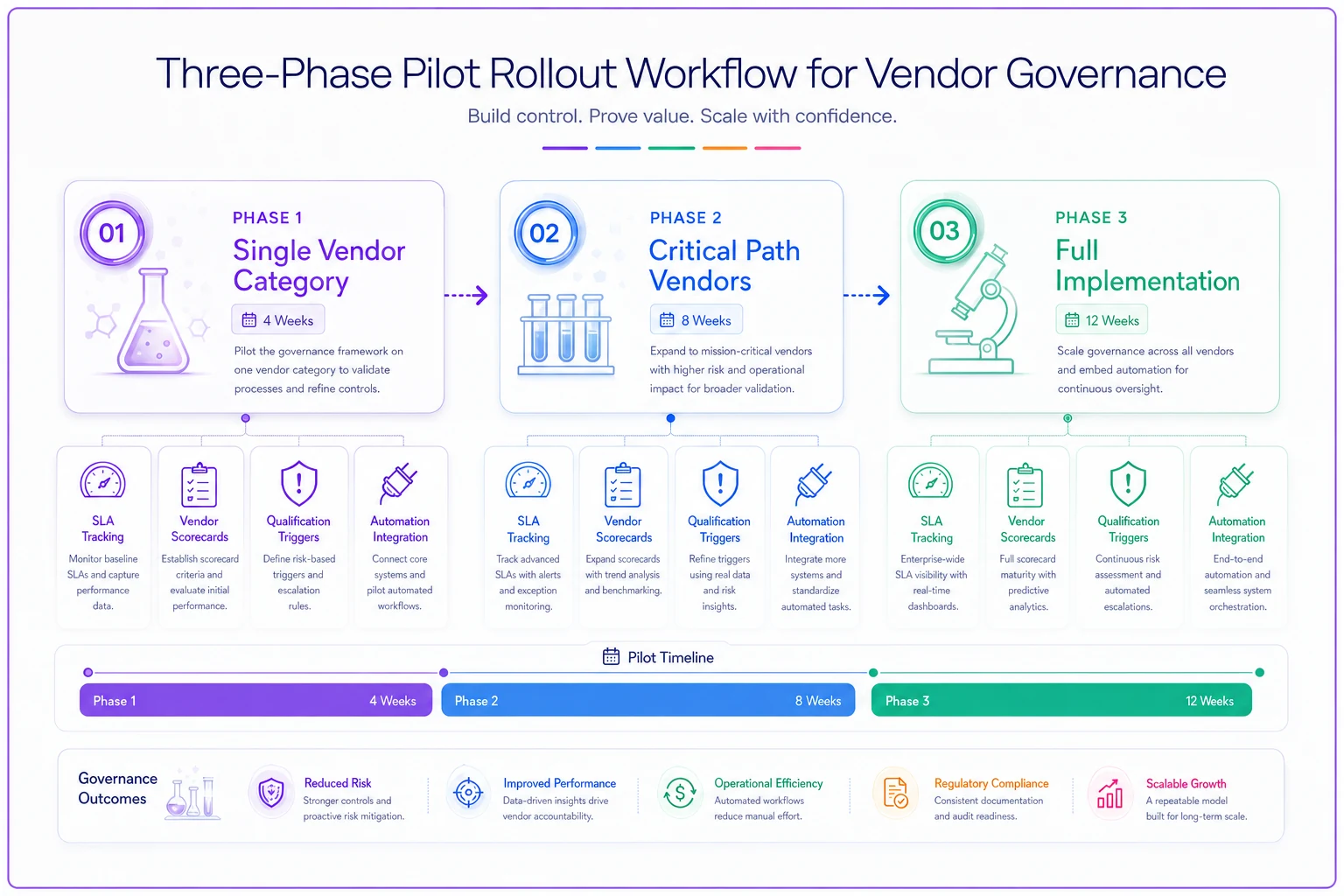
Each phase has clear success criteria. Phase 1 succeeds if you can identify at least two vendor issues before they impact operations. Phase 2 succeeds if critical-path vendor issues drop meaningfully. Phase 3 succeeds if manual vendor management time drops while issue detection actually improves.
Automation without losing flexibility
The vendor governance framework generates significant data flows - delivery confirmations, quality reports, temperature logs, specification sheets, performance metrics. Manual tracking breaks down somewhere around 20 vendors. But full automation often fails in research labs because the needs are too variable for rigid systems.
The sweet spot is selective automation. Automate data collection through integrations with receiving systems, LIMS, and financial platforms. Automate alert generation when thresholds are exceeded. Automate report distribution and escalation workflows. Keep human decision-making for vendor selection, relationship management, and exception handling.
Start by automating alerting for temperature excursions and delivery confirmations to reduce manual tracking overhead.
AI-powered operational software helps here by handling the pattern recognition and anomaly detection that makes vendor governance actually work at scale. Instead of manually checking whether today's delivery matches historical patterns, the system flags when a typically reliable vendor starts showing degraded performance. Instead of remembering to check financial health quarterly, automated monitoring surfaces concerning changes when they happen. The operational framework stays flexible while the tedious tracking becomes automatic.
This balance preserves the relationship aspects of vendor management that actually matter in research - the sales rep who expedites critical orders, the technical support that helps troubleshoot method problems, the quality team that provides extra documentation for regulatory submissions. Those human elements don't get automated away, but the surrounding operational framework absolutely should be.
When vendor governance actually pays off
The value of proper vendor governance isn't visible during normal operations. It reveals itself during crisis points. When a major supplier has a quality failure, labs with good governance have pre-qualified alternatives ready. When lead times suddenly extend, they have critical spare strategies already in motion. When auditors ask for vendor qualification evidence, they have current documentation rather than scrambling to reconstruct it.
During the 2021 plastic shortage, labs with robust vendor governance saw early warning signals - gradually extending lead times, allocation notices, quality shortcuts at overwhelmed suppliers. They activated backup suppliers while inventory was still available. Labs without these systems found out when orders started getting cancelled, then competed with everyone else to find alternatives.
The operational payoff comes from avoiding hidden costs: emergency shipping charges when standard suppliers fail, repeated experiments due to quality issues, audit findings requiring retroactive vendor qualification, project delays from stockouts. These costs typically run several times higher than visible procurement spending but hide across different budgets throughout the organization.
Making it sustainable
The reason most vendor governance initiatives fail isn't poor design - it's inability to sustain execution over time. Initial enthusiasm generates detailed SLAs and scorecards. Six months later, nobody updates anything because the overhead exceeded the perceived value.
Sustainability requires embedding governance into existing workflows rather than layering new ones on top. Purchase orders already flow through your system - add the SLA check there. Receiving already logs deliveries - extract performance metrics automatically. Quality already investigates failures - make sure vendor coding enables trending. The governance framework should feel like enhanced visibility into existing operations, not an additional burden.
This integration means someone ordering supplies sees vendor scores during selection. Scientists reviewing experimental failures can quickly check whether vendor quality was a factor. Management reviewing budgets understands which vendors drive hidden costs through poor performance. The framework becomes part of operational thinking rather than a separate compliance exercise.
Effective lab procurement vendor governance isn't about perfect documentation or elaborate scorecards. It's about creating systems that surface problems before they impact operations, enable quick responses when issues arise, and continuously improve vendor relationships based on actual performance data. The templates and frameworks are just starting points - the real value comes from consistent execution that turns vendor management from a reactive scramble into a proactive operational advantage.
Ready to upgrade your lab operations?
Join 500+ labs using Labioly to save time, reduce errors, and enhance productivity and compliance.