

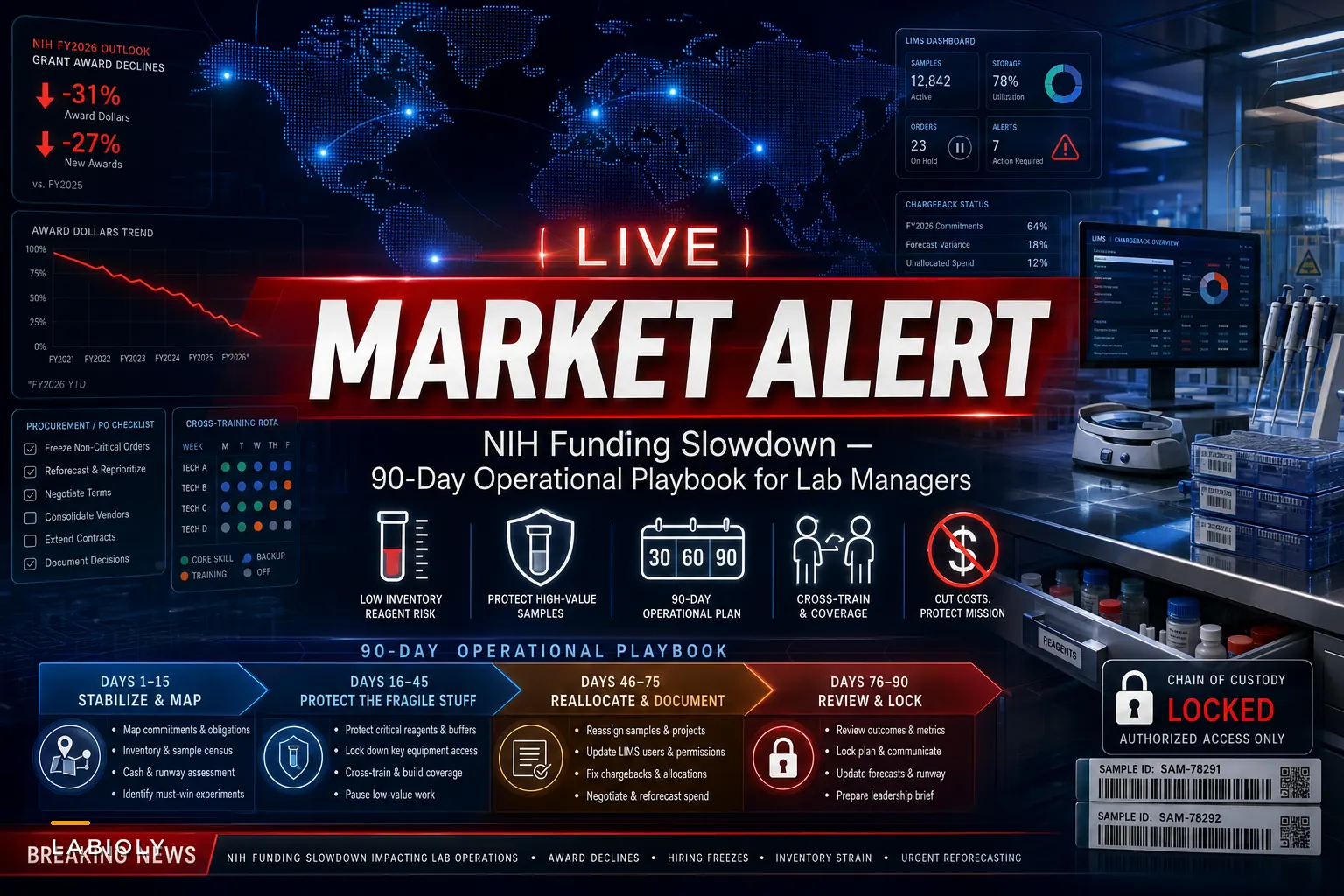

The FY2026 numbers landed at the worst possible time of year for planning. According to AAMC's ongoing tracking of NIH extramural funding, the drop isn't a one-off dip — roughly 7,400 fewer grants were awarded compared to FY2024, and multiyear commitments softened alongside it. CIDRAP's reporting sharpened the picture: the shortfall hit right as the federal fiscal year closed, meaning most labs got the signal after they'd already built their fall staffing and purchasing assumptions.
So this stopped being a forecasting exercise a while ago. For core facilities and mid-sized university labs, the money math already shifted under them. The question isn't whether funding tightened — it's which decisions over the next 90 days are reversible, and which ones lock you in.
That framing matters because the worst outcomes during funding crunches rarely come from the funding itself. They come from panic decisions made in week two that couldn't be unwound in week ten.
Start by sorting your commitments into reversible vs. irreversible
Before touching a single line item, the most useful thing a lab manager can do in the first week is split every active commitment into two buckets: things you can pause and restart, and things that, once stopped, are gone or expensive to rebuild.
This sounds obvious. In practice almost nobody does it, because the instinct under budget pressure is to cut whatever's biggest and most visible — which usually means reagents and headcount, the two most expensive things to rebuild.
| Commitment type | Reversibility | What happens if you cut too fast |
|---|---|---|
| Grant-funded postdoc / tech role | Low | Lose institutional knowledge, 3–6 month rehire + ramp |
| Long-lead reagents & antibodies | Low | Re-order lead times blow up; validation restarts |
| Recurring maintenance contracts | Medium | Instrument downtime risk, but often resumable |
| Discretionary consumables | High | Easy to throttle and restore |
| Non-critical pilot projects | High | Deprioritize cleanly, resume when funding returns |
| Core facility booking slots | Medium | Lose scheduling momentum, chargeback gaps |
The pattern worth noticing: the cheapest-to-cut items sit at the bottom, and the most damaging cuts sit at the top. Labs that survive slowdowns well tend to cut deep into the high-reversibility rows before touching anything in the low-reversibility rows. Labs that struggle do it backwards because the big numbers are tempting.
The staffing trap: hiring freezes that quietly become capability loss
The first operational hit from a slowdown is almost always a hiring freeze or a delayed onboarding for grant-funded roles. On paper it looks clean — you're not firing anyone, you're just not filling.
Eliminate lab bottlenecks and errors.
Labioly helps you monitor, manage, and report lab activities efficiently and compliantly.
- Real-time sample tracking
- Inventory and supply alerts
- Staff workflow coordination
No credit card required
The problem is that a freeze doesn't distribute its damage evenly. In most mid-sized labs, one or two people hold 60–70% of the undocumented operational knowledge: who knows the quirks of the old flow cytometer, who actually understands the freezer map, who remembers why a particular SOP has that weird extra wash step.
When a funded role goes unfilled and the workload shifts onto those people, you don't just lose capacity — you concentrate risk. If one of them leaves during the freeze (and tight budgets do increase the odds of that), you lose both the frozen role and the knowledge holding everything together.
A realistic scenario: a translational core running around 120–140 samples a week loses its second tech slot to a freeze. The remaining tech absorbs it fine for about six weeks. Then they take a pre-planned two-week leave. Suddenly sample intake backs up, chain-of-custody logging slips, and two experiments miss their processing windows. The freeze saved maybe $8k–$10k over the quarter and cost more than that in rerun reagents and delayed deliverables.
The move isn't to resist the freeze — you often can't. It's to make cross-training mandatory the moment the freeze starts, not after someone leaves.
Document the tribal knowledge while the person holding it is still in the building.
Reagents and consumables: the inventory decisions change under a slowdown
Tightened reagent budgets plus compressed procurement cycles create a nasty squeeze. Approvals take longer exactly when you have less room to absorb a stockout.
What changes operationally is the shape of your safety stock, not just the amount. Under normal funding you can carry decent buffers across the board. Under a slowdown you can't — so you have to get surgical about which consumables actually justify one.
-
List your top 15–20 consumables by annual spend AND by criticality to active, funded work. Spend alone will mislead you.
-
Flag anything with a lead time over three weeks. Long-lead items are where stockouts turn into missed experiments.
-
Cross-reference against which projects are still fully funded. Don't buffer reagents for work that's being deprioritized.
-
Set two buffer tiers a protected buffer for critical + long-lead + funded items, and a near-zero buffer for everything else.
-
Re-check lot and expiration exposure. Buying bigger buffers to beat price increases backfires if half expires before use.
The mistake that comes up most often during budget crunches: labs either freeze all purchasing and then eat emergency rush orders at 2–3x cost, or they panic-buy everything and watch reagents expire in the freezer. A slowdown rewards precision, not blanket policies.
If you want the deeper framework for making these tradeoffs — how to model capacity against a shrinking budget rather than just cutting proportionally — the laboratory financial and capacity strategy breakdown walks through the decision structure in more detail. That financial logic is the backbone under everything in this playbook.
Project rescoping: the part everyone does badly
When funding tightens, PIs start deprioritizing projects and rescoping experiments. This is necessary. What makes it painful operationally is that project ownership, sample ownership, and chargeback accounting all have to move at the same time — and they rarely do.
The underlying problem a slowdown exposes: most labs never built a clean mechanism for handing a project off or putting it in cold storage. Projects were born in a LIMS or an ELN under one PI, one grant code, one set of permissions. When the money shifts, you discover your systems assumed projects only get created, never reassigned or paused.
-
Samples tied to a defunded project still consume freezer space but no longer have a clear owner.
-
Chargebacks keep hitting a grant code that's winding down.
-
Access permissions stay with people who've rotated off.
-
Nobody's sure whether a paused project's samples should be retained, consumed, or disposed.
A 90-day fix here is less about software and more about defining the states a project can be in: active, paused, deprioritized, transferred, closing. Each state needs clear rules for sample handling, permissions, and who pays. Labs that have those states defined can rescope in an afternoon. Labs that don't spend weeks untangling who owns what.
A 90-day sequence that actually holds up
Pacing matters more than people expect. Doing everything in week one is how you make irreversible cuts. This sequence front-loads the reversible stuff and defers the hard calls until you have better information.
Here's a simple visual summary of the four-phase 90-day workflow below.
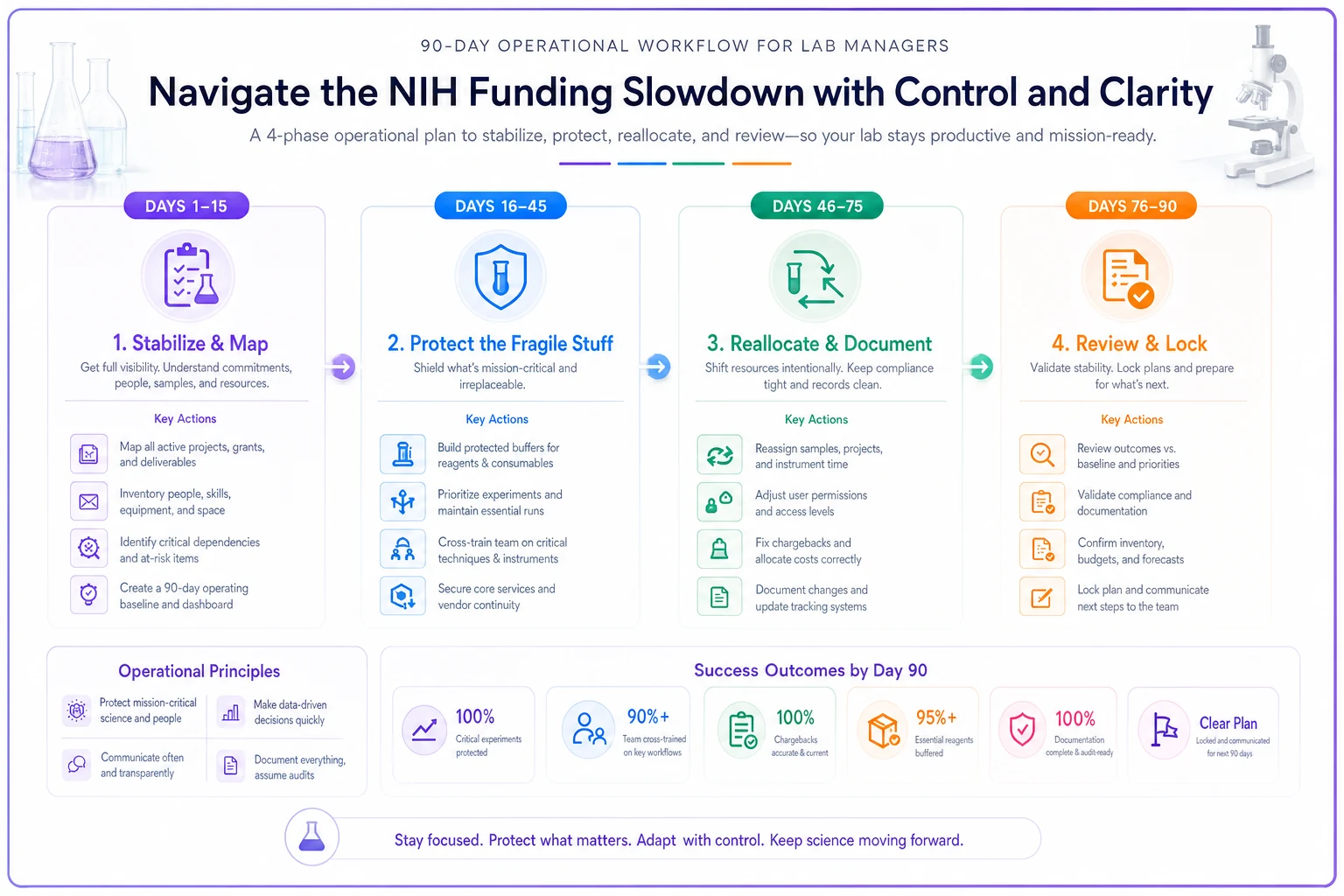
Days 1–15 — stabilize and map
-
Split all commitments into reversible vs. irreversible (the table above).
-
Throttle high-reversibility discretionary spend immediately.
-
Identify the one or two people holding concentrated knowledge.
-
Pull your top consumables by spend × criticality × lead time.
Days 16–45 — protect the fragile stuff
-
Start mandatory cross-training on concentrated-knowledge roles.
-
Set the two-tier reagent buffer; place protected long-lead orders before procurement cycles tighten further.
-
Define project states (active / paused / transferred / closing) with PIs.
-
Audit freezer space against project funding status.
Days 46–75 — reallocate and document
-
Reassign samples and permissions for deprioritized projects.
-
Fix chargeback routing so defunded codes stop getting billed.
-
Build the audit trail PIs and the institution will ask for — and they will ask.
Days 76–90 — review and lock
-
Re-forecast with actual spend data from the first 75 days.
-
Decide which paused projects resume, which close.
-
Revisit any irreversible cuts you deferred — now with real numbers instead of guesswork.
Re-forecast with actual spend data from the first 75 days.
The audit evidence surge nobody warns you about
One quiet side effect of a funding slowdown: reporting requests go up, not down. PIs under pressure want to prove their remaining funds are well-spent. Institutions tighten oversight. You'll get asked for chargeback reconciliations, sample disposition records, and spend justifications far more often than in a normal year.
If your records live across spreadsheets, email threads, and one person's memory, that surge becomes a second job on top of managing the actual crunch. Labs that handle it without drowning are the ones where sample movement, reagent consumption, and chargeback events were already being captured as they happened — so pulling an audit-ready report is a quick query, not a two-week archaeology project.
This is where having operational data centralized — inventory, chain-of-custody, chargebacks, and access logs in one connected system rather than scattered tools — pays off disproportionately during a slowdown. Not because it saves funding, but because it saves hours you can't spare when you're already short-staffed and everyone wants a report at once.
When to hold the line vs. when to cut
Not every slowdown response should be defensive. A few practical anchors:
Cut aggressively when: the spend is discretionary, the project is genuinely deprioritized, or the consumable has a short lead time and you can re-buy it in days.
Hold the line when: you're looking at long-lead critical reagents for funded work, or at the one role whose departure would collapse your operational knowledge. Those "savings" almost always cost more later.
Don't touch yet: irreversible cuts you haven't modeled with real numbers. Defer them to the day 76–90 review. The number of labs that made a permanent cut in week two and regretted it by week eight is higher than it should be — mostly because the panic timeline and the information timeline don't line up.
Where this leaves you
The FY2026 award drop is real and it's abrupt, but the labs that come through it in decent shape won't be the ones that cut fastest. They'll be the ones that cut in the right order — protecting the people and consumables that are expensive to rebuild, throttling the stuff that's easy to restart, and refusing to make irreversible decisions on panic-timeline information.
A funding slowdown doesn't just test your budget. It tests whether your operations were ever actually legible — whether you can see what you have, who owns it, and what it would cost to lose it. The 90-day window ahead is enough time to answer those questions properly, as long as you spend the first two weeks mapping instead of slashing.
Ready to upgrade your lab operations?
Join 500+ labs using Labioly to save time, reduce errors, and enhance productivity and compliance.