


Most sample problems don't come from technology. They come from the handoff points where nobody owns the sample for a few minutes — the gap between a courier dropping off a cooler and someone actually logging what's inside. A lab can have a six-figure LIMS and still lose a vial because the person who received it at 7:40 AM wasn't the person who accessioned it at 9:15, and the sticky note in between went in the trash.
This playbook is for the people who run the floor: lab managers, QA officers, operations leads at small-to-mid labs where you don't have a dedicated sample-management department and the same three people are doing receiving, accessioning, and processing. The goal here is boring on purpose — a lifecycle you can write down, a role matrix that assigns blame correctly, standardized fields, and chain-of-custody forms you can copy. No barcode-versus-RFID debate here; that decision deserves its own analysis, which you'll find in the Barcode vs RFID decision matrix and pilot plan.
The six-stage lifecycle, and the failure point hiding in each
Every sample moves through the same sequence whether you're a 4-person research lab or a mid-size clinical operation:
Receive → Accession → Label → Process → Store/Transport → Archive/Dispose
What matters isn't the sequence — everyone knows the sequence. What matters is the state transition between stages, because that's where custody changes hands and where samples disappear. A sample doesn't vanish "in storage." It vanishes in the five minutes between receiving and accessioning when it exists physically but not yet in the system.
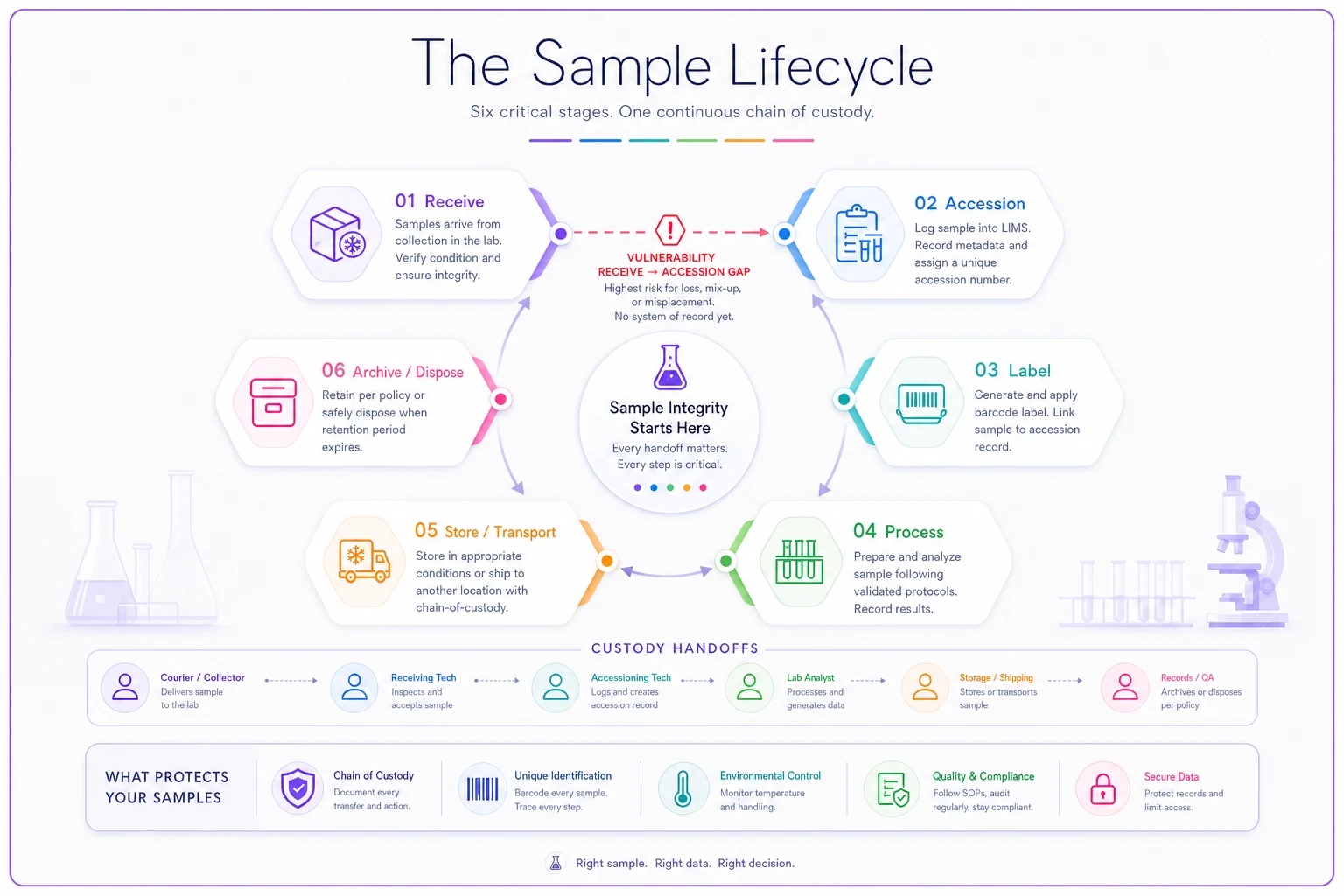
The graphic shows the workflow and the handoff points so you can see where custody gaps most often occur.
Here's each stage with the specific thing that tends to break:
| Stage | What happens | The common failure |
|---|---|---|
| Receive | Physical intake, temp check, condition note | Sample sits unlogged; no timestamp on arrival |
| Accession | Assign internal ID, link to request/order | Duplicate IDs, or accession before verifying count |
| Label | Apply durable label with required fields | Handwritten labels, missing lot/aliquot suffix |
| Process | Aliquot, test, extract, derive children | Child samples not linked to parent |
| Store/Transport | Place in defined location or ship | "Temporary" placement that becomes permanent |
| Archive/Dispose | Retain per policy or destroy with evidence | Disposal with no witness or manifest |
The pattern across all six: a sample is most vulnerable when it has a physical existence but no recorded existence, or vice versa. Your whole SOP system exists to shrink those windows.
Worth internalizing early — labs that track sample loss rate by stage almost always find that 60–70% of losses cluster in the receive-to-accession gap and in "temporary" storage placement. Those two spots are where you spend your effort.
Who owns the sample at each moment (the role matrix)
Lost samples are almost always an ownership problem. When everyone is responsible, no one is. The fix is a matrix that names, for each lifecycle stage, exactly one accountable role — not a committee.
Eliminate lab bottlenecks and errors.
Labioly helps you monitor, manage, and report lab activities efficiently and compliantly.
- Real-time sample tracking
- Inventory and supply alerts
- Staff workflow coordination
No credit card required
Use a simplified RACI, but be strict about the A (Accountable). There can only be one.
| Stage | Receiver | Accessioner | Processor | Storage Custodian | QA Officer |
|---|---|---|---|---|---|
| Receive | A | C | — | — | I |
| Accession | C | A | — | — | I |
| Label | — | A | R | — | C |
| Process | — | I | A | C | I |
| Store/Transport | — | — | R | A | I |
| Archive/Dispose | — | — | C | R | A |
A few things this matrix does that generic ones don't:
-
The QA Officer is Accountable for disposal, not storage. Disposal is the stage where audit findings happen, because it's the one that destroys evidence. QA owning the sign-off keeps it honest.
-
Accessioner owns labeling. In a lot of labs, whoever processes the sample slaps a label on it. That's backwards. Labeling should happen at accession, tied to the ID that was just assigned, before the sample moves to a bench.
-
Storage Custodian is a named role, even if it's a rotating weekly assignment. The worst freezers are the ones "everyone" manages.
In small labs, one person wears three of these hats. That's fine — the point isn't headcount, it's that for any given sample at any given minute, you can answer "who is accountable right now?" without calling a meeting.
Standardized labeling and metadata — the minimum fieldset
The temptation is to capture everything. Don't. Over-stuffed label templates are exactly why people revert to handwriting. Define a core required set that's small enough to always get filled in, and an extended set that lives in the system but not necessarily on the physical label.
On the physical label (required, always):
-
Internal sample ID (unique, system-generated)
-
Parent ID (if this is a child/aliquot)
-
Collection or receipt date
-
Sample type / matrix
-
Storage condition code (e.g.,
-80,-20,RT,4C)
In the record, not necessarily on the label:
-
Requesting project / study / order number
-
Source or subject identifier (de-identified per your privacy SOP)
-
Volume / quantity and units
-
Accessioner initials + timestamp
-
Chain-of-custody link / custody event log
-
Retention class and disposal-eligible date
One specific thing that saves hours later: make child IDs derive from the parent, not stand alone.
One more field people skip and regret: a storage condition code on the label itself. When a rack gets pulled during a freezer event and tubes are scattered across benches, the only thing telling a tech whether that vial can sit at room temp for 20 minutes is what's printed on it.
Chain-of-custody: the form, and what makes it audit-ready
Chain-of-custody fails when it's treated as a document you sign once at handoff instead of an event log that accumulates. Every custody change is an event with four facts: who released, who received, when, and condition at transfer.
A workable custody event row looks like this:
Event# | Sample ID | From (name/role) | To (name/role) | Date-Time | Temp/Condition | Notes | Signature/Initials
Example of a filled log for a single sample:
1 | RCV-2024-00831 | Courier-ACME | J.Ortiz (Receiver) | 2024-03-11 07:42 | 2.1°C, cooler intact | — | JO 2 | RCV-2024-00831 | J.Ortiz (Receiver) | M.Lin (Accessioner) | 2024-03-11 09:05 | 3.4°C | count verified 3/3 | ML 3 | RCV-2024-00831-A1 | M.Lin (Accessioner) | Bench-2 (Processor) | 2024-03-11 10:20 | RT | aliquot created | ML 4 | RCV-2024-00831-A1 | Bench-2 | Freezer-B rack C4 | 2024-03-11 11:50 | -79.6°C | stored | DS
What makes this version hold up in an audit:
-
Every row has a time and a temperature/condition. An auditor's favorite question is "what happened to this sample between 7:42 and 9:05?" If the gap is more than a couple hours with no event, that's a finding.
-
Custody passes to a location, not just a person, once it's stored. Row 4 hands custody to "Freezer-B rack C4," which means the storage custodian is now accountable.
-
Count verification is logged at accession (row 2). This is the single most skipped step and the one that turns a "we received 2 of 3 tubes" dispute into a documented fact.
For translational and research samples specifically — where constraints differ from clinical — the detail work is worth getting right up front rather than retrofitting after your first audit flags gaps.
Storage and transport rules you can actually enforce
Temperature handling SOPs fail from being too vague ("store at appropriate temperature") or too rigid (a rule nobody can follow during a real freezer event). Write them as decision rules with excursion tolerances, not aspirations.
A usable storage rule set:
-
Define allowable condition codes and their numeric ranges.
-80means −90°C to −65°C. Spell out the band so a reading of −68°C isn't a panic. -
Define maximum excursion time per condition. For a −80 sample, maybe 15 minutes above −65°C before it needs a documented excursion note.
-
Require a placement record at the moment of storage, not end-of-day. "I'll log it later" is where samples die.
-
Never allow "temporary" placement without a flag and an expiry on that flag. A sample in a temp location for more than 24 hours triggers a review.
Transport checklist (receiving or shipping):
-
[ ] Cooler/container condition inspected and noted
-
[ ] Temperature logger present and reading within band
-
[ ] Sample count matches manifest
-
[ ] Each sample label legible and intact
-
[ ] Custody transfer row completed (from/to/time/temp)
-
[ ] Any excursion documented with duration and max temp
-
[ ] Recipient confirms condition before releasing courier
The excursion-time rule is what separates mature labs from the rest. During a freezer alarm at 2 AM, nobody remembers policy — but if the SOP says "move prioritized racks first, log excursion, you have X minutes," people execute instead of freeze.
Retention and disposal — the stage auditors actually scrutinize
Disposal is where labs get written up, because it's the only lifecycle stage that destroys the evidence trail. The rule is simple: nothing gets disposed without a retention class, a disposal-eligible date, and a witnessed disposal record.
Assign every sample type a retention class at accession — not at disposal. Deciding retention when you're trying to clear freezer space is how samples under legal hold get destroyed.
| Retention class | Example sample types | Minimum hold | Disposal evidence required |
|---|---|---|---|
| A — Regulated/clinical | Patient-derived, diagnostic | Per regulation | Manifest + witness + QA sign |
| B — Study-bound | Project samples under active study | Study close + defined period | Manifest + PI sign |
| C — Routine/QC | Internal controls, spares | Short fixed window | Manifest only |
| Legal hold | Any class under hold | Indefinite | Hold release required first |
The disposal record itself should name what was destroyed (ID ranges), the method, the date, who performed it, and who witnessed it. A disposal manifest that lists "misc expired samples, March" is worthless in an audit. List the IDs.
Audit schedule and the KPIs that matter
You don't need twenty metrics. You need three that tell you whether the system is actually working, tracked consistently.
1. Sample loss rate — samples that can't be located or reconciled, as a percentage of total handled per period. Break it down by lifecycle stage so you know where losses happen, not just that they happen. A mature small lab usually runs well under 0.5%; if you're seeing 2–3%, your receive-to-accession gap is almost certainly the culprit.
2. Accession turnaround time — time from physical receipt to fully accessioned and labeled. This is your early-warning metric. When turnaround stretches from 30 minutes to a few hours, your loss rate is about to climb, because that's exactly the vulnerable window widening.
3. Inventory accuracy — percentage of a sampled set whose physical location matches the record. Run a cycle count on a subset regularly rather than a painful full count annually. Target 98%+ for small labs; anything below 95% means your storage-placement discipline has slipped.
-
Weekly — spot-check 10–20 recently accessioned samples for label accuracy and custody completeness.
-
Monthly — cycle-count one freezer or storage zone against records; calculate inventory accuracy for that zone.
-
Quarterly — review sample loss rate and accession turnaround trends; investigate any stage showing clustering.
-
Annually — full retention/disposal review, confirm nothing past disposal-eligible date is sitting unaddressed, and verify no legal-hold items were destroyed.
These three KPIs are leading and lagging in sequence — something most labs don't realize until they've been tracking for a while. Accession turnaround leads, loss rate lags, inventory accuracy confirms. When turnaround creeps up, you have weeks to fix it before loss rate reflects the damage.
A real scenario: the Monday-morning cooler problem
A mid-size environmental testing lab — about 15 staff, handling roughly 300–400 samples a week — kept losing a handful of samples a month, almost all traced to Monday mornings. Couriers dropped multiple coolers between 6:30 and 8:00 AM, before the accessioning team arrived. Samples sat on a receiving counter for up to two hours, logged by nobody. Their loss rate sat around 1.8%, and worse, two disputed "we never received that" claims in a single quarter cost them a client relationship.
The fix wasn't technology. They introduced a receive-stage custody step that was separate from accession: the first person in the building — usually a prep tech — completed a short receiving log (count, condition, time, temp, initials) and moved coolers into a holding fridge, nothing more. Accessioning happened later, but custody was now documented from 6:40 AM.
Within about two months, the Monday losses essentially stopped, loss rate dropped to around 0.4%, and the disputed-receipt problem disappeared because they could produce a timestamped receiving log. No new software — just one SOP step that closed the vulnerable window and one clearly accountable role for it.
Integrating tracking tech: mapping your SOP fields into a LIMS
Once the SOP and fieldset are stable, mapping them into a LIMS or tracking system is straightforward — and much easier than doing it in reverse. The common mistake is buying the system first and discovering your fields don't match its data model.
-
Identifiers first. Your internal ID scheme and parent-child derivation become the system's primary key and lineage link. Get this right before anything else.
-
Custody events second. Each custody row in your log maps to an event/transaction record. If your system can't store a custody event log with timestamp and condition, that's a gap to solve on day one.
-
Metadata and retention third. Required label fields map to mandatory record fields; retention class maps to a disposal-eligibility rule the system can flag automatically.
This is also where AI-assisted operational platforms earn their place quietly — not by replacing the SOP, but by flagging the gaps your KPIs are designed to catch. A system that automatically surfaces samples sitting too long between receive and accession, or highlights "temporary" placements that have gone stale, or warns before a legal-hold item approaches its disposal date, turns your three KPIs from a monthly report into a live safety net. The automation works because the underlying SOP defined the rules clearly; software can only enforce what you've already decided.
For the hardware-tracking layer specifically — whether printed barcodes or RFID fit your throughput and environment — work through the Barcode vs RFID decision matrix and pilot plan rather than guessing. The right answer depends on your sample volume, freezer conditions, and budget, and that comparison walks through the tradeoffs with a pilot you can actually run.
When this level of rigor makes sense — and when it's overkill
This full playbook fits labs handling meaningful sample volume with any audit, regulatory, or client-dispute exposure. If you're running clinical, environmental, or sponsored research work, the chain-of-custody and retention pieces aren't optional.
When it's overkill: a tiny internal research group running 20 non-regulated samples a month, all handled by one person start to finish, probably doesn't need a formal role matrix. A simple labeled-ID scheme and a storage map is enough — forcing a full custody log would just create paperwork nobody maintains.
Who should not start here: if your labels are falling off in the freezer or your IDs aren't unique yet, fix those fundamentals before layering on KPIs and audit cadence. Metrics on top of a broken fieldset just measure the chaos more precisely.
The thread running through all of this: sample loss is a handoff problem, not a storage problem. Name who's accountable at each transition, timestamp every custody change, and shrink the windows where a sample exists physically but not on record. Do those three things and most of your losses disappear before you've spent a dollar on hardware.
The thread running through all of this: sample loss is a handoff problem, not a storage problem. Name who's accountable at each transition, timestamp every custody change, and shrink the windows where a sample exists physically but not on record. Do those three things and most of your losses disappear before you've spent a dollar on hardware.
Ready to upgrade your lab operations?
Join 500+ labs using Labioly to save time, reduce errors, and enhance productivity and compliance.