



The staffing math a lot of research labs quietly rely on just broke. For years, the graduate student and postdoc pipeline filled predictable gaps — you knew a certain number of new international students would land each fall, and project timelines were built on that assumption even if nobody wrote it down. That assumption is now shaky.
CNBC reported in August 2026 that international student enrollment has fallen sharply amid tighter U.S. visa rules and processing delays, and NAFSA's analysis projects up to 111,000 fewer students and roughly $3.4 billion in lost economic activity for the coming year. The headline story is economic. For lab managers, the real story is narrower and more immediate: the people you were counting on to run assays, maintain instruments, and carry projects through the winter may simply not arrive.
This isn't something you can fix with a job posting. It's an operational resilience problem, and it exposes how fragile most lab staffing models actually are when one input dries up.
The gap isn't headcount — it's undocumented capability
When you lose two incoming grad students, you don't just lose two pairs of hands. You lose whatever only they were going to do, and in most labs that knowledge lives in exactly one person's head at a time.
Think about how work actually gets distributed on a real bench. One postdoc runs the flow cytometer and nobody else has touched it in eight months. A senior grad student is the only one who knows the finicky steps in a protocol that isn't fully written down. A tech handles all the reagent QC and freezer organization, and when they're out, samples pile up in the wrong places. None of this shows up on an org chart. It shows up when the person is gone and a run fails.
So the shortfall doesn't hit as "we're down 20% headcount." It hits as "the only person who can validate this instrument left, and their replacement is stuck in visa processing until who-knows-when." The underlying weakness the enrollment drop reveals is that most labs have never mapped capability separately from headcount. They know who's employed. They don't know who can actually do what, or how many people are qualified to run each critical workflow.
A useful way to see this is a coverage view — not "how many people" but "how many qualified people per critical task":
| Critical Task | Qualified Now | Single Point of Failure? | Time to Train a Backup |
|---|---|---|---|
| Flow cytometer operation | 1 | Yes | 6–8 weeks |
| Human-sample intake & consent metadata | 2 | No | 3–4 weeks |
| LC-MS run + data reconciliation | 1 | Yes | 10–12 weeks |
| Reagent QC / lot verification | 1 | Yes | 2–3 weeks |
| Freezer inventory & rack mapping | 3 | No | 1 week |
When you fill this out honestly, the rows with "1" and "Yes" are your actual exposure. The enrollment situation just makes those rows more likely to go to zero. That table is uncomfortable to look at. Fill it out anyway.
Why the usual response makes things worse
The instinct when facing a staffing gap is to lean harder on the people you still have and defer the "soft" stuff — cross-training, documentation, formal sign-offs — until the crunch passes. In practice this is exactly backwards.
Eliminate lab bottlenecks and errors.
Labioly helps you monitor, manage, and report lab activities efficiently and compliantly.
- Real-time sample tracking
- Inventory and supply alerts
- Staff workflow coordination
No credit card required
What tends to happen in labs under staffing pressure is a predictable failure sequence. First, the remaining people start doing tasks slightly outside their normal scope because someone has to. Nobody documents that they've done it. Then a run goes sideways, and during the post-mortem you can't reconstruct who was trained on what, or whether the person running the assay was actually qualified. In a regulated or grant-audited environment, that's not just an operational headache — it's an evidence gap that surfaces during monitoring visits.
The second-order problem is turnover risk. The people carrying extra load are usually your most capable staff, and they're also the most employable. Burn them out during a shortage and you don't lose one person — you lose the person who was holding up three workflows.
The mistake is treating a staffing shortfall as a scheduling problem when it's really a qualification and knowledge-transfer problem.
What to actually do first: triage by criticality, not by workload
Before you touch hiring, you need to know which workflows can absorb reduced staffing and which ones fall over immediately. This is a triage exercise, and it should take a couple of days, not a couple of months.
-
List every workflow that must not stop. Not everything the lab does is equally load-bearing. Separate the assays tied to grant deliverables, ongoing sample streams, and instrument maintenance schedules from the exploratory or flexible work.
-
Count qualified operators per critical workflow. Use the coverage table above. Anywhere the count is one, flag it red.
-
Identify what's undocumented. For each red workflow, ask
if this person disappeared tomorrow, could someone follow written instructions and do the job at an acceptable standard? If the answer is no, that's a documentation task, not a hiring task.
-
Rank cross-training by payoff. Training a second person on a two-week reagent QC task buys resilience fast. Training a backup LC-MS operator takes three months — start it now, because you can't compress it later.
-
Decide what to pause, not just what to protect. Some projects should slow down. Making that call deliberately is far better than letting it happen through missed runs and quiet failures.
The point of triage is to stop spreading thin effort evenly. A lab that tries to cross-train everyone on everything will do all of it badly. A lab that protects its five red rows will stay functional.
Cross-training only works if the evidence is real
A lot of well-intentioned cross-training falls apart the same way. Someone shadows the flow cytometer operator for an afternoon, everyone agrees they "know it now," and it goes on a mental list of backups. Three months later the backup runs it solo, misconfigures a setting, and a week of samples is compromised. The shadowing happened. The competency didn't.
Real cross-training under staffing pressure needs a defined standard for what "qualified" means per task, and actual evidence that the person met it. That means a competency matrix tying each critical workflow to specific skills, a record of who was assessed and by whom, and a re-verification schedule so qualifications don't silently expire. Same discipline you'd apply to instrument calibration — you don't assume it holds, you check.
If you don't already have this structured, building a proper role-based competency program with matrices, KPIs, and audit-ready evidence is probably the highest-leverage thing you can do right now. It turns "we think Sana can cover the LC-MS" into a documented, defensible statement — which matters both for keeping the lab running and for surviving the audit that follows any staffing disruption.
A minimal competency-evidence checklist for each cross-trained task:
-
Written SOP the trainee actually followed (not just watched)
-
Named assessor and assessment date
-
At least one supervised run with acceptable results
-
One independent run reviewed after the fact
-
Expiry / re-check date recorded
-
Access permissions updated to match new qualification
That last bullet matters more than people expect. Qualifications without matching permissions create a different kind of bottleneck — someone technically cleared to run an assay who still can't sign off in the system because nobody updated their role.
The LIMS and access-provisioning trap nobody plans for
When staffing shuffles fast, permissions lag. A departing postdoc's LIMS access stays active for months. A newly cross-trained tech can't sign off on results because their role was never updated, so a qualified person still gets bottlenecked by the system. Or someone gets over-provisioned in a hurry "just so they can get things done," and now your access controls don't reflect who's actually authorized.
This usually happens because provisioning gets treated as an IT afterthought rather than part of the staffing change itself. The fix is to make LIMS access and role permissions a required step in both onboarding and cross-training, tied directly to the competency record. If someone becomes qualified to run and sign off on an assay, their system role changes at the same time — same event, same paperwork. If someone leaves or their visa timeline slips, access is revoked on a defined schedule, not whenever someone remembers.
A short workflow that keeps this clean:
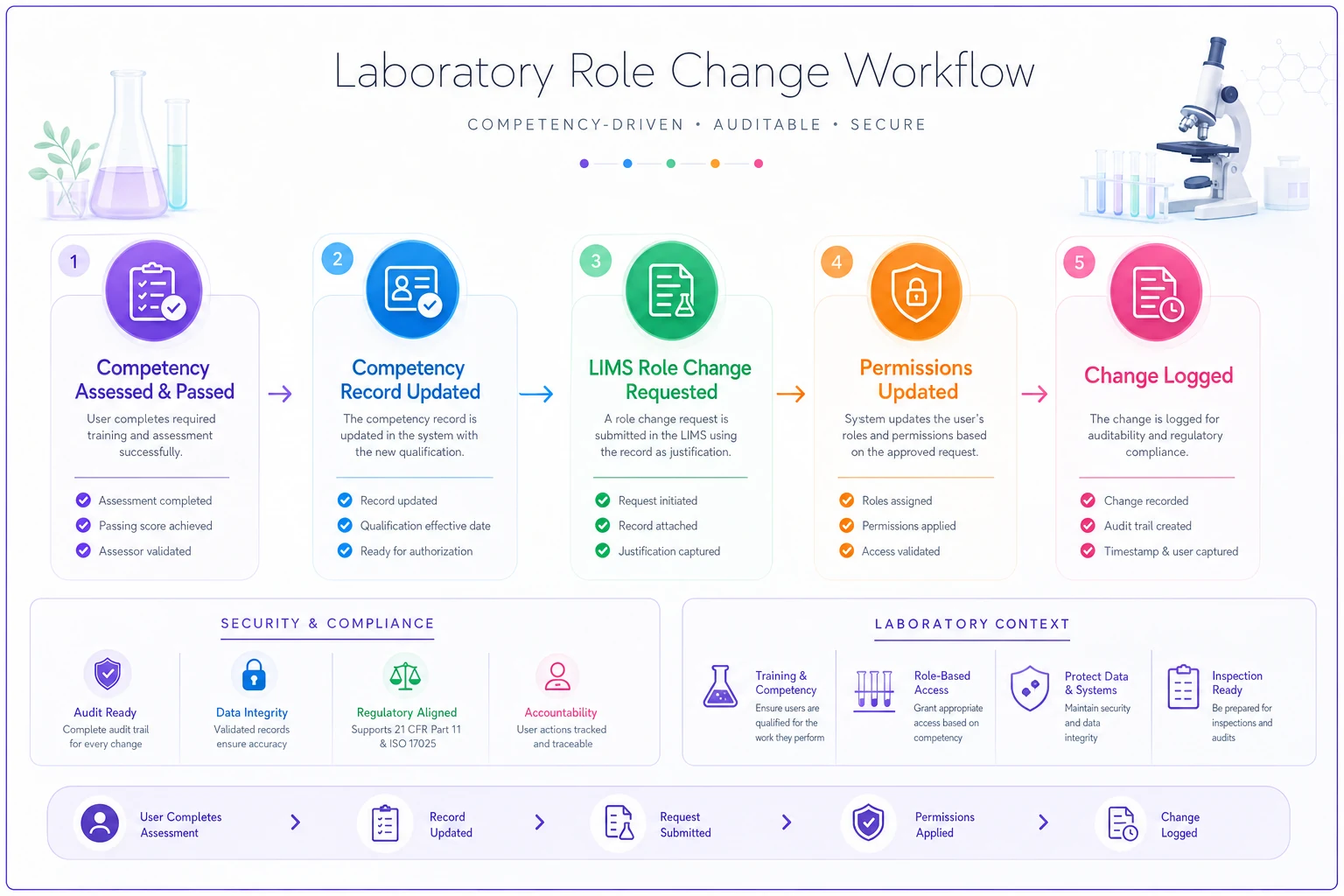
When the qualification and the access permission move together, you avoid both the bottleneck and the compliance exposure. Unglamorous work, but during a staffing crunch it's exactly the kind of coordination that either holds the lab together or quietly lets it leak errors.
Tie LIMS role-change requests directly to competency records so permissions move in the same workflow as training and assessment.
Unglamorous work, but during a staffing crunch it's exactly the kind of coordination that either holds the lab together or quietly lets it leak errors.
Don't forget the downstream: reagents, schedules, and capacity
Fewer people doesn't just mean slower science — it changes your consumption and timeline assumptions, and those feed other systems. If two projects slow down, your reagent demand for the next couple of quarters shifts. Keep ordering to the old forecast and you'll have lots expiring on the shelf. Cut orders too aggressively and then a delayed hire finally arrives, and you're short.
The practical move is to re-baseline your capacity plan against realistic staffing, not hoped-for staffing. Build the schedule around the people you're reasonably sure you'll have, treat delayed arrivals as upside rather than part of the plan, and revisit reagent forecasts once the revised project pace is set. A lab that keeps planning for the optimistic headcount number and then misses it repeatedly burns credibility with sponsors and money on wasted consumables.
A real scenario
A mid-sized university core lab — around 14 people, mix of grad students, two postdocs, and three techs — was expecting three incoming international students in the fall to backfill a postdoc rotating out and to expand a translational sample-processing project. By late summer, two of the three were stuck in visa processing with no clear timeline, and the postdoc's departure was fixed.
Their exposed workflows were the usual suspects: one qualified LC-MS operator, one person handling all sample intake metadata. Instead of trying to hire their way out on a timeline that wasn't going to work, they ran the triage. They paused the sample-processing expansion — the honest call — cross-trained a tech on intake metadata over about three weeks with documented sign-off, and started longer LC-MS backup training on the one new arrival who did make it plus one existing grad student.
The results weren't dramatic. Turnaround on core assays slipped by roughly a week during the transition, which they'd communicated to sponsors in advance. No compromised runs from an under-trained backup, no scramble when the postdoc actually left, and when a monitoring visit came around, the competency and access records held up cleanly. Around $4k–$5k in reagents that would have been ordered against the old forecast got deferred. Not a headline number — just the difference between a lab that absorbed the shock and one that would've limped through it.
Where this leaves you
The enrollment drop is outside your control. What's inside your control is whether your lab's ability to function depends on specific individuals showing up, or on documented capability that more than one person holds.
The labs that struggle over the next year won't necessarily be the ones with the biggest gaps — they'll be the ones who never mapped capability separately from headcount and got caught with too many single points of failure. Start with triage. Protect the red rows. Make cross-training produce real evidence, not just goodwill. Keep permissions moving with qualifications. Plan your capacity and reagents around the staffing you actually have, not the staffing you're hoping for. None of this requires the pipeline to recover — that's the whole point.
The labs that struggle over the next year won't necessarily be the ones with the biggest gaps — they'll be the ones who never mapped capability separately from headcount and got caught with too many single points of failure. Start with triage. Protect the red rows. Make cross-training produce real evidence, not just goodwill. Keep permissions moving with qualifications. Plan your capacity and reagents around the staffing you actually have, not the staffing you're hoping for. None of this requires the pipeline to recover — that's the whole point.
Ready to upgrade your lab operations?
Join 500+ labs using Labioly to save time, reduce errors, and enhance productivity and compliance.