



Most labs track competency training the same way they track equipment maintenance logs — sporadically, inconsistently, and with a frantic scramble to pull together documentation a few weeks before an audit. Having watched dozens of research labs stumble through competency reviews, the problem rarely comes down to technicians lacking skills. The problem is that labs don't have a reliable way to prove those skills exist.
Nothing makes that gap more obvious than standing in front of an auditor who just asked to see proficiency records for every technician who touched samples in the past six months. Suddenly that Excel spreadsheet with completion dates doesn't look so comprehensive.
Why Traditional Training Records Fall Apart
Research labs face a genuinely difficult challenge with competency documentation. Unlike clinical labs with fairly standardized procedures, research environments are constantly shifting. New protocols pop up regularly. Equipment configurations change based on experiment needs. Team members rotate between projects with different technical requirements.
The typical approach — annual training certificates stored somewhere in HR — completely misses how the work actually gets done. A molecular biology tech might be proficient in PCR setup but struggle with qPCR data analysis. A mass spec operator could handle routine runs without issue but fall apart when method development requires troubleshooting. Generic "instrument qualified" checkboxes tell you nothing meaningful about actual capabilities.
What makes this worse is the disconnect between training records and day-to-day performance. Labs document initial training thoroughly, then basically assume competency persists forever. Meanwhile, technicians develop bad habits, start skipping steps when they're rushed, or forget procedures they haven't performed in months. By the time problems show up in data quality reviews or audit findings, the gaps have already affected a significant chunk of work.
The administrative side compounds everything. Lab managers are already juggling experiment planning, equipment upkeep, and reagent management. Layering in detailed competency tracking feels impossible without dedicated resources. So documentation defaults to reactive — created when an auditor asks or after something has already gone wrong.
Building Role-Based Competency Matrices That Actually Work
A functioning lab competency training program starts with role clarity. Not the job titles that come out of HR, but the actual operational roles people fill day to day. The person running Western blots has different proficiency requirements than someone doing cell culture, even if both carry the same "Research Associate II" title.
Eliminate lab bottlenecks and errors.
Labioly helps you monitor, manage, and report lab activities efficiently and compliantly.
- Real-time sample tracking
- Inventory and supply alerts
- Staff workflow coordination
No credit card required
Map competencies to specific technical tasks, not broad categories. Instead of "pipetting skills," break it down: single-channel accuracy at different volumes, multichannel consistency, serial dilution precision. Each measurable skill gets tracked separately because proficiency genuinely varies across techniques.
| Technical Area | Core Task | Proficiency Indicator | Assessment Method | Frequency |
|---|---|---|---|---|
| Sample Prep | RNA extraction from cells | Yield >30ng/μL, 260/280 ratio 1.8-2.0 | Review last 10 extractions | Quarterly |
| qPCR Setup | Plate preparation | CV <15% across triplicates | Blind replicate test | Every 6 months |
| Data Analysis | Threshold cycle interpretation | Correctly identifies 95% of outliers | Sample dataset review | After 20 runs |
| Equipment Operation | Centrifuge balancing | No imbalance errors in 3 months | Equipment log review | Ongoing |
| Documentation | ELN entry completeness | <5% missing fields | Random audit of 5 entries | Monthly |
Notice how each competency ties to measurable outputs, not just task completion. That shift — from "attended training" to "demonstrates proficiency" — is what makes this useful.
Tie matrix proficiency indicators to data sources (QC logs, LIMS entries) upfront so evidence pulls are automatable.
The matrix should evolve alongside actual lab operations. When new techniques get introduced, add competency requirements right away. When equipment gets upgraded, update proficiency indicators to match. This keeps documentation grounded in current reality instead of frozen at some baseline from two years ago.
For specialized techniques, tiered proficiency levels work well. Level 1 might mean supervised operation. Level 2 allows independent work. Level 3 includes troubleshooting authority. Level 4 can train others. This kind of granularity helps match task assignments to actual capability while giving staff a clear path forward.
Minimal Evidence Bundles That Pass Audits
Auditors don't want to see hundreds of training certificates. They want proof that competency translates to consistent performance. The challenge is packaging evidence efficiently without turning documentation into a second job.
Each competency needs three types of evidence: initial qualification, ongoing performance, and remediation when issues come up. Bundle these together by person and technique — not scattered across five different systems.
Initial qualification evidence should include:
-
Trainer sign-off with specific tasks observed
-
Practice run data showing acceptable results
-
Written assessment scores for critical knowledge
-
Date ranges for the supervised operation period
But initial training is just the starting point. Ongoing performance evidence matters more for demonstrating sustained competency. Pull this from routine operations:
-
QC data showing technician-specific performance
-
Proficiency testing results by individual
-
Error rates from data review findings
-
Equipment logs showing proper operation patterns
The key is reducing manual compilation wherever possible. Instead of pulling everything together by hand, build queries that extract technician-specific metrics from existing data. If your LIMS tracks who performed each step, aggregate success rates automatically. When tracking operational KPIs, include technician-level breakdowns that double as competency evidence.
For audit packages, standard templates that pull recent evidence work well:
-
Last 30 days of QC results for relevant techniques
-
Most recent proficiency test scores
-
Any corrective actions or retraining in the past year
-
Supervisor observations from quarterly reviews
Keep evidence proportional to risk. High-complexity techniques need more frequent review. Routine procedures can probably get by with quarterly checks. This prevents documentation overload while keeping you genuinely audit-ready.
KPIs for Proficiency Tracking
Generic training completion rates tell you nothing about actual lab capability. Real proficiency KPIs connect individual performance to operational outcomes.
Start with technique-specific accuracy metrics. For PCR setup, track contamination rates by technician. For cell culture, monitor passage consistency and contamination frequency. These direct measures reveal proficiency gaps that training records miss entirely.
Individual Performance Metrics:
-
First-pass success rate by technique
-
Rework frequency for assigned tasks
-
Time to complete standard procedures
-
Error types and patterns
-
Deviation from expected results
Team Capability Metrics:
-
Percentage of staff qualified for each technique
-
Average proficiency level across critical skills
-
Cross-training coverage for key procedures
-
Time since last proficiency assessment
-
Skills gap analysis against current project needs
Operational Impact Metrics:
-
Correlation between proficiency scores and data quality
-
Repeat rate changes after retraining
-
Project delays attributed to skill gaps
-
External proficiency test performance
-
Audit findings related to competency
The goal isn't perfect scores across the board — it's visibility into actual capability. When a new project requires specific techniques, you can immediately assess whether the team has enough qualified staff. When quality issues surface, you can check whether competency gaps played a role.
Connecting proficiency tracking to workload distribution matters too. If only two technicians are Level 3 qualified for flow cytometry, that's a real bottleneck risk. Competency data should inform training investments and hiring decisions, not just sit in a compliance folder.
Short Remediation Workflows
When competency gaps surface, the default response tends to be "schedule more training." But sitting through the same presentation again rarely fixes actual performance issues. Effective remediation targets specific deficiencies with focused interventions.
Design remediation workflows based on gap type, not a one-size-fits-all retraining model. Someone struggling with calculation errors needs a different approach than someone with poor sterile technique. Match remediation intensity to risk — minor documentation gaps might need a quick review session, while critical technique failures require supervised practice.
Start with root cause analysis. Did the technician never properly learn the technique? Did they develop bad habits over time? Are they following an outdated procedure? Understanding why performance degraded shapes what remediation actually makes sense.
-
Review specific procedure sections, not entire SOPs
-
Complete targeted assessment questions
-
Demonstrate understanding to supervisor
-
Document completion with specific topics covered
For skill degradation:
-
Observe an experienced technician performing the technique
-
Practice with supervision on non-critical samples
-
Complete a proficiency test with predetermined acceptance criteria
-
Gradually increase independence with milestone checks
For systematic issues:
-
Update procedures if they're unclear or outdated
-
Improve workspace setup if ergonomics are affecting performance
-
Adjust workload if rushing is causing errors
-
Consider whether different equipment would help
Keep remediation cycles short — two weeks is usually the right ceiling for most issues. Longer timelines lose urgency. If someone can't achieve proficiency after a focused remediation effort, that becomes a different conversation about role fit.
Document remediation simply but completely:
-
Specific deficiency identified
-
Root cause determination
-
Remediation method selected
-
Completion evidence (test scores, observation notes)
-
Performance monitoring plan going forward
This creates an audit trail showing active competency management, not just reactive damage control.
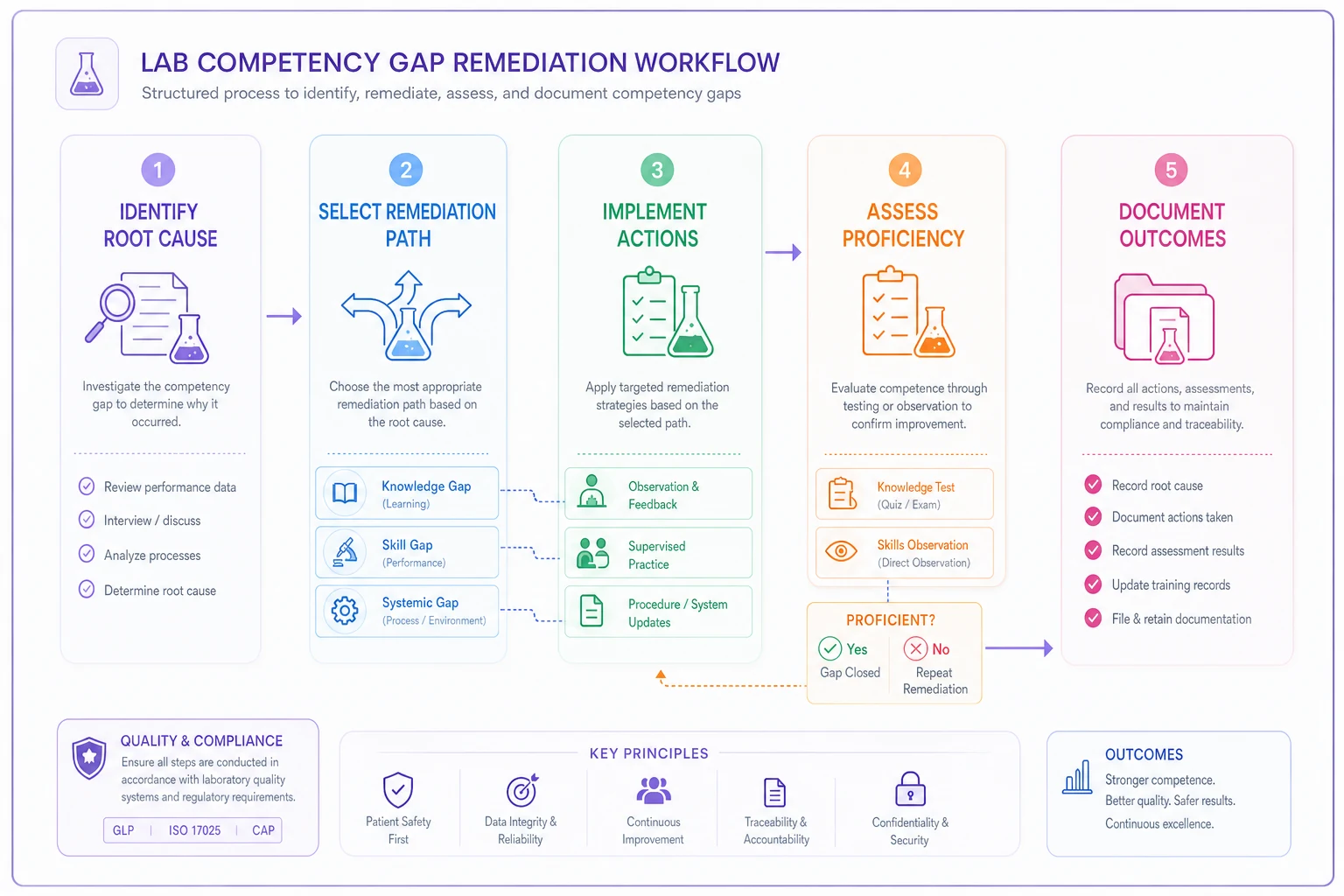
Below is a visual workflow for focused remediation.
Templates and Sample Schedules
The gap between knowing what to do and actually implementing it usually comes down to missing templates. Below are structures that work across different lab environments.
Competency Assessment Schedule Template:
-
Month 1-3 (New Hire)
- Week 1-2: Safety and documentation training - Week 3-4: Basic technique observation - Week 5-8: Supervised practice on routine procedures - Week 9-12: Progressive independence with checkpoints
-
Month 4-6 (Skill Building)
- Monthly proficiency tests on assigned techniques - Bi-weekly supervisor observations - Weekly data quality reviews - Documented progression through competency levels
-
Month 7-12 (Establishing Proficiency)
- Quarterly proficiency assessments - Monthly performance metric reviews - Semi-annual cross-training on adjacent techniques - Annual comprehensive competency evaluation
-
Ongoing (Maintaining Proficiency)
- Annual full assessment for all qualified techniques - Quarterly spot checks on high-risk procedures - Monthly KPI monitoring for performance trends - Triggered reassessment after extended absence (>30 days)
Evidence Collection Checklist:
-
- [ ] Initial training documentation with dates
-
- [ ] Supervised operation period records
-
- [ ] Proficiency test results (initial and ongoing)
-
- [ ] Recent performance data (last 90 days)
-
- [ ] Error log entries if applicable
-
- [ ] Corrective action records
-
- [ ] Retraining documentation if performed
-
- [ ] Supervisor observation notes
-
- [ ] Self-assessment forms
-
- [ ] Competency matrix current status
Remediation Decision Tree:
-
Performance Issue Identified → - Data quality problem? → Review last 10 results → >20% out of spec? → Full technique retraining
-
Procedural deviation? → Intentional or accidental? → Accidental
Focused refresher / Intentional: Root cause analysis
-
Extended absence? → >60 days? → Supervised re-qualification required
-
New equipment/method? → All staff require update training → Schedule based on project needs
-
Audit finding? → Critical or minor? → Critical
Immediate remediation / Minor: Next scheduled review
These templates are starting points, not rigid frameworks. Customize them for your specific lab environment. The part that actually matters is consistency — everyone follows the same assessment schedule and documentation requirements, regardless of seniority or how long they've been running a given technique.
Managing Competency Data at Scale
Small labs can probably get by tracking competency in spreadsheets. Once you hit 15 or more people across multiple techniques, that starts breaking down. The data lives in too many places — training records in HR systems, proficiency tests in quality folders, performance metrics in LIMS, error logs in deviation databases.
The challenge isn't just volume but how everything connects. When investigating a data anomaly, you need to quickly verify whether the technician was properly qualified, when they last demonstrated proficiency, and whether similar issues have come up before. That requires linking competency data to operational records in a way that manual systems can't really support.
Most labs end up with fragmented workarounds. Training tracked in one spreadsheet, proficiency tests in another, performance metrics calculated monthly in a third. Updates happen inconsistently. Audit prep means hours of manual compilation every single time.
AI-powered operational software can genuinely change this dynamic. Instead of maintaining disconnected records, an integrated platform pulls performance data automatically from connected systems. When someone completes a procedure in chain-of-custody tracking, their competency profile updates with recent performance metrics without anyone having to manually enter anything.
The automation handles the tedious work — calculating proficiency scores, flagging overdue assessments, generating audit packages. That frees lab managers to focus on actual capability development rather than documentation upkeep. When the system notices performance degrading, it can trigger remediation workflows automatically. When new techniques get added, it prompts for competency requirements and schedules initial assessments.
More importantly, competency data becomes predictive rather than just historical. Patterns across technicians and techniques can surface training needs before they become quality problems. If multiple people are struggling with the same procedure step, that signals a systematic issue requiring process improvement, not just individual retraining.
The Audit-Ready Reality
The real test of any lab competency training program isn't the scheduled inspection you've had weeks to prepare for. It's the surprise client audit or the FDA visit where you have maybe ten minutes to produce evidence.
Strong competency programs make those moments manageable. When asked about technician qualifications, you pull pre-compiled evidence packages. When questioned about performance issues, you show remediation workflows already completed. When challenged on training effectiveness, you present KPI trends showing actual improvement over time.
Getting there requires real upfront investment in systematic documentation. Every assessment needs clear criteria. Every remediation needs documented resolution. Every proficiency claim needs supporting evidence. This feels like overhead in the beginning, but it pays off when audits become conversations about continuous improvement rather than exercises in justifying why your records look the way they do.
The less obvious benefit is operational confidence. When you know exactly who can perform which techniques at what proficiency level, work assignment becomes strategic. Training investments go toward actual gaps rather than generic courses. Quality issues get traced to root causes faster. The lab runs more efficiently because capability is visible and actively managed.
Start with one critical technique and build the full framework around it — matrix, KPIs, evidence requirements, remediation workflow. Once that's working well, expand to additional techniques. Within six months, you'll have competency management that holds up under audit scrutiny while actually improving how the lab operates day to day. The difference between labs that pass competency audits and those that struggle usually isn't the skill level of their technicians. It's how robustly they document capability and how consistently they run assessments. Build those foundations properly, and competency management stops being a compliance burden and starts being something the lab actually benefits from.
Start with one critical technique and build the full framework around it — matrix, KPIs, evidence requirements, remediation workflow. Once that's working well, expand to additional techniques. Within six months, you'll have competency management that holds up under audit scrutiny while actually improving how the lab operates day to day. The difference between labs that pass competency audits and those that struggle usually isn't the skill level of their technicians. It's how robustly they document capability and how consistently they run assessments. Build those foundations properly, and competency management stops being a compliance burden and starts being something the lab actually benefits from.
Ready to upgrade your lab operations?
Join 500+ labs using Labioly to save time, reduce errors, and enhance productivity and compliance.