


Most labs don't have a change-approval problem in the sense of not knowing what to do. They have a routing problem. A reagent swap and a full LIMS field-schema change end up going through the exact same informal process — a message to the lab manager, maybe a hallway conversation, maybe a signature on a form that lives in a binder nobody opens. The trivial changes clog the same channel as the risky ones, and eventually everything moves at the speed of the busiest person's inbox.
The fix isn't more paperwork. It's a tiered matrix that settles three things the moment a request comes in: what tier the change belongs to, who has to sign off, and what evidence must be attached before anyone signs. Get that right and you cut the review burden dramatically, because most changes never should have reached senior reviewers in the first place.
This is a companion to broader change-control thinking. If you haven't mapped your change triggers yet, start with SOP Change Control for Labs: Map Change Triggers to Required Evidence and Approval Bundles — this article assumes you already know what triggers a change and focuses on how to route it.
Why one approval lane breaks everything
Here's the pattern that shows up in labs that grew faster than their processes. Early on, there are maybe six people. The PI or lab manager approves everything, and that's fine — the volume is low and everyone shares context. Then the lab doubles. Now there are three instruments, two studies, an ELN, a LIMS, and four techs who each want to tweak something weekly.
The single approval lane doesn't scale, and it fails in a specific way: the important changes get the same 30 seconds of attention as the trivial ones, because the approver is drowning. A firmware update that could invalidate six weeks of runs gets rubber-stamped in the same batch as "we're switching pipette tip brands." The reviewer isn't careless — they're overloaded, and an overloaded reviewer defaults to fast approval.
In real operations, this usually surfaces during an audit or an investigation. Someone asks "who approved the change to the extraction protocol on March 12, and what did they review?" and the answer is a Slack thumbs-up with no attached evidence. That's not a documentation gap. That's a routing failure — the change went to a person, not through a lane designed for its risk level.
Labs that handle change smoothly aren't the ones with the strictest rules. They're the ones who match approval weight to change risk, so light changes move fast and heavy changes get real scrutiny.
The core idea: tier the change before anything else
Every change gets classified into a tier the moment it's logged. The tier determines everything downstream — approvers, evidence, timeline. This is the piece most labs skip, and it's the piece that makes the whole system work.
Eliminate lab bottlenecks and errors.
Labioly helps you monitor, manage, and report lab activities efficiently and compliantly.
- Real-time sample tracking
- Inventory and supply alerts
- Staff workflow coordination
No credit card required
A compact three-tier model covers the vast majority of lab changes:
| Tier | Change type & risk | Approvers required | Evidence required | Target turnaround |
|---|---|---|---|---|
| Tier 1 — Minor | Low-risk, reversible, no data-integrity impact. Consumable brand swaps, label wording, non-critical spare substitution | Single approver (team lead) | Description + reason + rollback note | 1 business day |
| Tier 2 — Standard | Moderate risk. SOP wording changes, non-validated instrument settings, workflow reroutes, minor IT config | Team lead + QA/QC reviewer | Before/after, risk note, verification plan, test result | 3–5 business days |
| Tier 3 — Major | High risk. Method changes, instrument firmware, LIMS/ELN schema, chain-of-custody logic, anything touching validated systems | Team lead + QA + system/data owner + PI/quality manager | Full validation package, impact assessment, revalidation evidence, sign-off log | 2–4 weeks |
The important insight here isn't the number of tiers — it's the classification rule. The person submitting the change should not pick their own tier freely. That's how everything drifts into Tier 1, because everyone thinks their change is small. Instead, tie tiering to objective triggers: does it touch a validated system? Does it change data structure? Is it reversible without effort? Answer those and the tier assigns itself.
A quick note on the gray zone
There's always a change that sits between two tiers. The rule of thumb worth following: when in doubt, route up one tier for the first instance, then re-classify future occurrences based on what the review actually revealed. If a Tier 2 review of a pipette-tip swap surfaces zero risk three times running, downgrade it to a standing Tier 1. You learn where the real risk lives by watching the reviews, not by guessing upfront.
Who approves what — and why over-assigning approvers backfires
The instinct when something goes wrong is to add approvers. A run got invalidated? Now three people sign every method change. Six months later those three people are the new bottleneck and half of them sign without reading, because someone else is on the chain and they assume that person checked.
This is the diffusion-of-responsibility trap, and it's one of the most common ways change control quietly rots. More approvers doesn't mean more scrutiny. Past two or three genuine reviewers, each additional signature reduces individual accountability.
-
Team lead — confirms the change is real, needed, and operationally sound. Owns Tier 1 outright.
-
QA/QC reviewer — confirms the evidence exists and meets the standard for the tier. Does not re-do the science; verifies the paper trail.
-
System / data owner — for anything touching LIMS, ELN, instruments, or data structure. Confirms downstream impact is understood. This role connects directly to your broader operational data governance framework, because schema and access changes ripple across everything.
-
PI / quality manager — final sign for Tier 3 only. Owns the risk decision, not the technical detail.
Each approver verifies a different thing. When two approvers are verifying the same thing, one of them is redundant — cut them.
The evidence side: capture it the same way every time
Approvers are only as good as what they're handed. The second half of a working matrix is standardized evidence capture, so that "sufficient evidence" isn't a judgment call made fresh every time.
A typical failure looks like this: a Tier 2 SOP change gets submitted with a description but no before/after diff. The QA reviewer has to go hunt down the previous version, compare manually, and email back asking for a verification result that was never attached. Three round-trips later, a two-day change has taken two weeks. The change was fine — the evidence packaging was the bottleneck.
Require verification results to be attached before routing; don't accept "will run later" as closure.
The fix is an evidence template tied to each tier. The submitter can't complete the request without attaching the required items. Here's a baseline checklist for a Tier 2 change:
-
[ ] Change description (what, specifically, is changing)
-
[ ] Reason / trigger (why now)
-
[ ] Before/after comparison (document diff, config screenshot, or parameter table)
-
[ ] Risk note (what could this break downstream)
-
[ ] Verification plan (how you'll confirm it worked)
-
[ ] Verification result (the actual test output, attached — not "will run later")
-
[ ] Rollback plan (how to undo it if verification fails)
For Tier 3 you add impact assessment, revalidation data, and a full approver sign-off log with timestamps. For Tier 1 you strip it down to description, reason, and rollback note — three fields, because anything heavier and people route around the system entirely.
That last point matters more than it sounds. If your Tier 1 process is too heavy, people stop logging Tier 1 changes at all. They just do them. Then you've lost visibility on the exact category of change that's most frequent. Light tiers must be genuinely light or the whole matrix leaks.
A five-step routing workflow
Here's how a request actually moves through the system, start to finish:
-
Submit — requester logs the change with a short description and reason. No tier selection required; the classification rules assign it.
-
Classify — objective triggers assign the tier (validated system touched? data structure changed? reversible?). Ambiguous cases route up one tier by default.
-
Attach evidence — the tier's evidence template loads. The request can't advance until required fields are complete.
-
Route to approvers — parallel where possible (QA and system owner review at the same time, not sequentially), which cuts Tier 3 turnaround significantly.
-
Sign, timestamp, archive — each approval is logged with who, when, and what they reviewed. The completed bundle is stored against the change record and is audit-retrievable.
The single biggest turnaround win is step 4: route approvers in parallel, not in series. Most labs email approver A, wait, then email approver B. If each person takes two days to respond, a three-approver Tier 3 change eats six days in queue time before anyone's actually reviewing. Parallel routing collapses that to two.
Here's a quick visual of the routing process.
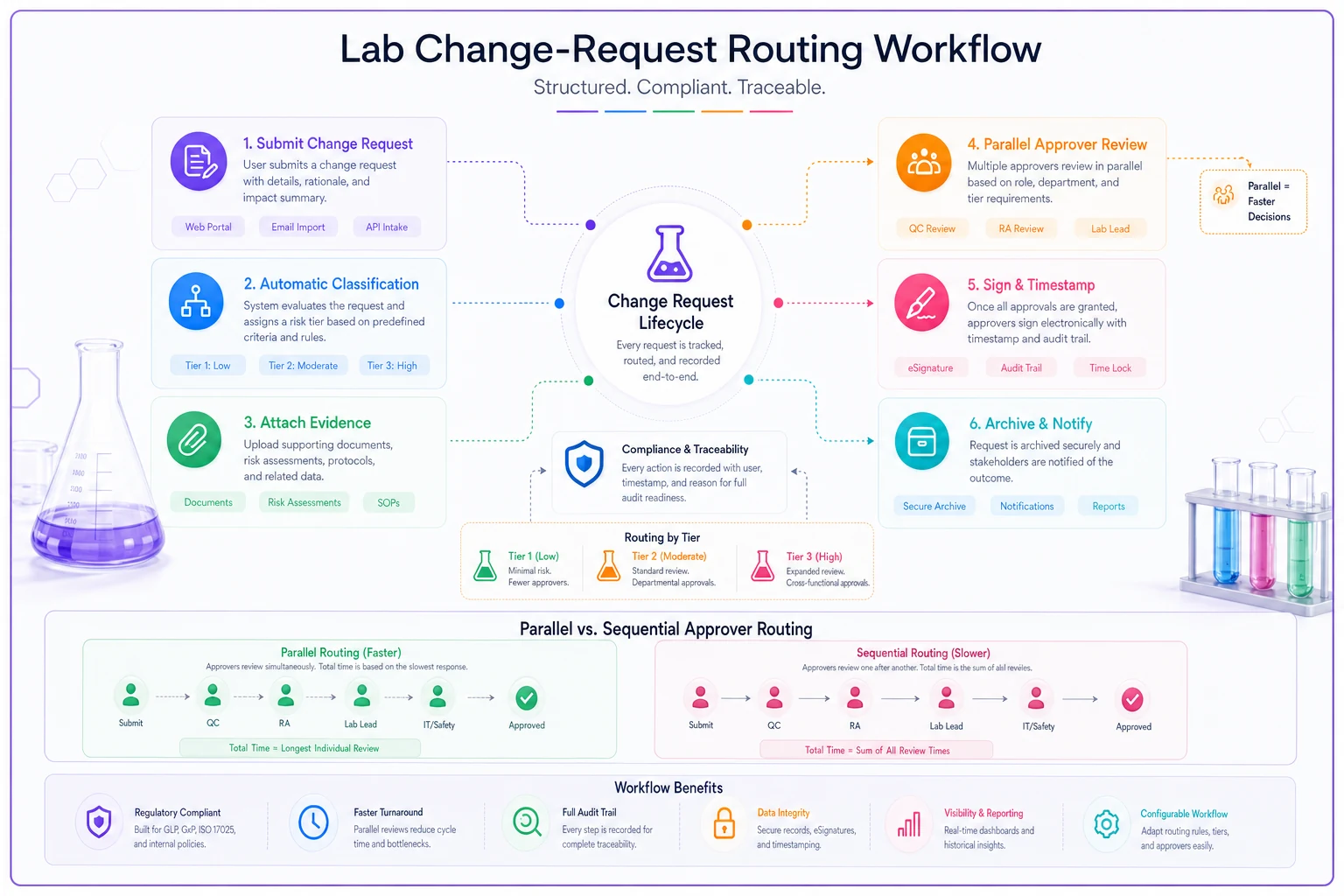
This visual emphasizes parallel approver routing versus sequential routing and the required evidence checkpoint before approver review.
A real scenario
A mid-sized translational research lab — roughly 22 people across three study teams, running an ELN, a LIMS, and about a dozen instruments — was drowning in change requests. Everything funneled to the lab manager and one QA lead. Changes averaged somewhere around 11–14 days from request to approval, and roughly a third of that was pure queue time: requests sitting because the approver hadn't gotten to them, or bouncing back because evidence was missing.
They rebuilt the process around a three-tier matrix. Tier 1 changes — which turned out to be nearly 60% of all requests — dropped to same-day or next-day, because a single team lead could clear them with a three-field form. Tier 2 evidence templates cut the back-and-forth almost entirely, since QA stopped chasing missing before/after comparisons. Tier 3 stayed deliberately slow, which was the point.
After a few months: Tier 1 and Tier 2 turnaround improved dramatically, the QA lead got roughly a day a week back, and — this was the real win — the Tier 3 changes finally got the scrutiny they'd always needed, because senior reviewers weren't buried under trivial approvals anymore. Audit prep also got noticeably faster, since every change had its evidence bundle attached instead of scattered across email.
The numbers weren't magic. They just stopped treating a tip-brand swap and a firmware update as the same kind of decision.
Where software fits — and where it doesn't
You can run this matrix on paper or a spreadsheet, and small labs should start there. Don't buy a tool to solve a process you haven't defined yet. Design the tiers, the approver roles, and the evidence templates first. If those aren't clear, no platform will save you.
Where a workflow platform earns its place is at scale — once you're routing enough changes that manual assignment, parallel approver notification, and evidence enforcement become their own overhead. AI-assisted operational software helps here in unglamorous but real ways: auto-classifying incoming requests based on what they touch, flagging missing evidence before a request ever reaches an approver, and surfacing aging Tier 3 items before they stall. The point isn't automation for its own sake — it's removing the queue time and the evidence-chasing that eat most of your turnaround.
But the software only reflects the system you built. A good routing tool with a bad tier design just moves the mess faster.
When this makes sense — and when it doesn't
When a tiered matrix is worth it:
-
You've got more than one approver and more than one system (LIMS, ELN, instruments) in play.
-
Changes are stalling in queue or getting bounced for missing evidence.
-
Audits keep surfacing "who approved this and what did they review" gaps.
When it's overkill:
-
A four-person lab where everyone shares full context and change volume is low. A single reviewer with a simple log is fine. Adding three tiers here creates friction with no benefit.
Who should not do this yet:
-
Labs that haven't first mapped their change triggers and required evidence. Tiering is the routing layer on top of that foundation. Without it, you're assigning tiers to changes you haven't defined — and that just produces an official-looking version of the same confusion.
Tiering is the routing layer on top of that foundation. Without it, you're assigning tiers to changes you haven't defined — and that just produces an official-looking version of the same confusion.
Closing thought
The labs that handle change well aren't the ones with the most controls. They're the ones who decided, ahead of time, that not every change deserves the same amount of attention — and then built the routing to enforce that. A tiered matrix does one thing well: it puts fast changes on a fast lane and risky changes in front of the right eyes, with the evidence already attached. Everything else — the audit-readiness, the reclaimed reviewer time, the fewer stalled requests — follows from that one decision.
Ready to upgrade your lab operations?
Join 500+ labs using Labioly to save time, reduce errors, and enhance productivity and compliance.