

Research labs live and die by their SOPs. Change one step in a DNA extraction protocol, swap out a reagent supplier, or update temperature parameters on your thermocycler—and suddenly you're buried in questions about what documentation you need, who needs to approve it, and whether you need to revalidate the entire method.
Having built operational software for over 100 research facilities, from university core labs to clinical research organizations, the pattern is always the same: labs either overcomplicate their SOP change control (requiring full validation for minor formatting updates) or they wing it and get burned during their next audit when they can't explain why a critical parameter changed without proper review.
The real problem isn't tracking changes—it's knowing exactly what evidence you need for different types of modifications. A typo fix shouldn't trigger the same approval cascade as changing your PCR primers. But most labs treat every change the same way because they never mapped out their change categories properly.
Why Labs Struggle with Change Control Evidence Requirements
Most research labs inherit their change control processes from pharma or clinical labs, where every tiny modification gets the full regulatory treatment. But research environments move faster and change more frequently. You're optimizing protocols, testing new approaches, adapting to supply chain disruptions.
The typical lab ends up with one of two broken systems:
The first type creates a single massive change control form that treats updating page numbers the same as changing critical assay parameters. Every change requires director approval, three-week review periods, and a validation study. Scientists start avoiding documentation altogether because fixing a typo shouldn't take a month.
The second type runs changes through informal email chains and verbal approvals. "Hey, we're switching to the new buffer formulation starting Monday." Then six months later during a grant audit or collaboration review, nobody can explain when the change happened, why it was made, or who approved it.
Neither approach scales. When you're managing 30+ active protocols across multiple research projects, you need a system that actually differentiates between administrative updates and critical technical changes.
Building a Tiered Change Classification System
The key to functional SOP change control in research labs is creating clear tiers with proportional evidence requirements. Not every change is created equal, and your documentation burden should reflect actual risk and impact.
Eliminate lab bottlenecks and errors.
Labioly helps you monitor, manage, and report lab activities efficiently and compliantly.
- Real-time sample tracking
- Inventory and supply alerts
- Staff workflow coordination
No credit card required
Here's the framework that works in practice:
Tier 1: Administrative Changes Formatting fixes, typo corrections, clarifying language that doesn't alter the actual procedure. No technical content changes, no impact on results. Evidence requirement: single reviewer sign-off, tracked in change log. That's it. No validation, no extended review period, no committee meetings.
Tier 2: Minor Technical Adjustments Reagent vendor changes (same specs), equipment model updates (equivalent functionality), minor timing adjustments within established ranges. These need technical review to confirm equivalency but don't require full revalidation. Evidence: equivalency documentation, technical reviewer approval, abbreviated verification if touching critical parameters.
Tier 3: Method Modifications Changing incubation temperatures, switching detection methods, adjusting sample prep steps—these alter how the protocol actually works. You need proper validation data showing the change maintains or improves performance. Evidence: comparative study data, validation summary, technical and quality approval, updated training records for affected staff.
Tier 4: Critical/Regulatory Changes New regulatory requirements, changes affecting GLP compliance, modifications to validated methods used for regulatory submissions. Full validation protocol, complete approval chain, extensive documentation. This is where you pull out all the stops.
Pre-define common examples for each tier so reviewers can make consistent decisions without debate.
A visual workflow helps teams actually follow the tiers and gather the right evidence before initiating changes.
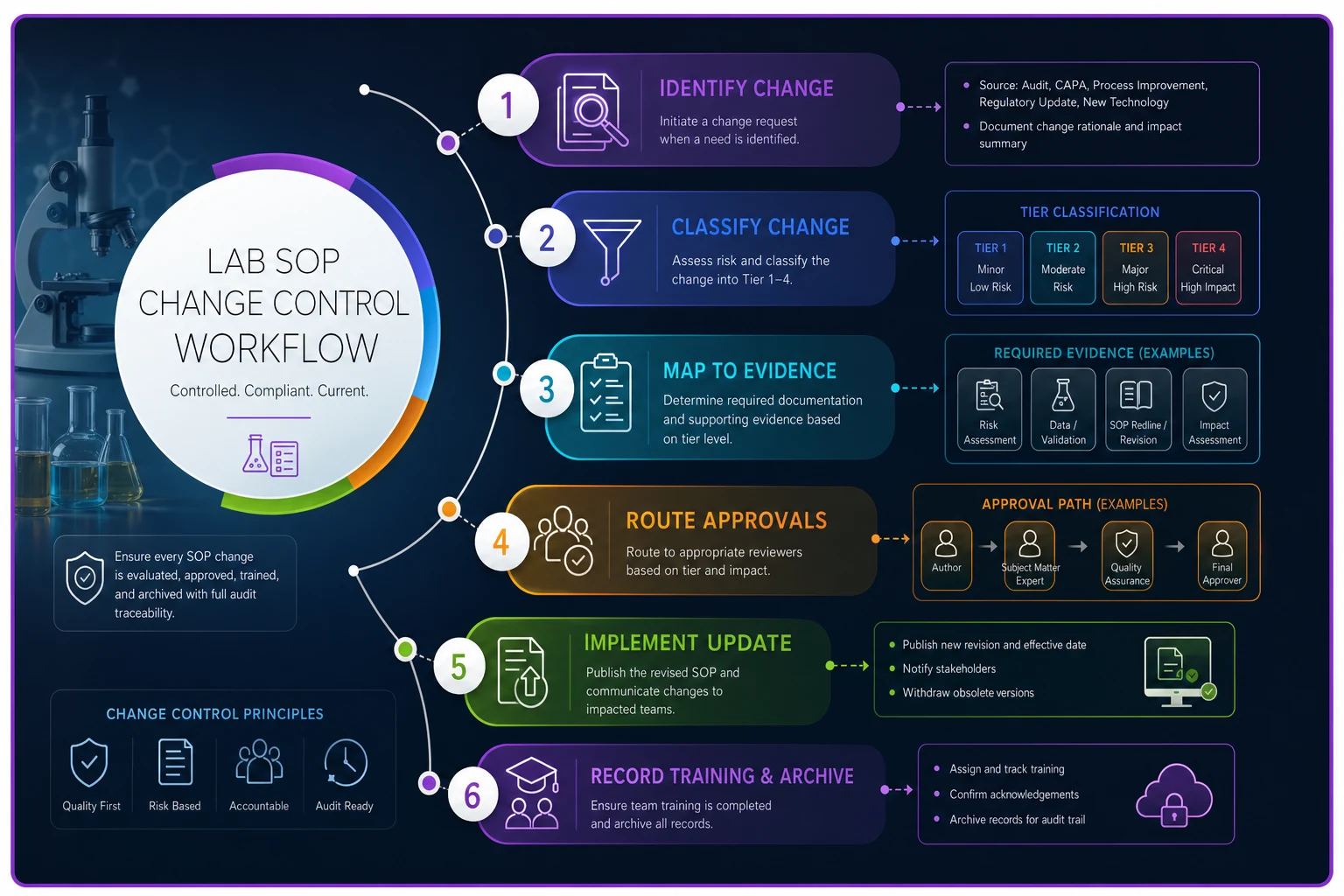
The real value comes from pre-defining what falls into each tier. No more debates about whether changing pipette brands needs validation. No more three-week delays for fixing grammatical errors.
Mapping Specific Change Triggers to Evidence Requirements
Here's how this mapping works with real lab scenarios:
Equipment Changes Replacing a broken centrifuge with the same model? Tier 1 if it's identical—just document the swap in your equipment log. Upgrading to a newer model with different speed ranges? Tier 2, you need confirmation your protocols still work within the new parameters. Switching from manual to automated liquid handling? That's Tier 3, requiring full method comparison data.
Reagent and Supply Modifications Running out of your usual extraction kit and switching brands temporarily? Tier 2 if you can show equivalent specifications. But if the new kit has different binding chemistry or elution volumes, you're looking at Tier 3 with side-by-side performance data. Changed suppliers for basic chemicals like ethanol or PBS? Usually Tier 1 with a certificate of analysis on file.
Personnel and Training Updates Adding a new technician to an established protocol? Not a change to the SOP itself, but document their training completion. Changing who can approve results? That's Tier 2—update the responsibility matrix. Shifting from PhD-level to technician-level staff for a critical step? Tier 3, you might need to add more detailed instructions or quality checks.
Software and Calculation Changes Updating analysis software to a new version? Tier 2 if the calculations remain the same, Tier 3 if algorithms change. Moving from manual calculations to automated QC reporting? Tier 3 with parallel run data to verify consistency. Fixing a formula error? Could be Tier 3 or 4 depending on impact to previous results.
This granular mapping prevents both over-documentation and under-documentation. You know exactly what evidence to gather before making the change.
Creating Release and Archive Checklists That Actually Get Used
Most change control checklists are theoretical exercises that get ignored in practice. The ones that work are specific, actionable, and tied directly to your tier system.
For Tier 1 administrative changes:
-
Mark up the current version showing changes
-
Get single reviewer signature
-
Update version number and date
-
Archive previous version
-
Distribute updated version
-
Log in change control database
Simple, fast, done. No committees, no waiting periods.
For Tier 3 method modifications:
-
Complete change request form with scientific justification
-
Run verification/validation studies per protocol
-
Compile data package with statistical analysis
-
Technical review of data (usually lab manager or senior scientist)
-
Quality review if applicable
-
Update training requirements assessment
-
Schedule retraining if needed
-
Director or PI approval
-
Update version with tracked changes visible
-
Archive previous version with clear date range
-
Distribute new version with training confirmation
-
Update any affected work instructions or quick reference guides
-
Verify LIMS or database parameters updated
-
Confirm inventory management reflects any new materials
The checklist becomes your roadmap. No wondering if you missed something, no scrambling during audits to prove you followed process.
Example Approval Bundle Packages
Here's what complete approval packages actually look like for different change scenarios:
Scenario 1: Fixing a calculation error in a qPCR data analysis SOP This hit a Tier 3 classification because it affected reported results.
-
Change request form documenting the error discovery
-
Impact assessment showing which studies used the incorrect calculation
-
Corrected calculation with worked examples
-
Reanalysis of affected datasets with comparison table
-
Technical review memo from bioinformatics lead
-
Quality review confirmation that grants and publications were checked
-
PI approval with acknowledgment of notification requirements
-
Updated SOP with correction highlighted
-
Communication plan for affected collaborators
-
Training deck for staff meeting review
Total package: 23 pages, completed in 4 days.
Scenario 2: Switching from -80°C to -70°C storage for extracted DNA Tier 2 change based on new freezer specifications.
-
Change justification citing equipment capabilities
-
Literature review showing stability at -70°C
-
Three-month stability data from pilot samples
-
Technical reviewer sign-off
-
Updated SOP pages with temperature ranges
-
Email confirmation to all users
Total package: 8 pages, completed same day once stability data was available.
Scenario 3: Major revision to cell culture protocols for a new cell line Tier 3 pushing toward Tier 4 due to impact on multiple downstream assays.
-
Comprehensive change request with background
-
New cell line characterization data
-
Growth curve comparisons
-
Contamination testing results
-
Optimized protocol with step-by-step modifications
-
Validation report across three operators
-
Downstream assay performance comparison
-
Technical review from cell culture core
-
Quality review for GLP implications
-
PI and department chair approval
-
Training records for all culture room users
-
Updated inventory requirements
-
Revised QC criteria and acceptance ranges
Total package: 47 pages plus raw data files, 3-week timeline.
Notice how the evidence scales with impact? That's the whole point.
Common Failure Points in Change Documentation
Even with good intentions, labs consistently stumble in the same places:
The Retroactive Documentation Trap Someone makes a "quick fix" during an experiment, it works better, everyone starts using it, and three months later you're trying to backdate a change control form. This happens constantly with buffer preparations and dilution series. The solution isn't stricter enforcement—it's making Tier 1 and 2 changes so easy that people document in real-time.
Version Control Chaos Multiple versions floating around, some printed, some digital, nobody sure which is current. Especially common in academic labs where grad students update their own copies. You need a single source of truth, whether that's a shared drive with clear naming conventions or a proper document management system. The operational data governance framework extends beyond just data—your SOPs need the same discipline.
Training Record Gaps You updated the SOP, emailed everyone, but never confirmed they actually read and understood the changes. Six months later, someone's still running the old method because they missed the email. For Tier 2+ changes, you need active confirmation of training, not passive distribution.
Approval Bottlenecks The PI is traveling, the quality manager is on vacation, and your change sits in limbo for weeks. Build in delegation protocols and response timeframes. For Tier 1 changes, any trained reviewer should suffice. Don't let perfect approval chains block necessary updates.
Validation Requirements Based on Change Type
Validation is where labs either over-invest (validating formatting changes) or under-deliver (assuming equivalent performance without data). Your validation effort should match the change magnitude.
For minor technical adjustments, abbreviated validation often suffices:
-
Run your positive and negative controls
-
Check precision with replicate measurements
-
Verify you're still within established acceptance criteria
-
Document that nothing unexpected occurred
For method modifications, you need comparative validation:
-
Parallel testing with old and new methods
-
Statistical analysis of differences
-
Assessment across the full measurement range
-
Multiple operators if technique-sensitive
-
Stability and robustness testing if applicable
For critical changes affecting regulated work:
-
Full validation protocol with pre-defined acceptance criteria
-
Comprehensive test plan covering all parameters
-
Edge cases and stress testing
-
Complete statistical analysis with confidence intervals
-
Formal validation report with conclusions
-
Quality review and approval before implementation
| Change Type | Validation Requirements |
|---|---|
| Minor technical adjustments | Run your positive and negative controls; Check precision with replicate measurements; Verify you're still within established acceptance criteria; Document that nothing unexpected occurred |
| Method modifications | Parallel testing with old and new methods; Statistical analysis of differences; Assessment across the full measurement range; Multiple operators if technique-sensitive; Stability and robustness testing if applicable |
| Critical changes affecting regulated work | Full validation protocol with pre-defined acceptance criteria; Comprehensive test plan covering all parameters; Edge cases and stress testing; Complete statistical analysis with confidence intervals; Formal validation report with conclusions; Quality review and approval before implementation |
The depth of validation should feel appropriate, not arbitrary. A research lab studying basic mechanisms doesn't need pharmaceutical-level validation for every protocol tweak. But if you're generating data for FDA submissions or clinical trials, that's a completely different standard.
How AI-Powered Systems Reduce Documentation Burden
Manual change control systems create unnecessary friction. You're copying information between forms, chasing signatures, manually updating version numbers, trying to track what changed between versions using Word's compare feature.
Modern operational software handles the mechanical parts automatically. When someone initiates a change request, the system already knows the current version, who needs to approve based on the tier, and what evidence templates to pull up. As reviewers add comments or request modifications, everything stays connected to the original request.
The real efficiency comes from integration. Equipment changes flow from the asset management module. Reagent substitutions pull directly from inventory. Training requirements flag automatically based on SOP associations. Instead of maintaining separate spreadsheets for change logs, version histories, and training matrices, everything links together.
AI automation adds another layer by identifying patterns across your changes. If you're constantly updating the same SOPs for similar reasons, the system can surface that pattern and suggest converting variables into adjustable parameters—ones that don't need formal change requests every time. It can also scan new SOPs against existing ones to prevent duplicates and flag where templates could save time down the road.
But the biggest operational gain is in approval routing. No more emails asking "did you review this yet?" The system knows who needs to sign off in what order, sends reminders, escalates when needed, and keeps a complete audit trail. What used to take weeks of back-and-forth often gets done in days.
Audit-Ready Documentation Without the Overhead
The ultimate test of your change control system comes during audits. Whether it's an internal quality review, a collaborator's due diligence, or a regulatory inspection, you need to quickly show:
-
What changed
-
When it changed
-
Why it changed
-
Who approved it
-
What evidence supported it
-
How people were trained
Labs with solid change control systems pull this together in minutes. Labs with scattered documentation spend days reconstructing the story.
Your goal isn't perfect documentation—it's sufficient documentation that tells the complete story. For a Tier 1 typo fix, that story is short: "Corrected 'centrifuge at 10,00 rpm' to 'centrifuge at 10,000 rpm' on page 4, reviewed by Lab Manager, implemented 3/15/24." For a Tier 3 method change, the story includes data, decisions, and downstream impacts.
Research environments demand flexibility. Protocols evolve as you learn more about your system. Supply chains force adaptations. New technologies open better approaches. Your change control system should enable that evolution while maintaining the documentation trail that shows you're operating systematically, not reactively.
Building a Change Control System That Scales
Small research labs often think they don't need formal change control until they hit a crisis—failed audit, questioned results, or a collaboration that demands documentation they simply don't have. By then, you're playing catch-up while trying to keep ongoing research moving.
-
Define your tiers with clear criteria
-
Create basic templates for each tier
-
Set up a central log, even if it's just a spreadsheet at first
-
Train everyone on the difference between tier levels
-
Begin with your most critical or frequently-changed SOPs
-
Add sophistication as you grow
The system that works is the one people actually use. Complex approval matrices and 40-page validation protocols might look thorough, but if they slow research to a crawl, scientists will find workarounds. Your change control should be just rigorous enough to maintain quality and compliance without crushing productivity.
For most research labs, this means embracing the tiered approach—minor changes move quickly, critical changes get appropriate scrutiny. It means pre-defining evidence requirements so nobody wastes time over-documenting or under-documenting. It means using modern tools to handle the administrative burden so scientists can focus on science.
The labs that handle this well treat change control as an operational asset, not a compliance burden. Their documentation tells the story of systematic improvement, not bureaucratic box-checking. When changes are properly classified, evidence is proportional, and approvals flow efficiently, change control stops being a bottleneck and starts being something you can actually lean on.
Your protocols will change—that's the nature of research. The question is whether those changes will be documented, justified, and traceable, or whether you'll be scrambling to explain them six months later.
Your protocols will change—that's the nature of research. The question is whether those changes will be documented, justified, and traceable, or whether you'll be scrambling to explain them six months later.
Ready to upgrade your lab operations?
Join 500+ labs using Labioly to save time, reduce errors, and enhance productivity and compliance.