


Running a core facility feels like juggling chainsaws blindfolded. Faculty are demanding immediate access to the flow cytometer, graduate students are booking the confocal for 12-hour overnight sessions they never show up for, and your budget spreadsheet shows chargebacks covering maybe 60% of actual operational costs.
The standard response? Write a booking policy document nobody reads, send passive-aggressive emails about no-shows, and hope the department covers the deficit at year-end. There's a better way to structure this—one that actually reduces conflicts while improving cost recovery.
The Real Cost of Bad Booking Systems
Most core facilities inherit their booking approach from whoever ran things before them. Usually it's some combination of a shared Google Calendar, an Excel sheet on a network drive, and verbal agreements everyone remembers differently.
This breaks down predictably. A PI's postdoc blocks out the mass spec for an entire week "just in case" their samples are ready. Meanwhile, another lab's time-sensitive experiment gets delayed because there's no availability. The facility manager spends half their day mediating disputes and manually tracking who actually used what.
The financial hit compounds fast. No-shows on expensive equipment mean you're paying service contracts on instruments sitting idle. When you try to enforce penalties, you discover your booking records aren't detailed enough to hold up against a challenge from an angry faculty member. Actual utilization hovers around 45% while the calendar shows 90% booked.
Building Priority Trees That People Actually Follow
Generic first-come-first-served policies sound fair until you're explaining to a grant reviewer why their time-sensitive samples sat three days while someone ran optimization experiments. You need a decision tree that balances fairness with operational reality.
Eliminate lab bottlenecks and errors.
Labioly helps you monitor, manage, and report lab activities efficiently and compliantly.
- Real-time sample tracking
- Inventory and supply alerts
- Staff workflow coordination
No credit card required
Start with your user categories. Most cores have some version of: internal funded projects, internal pilot studies, external academic collaborations, and industry clients. But within those categories you need granular rules. A faculty member with an active R01 directly requiring your instrument gets different priority than someone using startup funds for exploratory work.
Map out the actual decision logic. When two users want the same Tuesday morning NMR slot, what determines who gets it? Grant deadlines? Sample stability? Booking history? Whether they acknowledged your facility in their last publication?
What tends to work: tiers based on funding status and project urgency. Tier 1 might be federally funded projects with documented deadlines. Tier 2 could be institutionally funded work. Tier 3 covers pilot studies and training. Within each tier, factor in booking history—users who repeatedly no-show drop a tier for 30 days.
Document override conditions too. A degrading biological sample might jump the queue regardless of funding status, but make those exceptions require written justification that goes into your operational records. This protects you when someone complains about queue-jumping.
Chargeback Formulas That Actually Recover Costs
The typical chargeback formula looks something like: divide annual costs by expected hours of use, add 10%, call it the hourly rate. This almost guarantees a deficit.
Real operational costs include more than service contracts and consumables. There's technician time spent training new users, maintaining instruments between runs, handling contamination events, and generating quarterly usage reports. There's depreciation, utilities that spike during overnight experiments, and the inevitable repair that isn't covered by your service contract.
Build your rate structure from actual cost components. Track staff time per instrument per user type. New users on complex instruments might require 3 hours of technician time for every hour of instrument use. Experienced users might need 15 minutes. Your rates should reflect that difference.
Consider separating setup fees from hourly rates. A flow cytometry run might have a $75 setup fee plus $150/hour runtime. That captures the real cost of preparing the instrument regardless of whether someone runs for 30 minutes or 3 hours.
For consumables, decide between bundling and itemizing. Mass spec facilities often charge separately for columns and solvents because costs vary drastically between applications. Microscopy facilities typically bundle slide prep materials into the hourly rate since variation is minimal.
| User Category | Cost Recovery Target | Rate Structure Notes |
|---|---|---|
| Internal funded projects | 70% (department subsidy covers gap) | Standard hourly + setup fee |
| External academic collaborations | 100% | Full cost recovery, no subsidy |
| Industry clients | 110–130% | Overhead included, margin subsidizes internal research |
| Internal pilot studies | 50–60% | Reduced rate, limited booking priority |
Add multipliers for different user categories. Internal rates might aim for 70% cost recovery with department subsidy covering the gap. External academic rates target 100% recovery. Industry rates include overhead and generate margin that subsidizes internal research.
Consider separating setup fees from hourly rates.
Add multipliers for different user categories. Internal rates might aim for 70% cost recovery with department subsidy covering the gap. External academic rates target 100% recovery. Industry rates include overhead and generate margin that subsidizes internal research.
SLA Templates That Prevent Disputes
Your service level agreement isn't just legal protection—it's an operational tool that sets expectations and reduces daily friction. Most facilities either have no formal SLA or use a generic template that doesn't address their specific pain points.
Structure it around common failure points. Start with booking modifications. Users need flexibility, but last-minute cancellations destroy utilization metrics. Set clear windows: free cancellation 48 hours out, 50% charge for 24–48 hour cancellations, full charge for under 24 hours notice. Also specify force majeure conditions—what happens when the building loses power or someone contaminates the cell culture facility?
Define data responsibilities explicitly. Who stores raw data and for how long? What format must it be in? Who's responsible if data gets corrupted during transfer? One facility learned this the hard way when a user demanded six months of imaging data that had been auto-deleted after 30 days per standard protocol.
Be careful with quality specifications. Don't promise "publication-quality" results—that's subjective and journal-dependent. Instead, specify technical parameters: resolution specs for microscopy, mass accuracy for proteomics, cell viability thresholds for sorting. Make it clear these assume properly prepared samples.
Address training requirements upfront. New users complete safety training, instrument-specific training, demonstrate competence. But also specify retraining triggers: six months of inactivity, three reported incidents, significant protocol violations. This prevents the "I was trained five years ago" argument when something breaks.
Performance Metrics That Drive Better Operations
Most core facilities track the wrong things. Total hours booked, number of users, revenue generated—these look good in reports but don't help you run better operations.
Track utilization reality, not booking fiction. Measure actual run time versus booked time by user and by instrument. When someone books 8 hours and uses 3, that's operational data you need. Users who consistently overbook need different booking privileges than those who accurately estimate their time.
Building effective capacity planning requires understanding true demand patterns. Monitor queue depth by instrument and user type. How many experiments get delayed waiting for access? What's the average wait time from request to execution? This data justifies equipment purchases or extended hours better than aggregate utilization rates.
Cost recovery needs granular tracking. Don't just measure total revenue versus total costs. Break it down by instrument, user category, project type. You might find that while overall recovery is 75%, your confocal runs at 40% while your flow cytometer hits 110%. That drives very different operational decisions than the aggregate number.
Create efficiency metrics that matter. Sample throughput per technician hour shows where training investments pay off. Instrument downtime by cause—scheduled maintenance, repairs, user damage, contamination—shows where to focus prevention efforts. First-time success rates for new users indicate whether your training is actually working.
Implementing Escalation Rules Without Creating Enemies
Every core facility needs escalation procedures, but most rely on informal complaint processes that generate more problems than they solve. You need structured escalation paths that protect facility operations while keeping research relationships intact.
Define trigger events explicitly. Three no-shows in 30 days triggers automatic booking restrictions. Instrument damage requires immediate PI notification. Safety violations escalate to department level. But also define non-events—minor delays, reasonable equipment wear, failed experiments due to sample issues don't trigger escalation.
-
First offense
automated reminder sent to user
-
Second offense
PI notification, documented in operational records
-
Third offense
30-day booking restriction, formal review required
-
Fourth offense
escalation to department leadership, access suspended pending appeal
Build in appeals—sometimes that no-show was because a cell line got contaminated, not negligence. Document everything in operational systems, not just email threads. When you need to justify why a lab has restricted access, you need timestamped records of policy violations, not vague recollections.
The appeals process matters more than most facilities acknowledge. Without a fair way to contest escalations, you end up with faculty who feel targeted and department chairs who get pulled into disputes that should've been resolved at the facility level. Keep it simple—a written appeal submitted within 10 days, reviewed by the facility director, decision documented and final.
Workflow Integration Across Research Groups
Core facilities sit at the intersection of multiple research workflows with different rhythms and requirements. The proteomics lab needs samples immediately after extraction. The genomics group batches monthly. Microscopy users want to image live cells that can't wait.
Build booking flexibility that acknowledges these differences. Proteomics might need "urgent" slots held open daily. Genomics benefits from scheduled batch-processing days. Microscopy needs both scheduled sessions and drop-in availability for live cell work.
Connect scheduling to upstream and downstream processes. If sample prep typically takes 3 days, don't allow instrument booking without confirming prep has started. If data analysis typically needs 2 weeks, build that into project timelines. This prevents the "sample isn't ready but I don't want to lose my slot" problem.
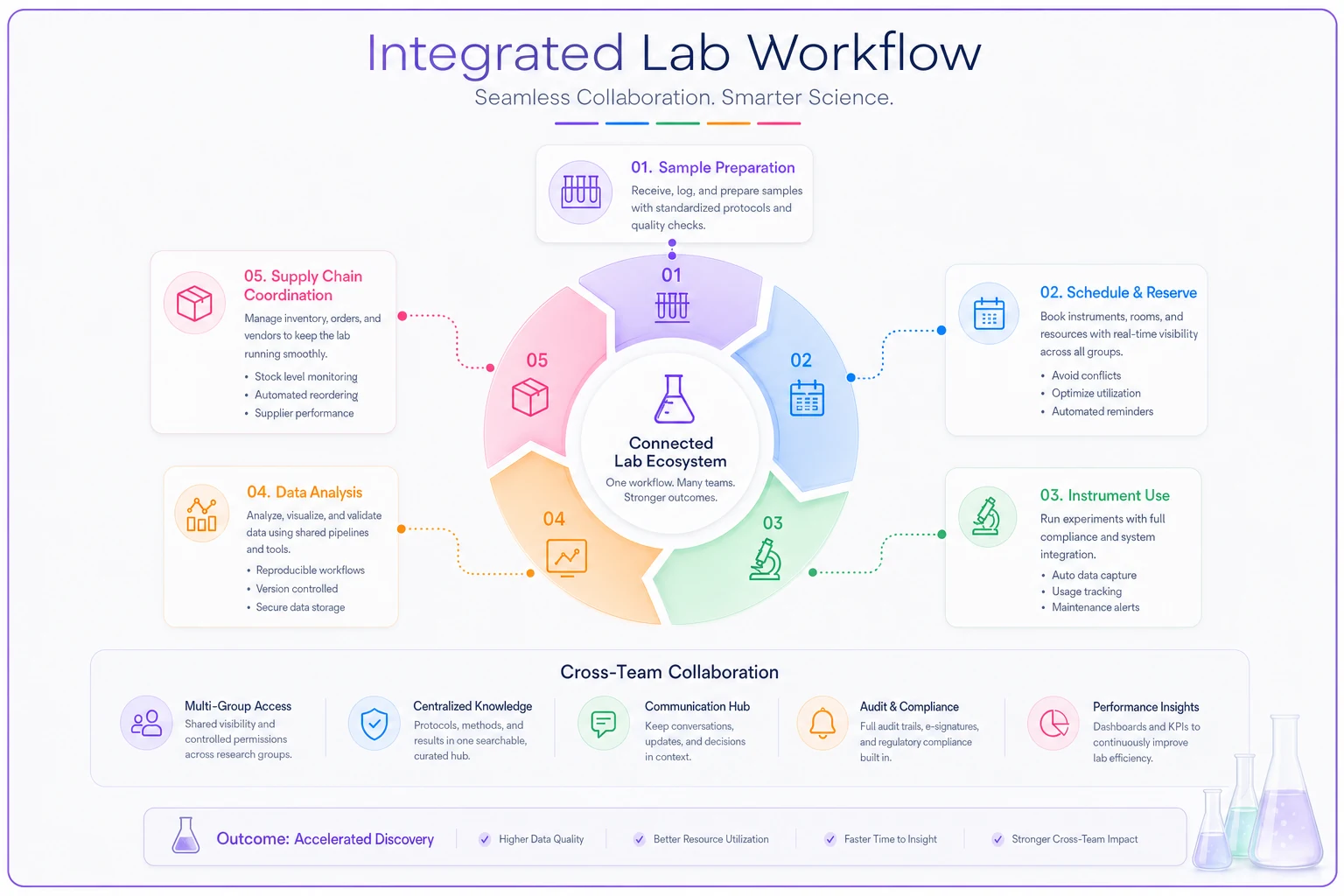
This simple diagram shows how upstream prep, scheduling rules, instrument time, and downstream analysis fit together so teams can see dependencies at a glance.
Coordinate with facility supply chains to prevent workflow breaks. When the flow cytometry facility runs out of specific antibodies, having clear communication channels prevents wasted booking slots. Standard material requirements lists for common procedures help users know exactly what to have ready before they show up.
Technology Systems That Actually Help
The temptation to solve operational problems with technology is real. But most core facilities end up with a mix of systems that creates more work than it saves. You need intentional technology deployment that reduces friction, not adds complexity.
Your booking system is the foundation. It needs to handle priorities, enforce policies, track actual usage versus bookings, and integrate with billing. Resist the urge to customize everything—the more complex your booking logic, the more ways it can fail and the harder it becomes to modify when needs change.
Billing integration saves significant time but requires careful setup. Automatic usage capture eliminates manual entry from paper logs, but you need clear rules for handling disputes, adjustments, and special cases. Build approval workflows for rate exceptions so they're documented rather than verbally agreed.
For reporting, operational dashboards beat static reports. Real-time utilization helps you spot problems immediately. Weekly efficiency trends let you adjust staffing. Monthly cost recovery by category drives pricing decisions. Automated alerts for unusual patterns—someone booking every Friday but never showing up—enable quick intervention before it becomes a bigger issue.
AI-powered operational software can reduce administrative burden without replacing human judgment. Automated booking reminders cut down on no-shows. Pattern recognition can flag likely problems before they occur—if someone consistently needs 3 hours more than they book, the system can suggest longer reservations. Smart scheduling can improve equipment utilization by grouping similar procedures. Keep human oversight for complex decisions like priority disputes or safety concerns, though. These systems help with the volume problem, not the judgment problem.
Moving Forward
Core facility management is a constant balance of competing demands while keeping operations functional. The frameworks here—priority decision trees, cost recovery formulas, SLA structure—work because they acknowledge operational reality rather than organizational fiction.
Start with your biggest pain point. If no-shows are killing utilization, implement tiered consequences based on booking history. If cost recovery is the issue, rebuild your rate structure from actual component costs. If user disputes consume your time, create clear SLAs with defined escalation triggers.
These systems need regular adjustment. As research priorities shift, funding patterns change, and technology advances, your operational frameworks have to evolve with them. Build review cycles into your calendar—quarterly for metrics, annually for rate structures, and continuously for process improvement.
The goal isn't perfect operations. It's sustainable operations that support research while keeping the facility viable. With the right structures in place, you spend less time mediating disputes and managing deficits, and more time enabling the science that justified creating your facility in the first place.
Ready to upgrade your lab operations?
Join 500+ labs using Labioly to save time, reduce errors, and enhance productivity and compliance.