

There's a moment most labs have hit at least once. Someone opens a folder called InstrumentExportsFINAL and finds run12final.csv, run12finalv2.csv, run12finalREAL.csv, and run12final (1).csv. Four files, different sizes. One timestamp says 14:02, another says 14:47. Nobody remembers which one got signed off, and the analyst who ran it is on vacation.
That's the problem this is about. Not data integrity in the abstract — the specific, grinding issue of reconciling instrument output files so you know, with actual evidence, which file is authoritative, which are duplicates, and where each one came from.
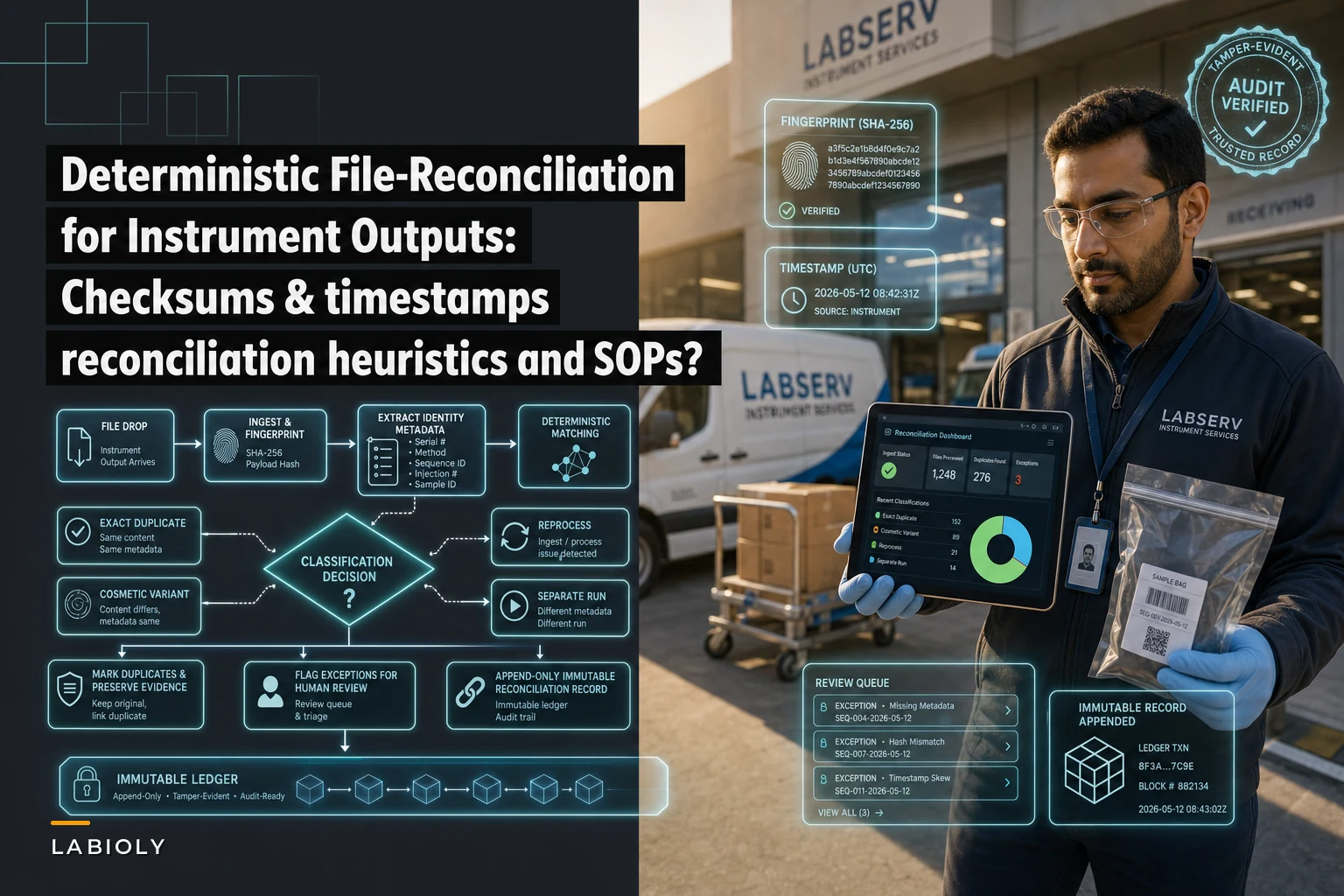
Most labs try to solve this with folder discipline and hope. Folder discipline dies the first time an instrument PC reboots mid-export or a network share hiccups and a file lands twice. What holds up under an audit is deterministic matching — rules that produce the same answer every time, backed by checksums, timestamps, and instrument metadata rather than someone's memory.
Why instrument outputs multiply in the first place
Before fixing anything, it helps to understand how the duplicates and orphans show up, because the fix depends on the mechanism.
-
Auto-export plus manual re-export. The instrument software drops a file on completion, then an analyst re-exports with a slightly different setting — different decimal precision, added columns. Now you have two files representing the same run, byte-for-byte different but scientifically identical in the parts that matter.
-
Retry storms. A flaky network mount causes the acquisition PC to write, fail to confirm, and rewrite. Same content, two files, timestamps seconds apart.
-
Copy-on-move. Someone copies a batch to a shared drive instead of moving it. Original stays behind. Weeks later both get "processed" independently.
-
Reprocessing. The raw acquisition is legitimately reprocessed with a new integration method. This is a new output with a real lineage relationship to the old one — not a duplicate. Treating it like a duplicate is how you lose a valid result.
Not all copies are duplicates, and not all differences mean a new result. A reconciliation system that can't distinguish "identical re-export" from "legitimate reprocessing" from "corrupted retry" will either drown you in false alerts or quietly delete something you needed.
The three signals that actually let you decide
You need signals that are deterministic — same inputs, same classification, no judgment call required. Three carry most of the weight in practice.
Eliminate lab bottlenecks and errors.
Labioly helps you monitor, manage, and report lab activities efficiently and compliantly.
- Real-time sample tracking
- Inventory and supply alerts
- Staff workflow coordination
No credit card required
Content checksums. A SHA-256 of the file content tells you if two files are byte-identical. Cleanest signal there is. If two files hash the same, they are the same file, and one can be treated as a duplicate reference rather than a separate record.
The catch: many instrument exports embed a timestamp or export-session ID inside the file. So two exports of the same run hash differently even though the actual data rows are identical. That's why you often need a second, content-scoped checksum — a hash computed over just the data payload after stripping known-volatile header fields.
Timestamps — but the right ones. File-system modified time is nearly useless. It changes on copy, on move, on some backup operations. What you want is the acquisition timestamp the instrument writes into the file or its sidecar metadata. That's the run's real identity anchor. If your device clocks aren't trustworthy, none of this works — which is its own separate problem worth solving first.
Instrument metadata. Serial number, method name, sequence position, sample ID, injection number. These are the fields that let you group files belonging to the same run even when checksums differ. A single sequence of 48 injections should produce a predictable, orderable set — and gaps or extras in that set are exactly what reconciliation should surface.
| Content hash | Payload hash | Acquisition timestamp | Classification |
|---|---|---|---|
| Same | Same | Same | Exact duplicate — keep one, link the rest |
| Different | Same | Same | Re-export / cosmetic diff — keep canonical, note variant |
| Different | Different | Same run ID, later export time | Reprocessing — new record, link to parent lineage |
| Different | Different | Different run, same sample | Legitimate separate run — keep both |
| Same | Same | Different filename, different folder | Copy-on-move duplicate — dedupe |
The table isn't the system — it's the decision logic the system encodes. Every file lands in exactly one bucket by rule, not by opinion.
A reconciliation workflow that survives audits
Walk through what actually happens to a file, start to finish. This is the workflow that holds up when someone from quality asks "prove this is the file you reported from."
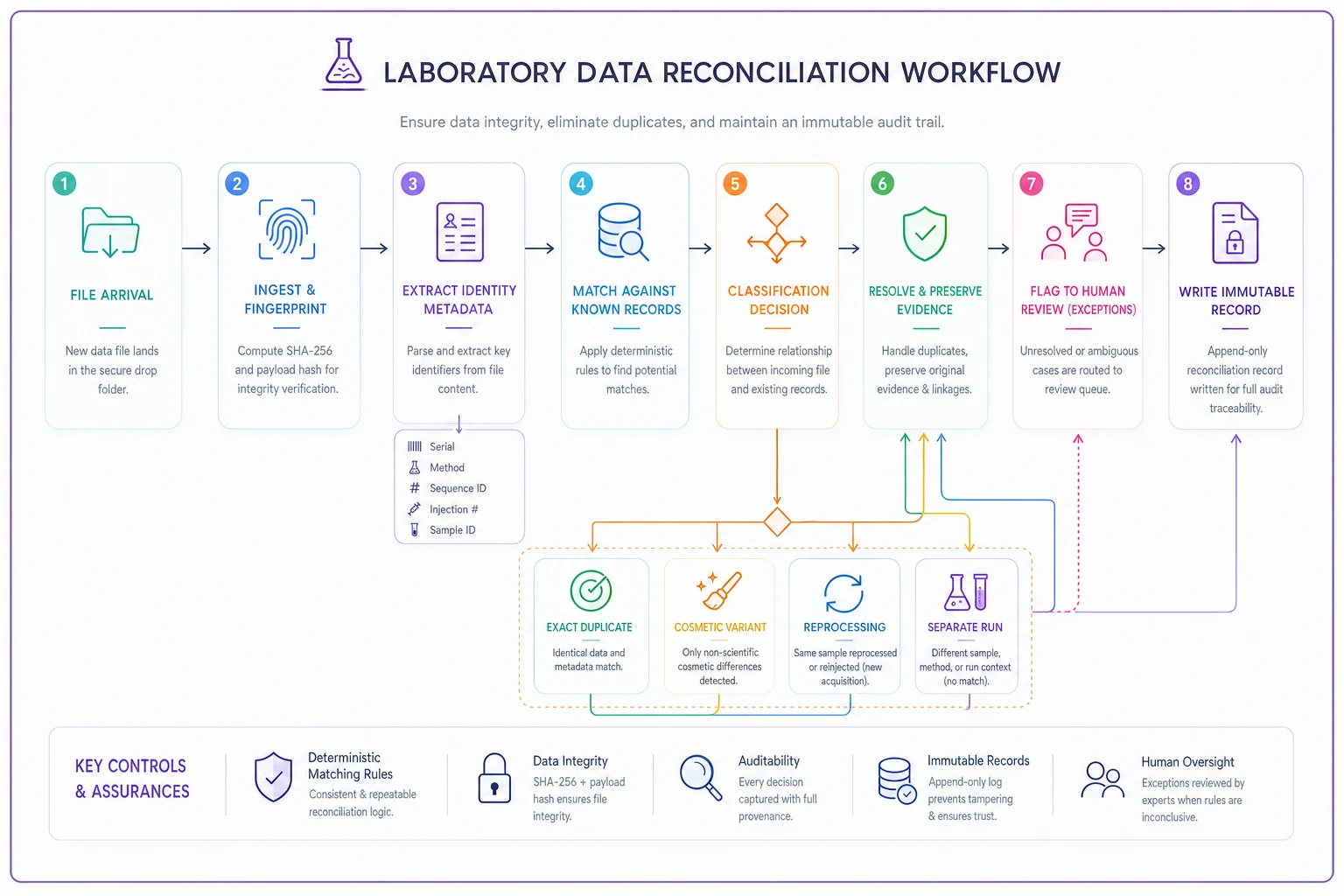
The diagram above summarizes the ingest→classify→record flow used to make reconciliations auditable.
-
Ingest and fingerprint. On arrival, compute the full-content SHA-256 and the payload-scoped hash. Record file size, source path, and the acquisition timestamp pulled from inside the file or its sidecar.
-
Extract identity metadata. Parse instrument serial, method, sequence ID, injection number, sample ID. Store these as structured fields, not as part of the filename.
-
Match against existing records. Run the deterministic rules from the table above. Every file gets a classification and a pointer to any parent or sibling files.
-
Resolve, don't delete. Duplicates aren't deleted — they're marked as duplicates and pointed at the canonical record. Deletion destroys evidence; a resolved duplicate is evidence.
-
Flag exceptions for a human. Anything that doesn't match cleanly — a sequence with a missing injection, a payload hash that changed with no reprocessing record — goes to an exception queue.
-
Write an immutable reconciliation record. Append-only. What arrived, what it matched, how it was classified, who reviewed exceptions.
That last step is the one labs skip most often, and it's the one auditors care about most. A reconciliation that leaves no trail is just cleanup. A reconciliation that produces an append-only record of why each file is duplicate/canonical/reprocessed is actually defensible.
Small scripts beat big platforms here
You don't need enterprise software to start. Most of this is a few hundred lines of scripting plus discipline about where files land.
-
A watch script that fires whenever a file appears in the instrument drop folder.
-
A fingerprint function — content hash, payload hash after stripping known header lines, file size.
-
A metadata parser per instrument type (this is the annoying part; every vendor formats exports differently).
-
A matcher that queries a small SQLite or Postgres table of known fingerprints and applies the classification rules.
-
An append-only log table where every decision is written with a timestamp and the rule that fired.
Focus effort on the parser per instrument — that's where the real work lives.
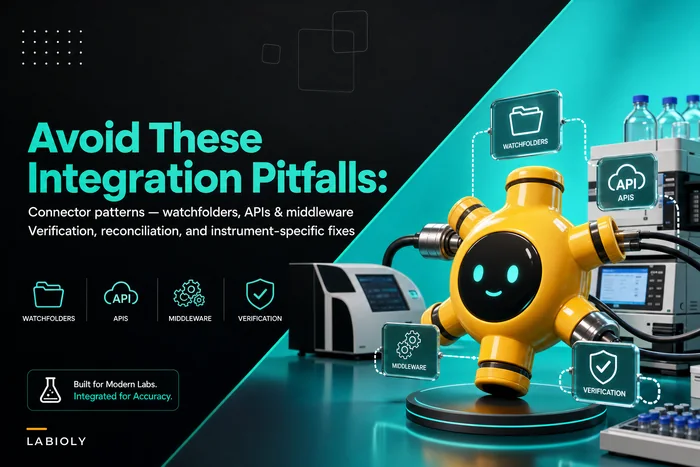
The parser per instrument is where the real work lives, and it's worth being honest about that. There's no universal format. Your Agilent CDS, your plate reader, your qPCR machine — each needs its own extraction logic. The connector patterns that make this reliable are close cousins of the ones covered in the instrument integration pitfalls guide, and skipping that groundwork is where most home-grown reconciliation quietly breaks.
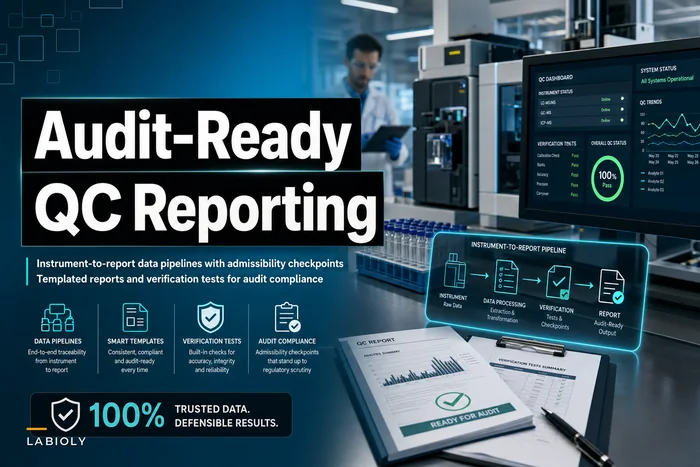
Once fingerprints and lineage records exist, the same structured output feeds naturally into automated QC reporting that passes audits — because the hard part of audit-ready reporting is usually proving the numbers came from the right file, which is exactly what reconciliation establishes.
A real scenario
A mid-sized contract analytical lab — three LC-MS systems, two plate readers, roughly 900–1,100 output files a month landing on a shared drive. Their process was folder-based, with an analyst manually renaming files into a Reviewed folder.
The recurring failure: about once a month, a duplicate got reported as if it were a separate sample, or a reprocessed file got reviewed while the original stayed in the queue looking un-reviewed. Not catastrophic individually, but each one triggered an investigation, and two of them in a single year turned into client-facing corrections.
They put in a fingerprinting script over a couple of weekends. Full hash plus a payload hash that stripped the export-session line their CDS injected. SQLite table for known fingerprints, an exception queue as a simple flagged view. Nothing clever.
The visible change was pretty immediate. Exact and copy-on-move duplicates — which turned out to be close to 15% of monthly files, mostly retry artifacts and copy-not-move mistakes — got auto-classified and stopped reaching human review. The exception queue analysts actually looked at dropped to a handful of genuine oddities per week. Time spent on the monthly "which file is real" investigation went from a recurring half-day scramble to basically nothing, and the two-a-year correction problem didn't recur the following year.
Nothing exotic happened. They replaced memory and filenames with checksums, timestamps, and rules.
When this is worth it — and when it isn't
When it makes sense: you have multiple instruments producing overlapping exports, more than one person touching output files, and any audit or client-reporting obligation. The break-even is roughly the point where you can't personally remember every run — usually somewhere around a few hundred files a month.
When it's overkill: a single instrument, one operator, low volume, no external reporting. If one person exports one file per run and nothing multiplies, folder discipline genuinely works. Building fingerprint infrastructure for that is effort you'll never recover.
Who should not start here: if your instrument clocks aren't synchronized and audited, fix that first. Reconciliation leans hard on acquisition timestamps, and unreliable clocks will make your matching produce confident wrong answers — which is worse than no matching at all.
The part nobody wants to hear
Deterministic reconciliation only works if you commit to never deciding by hand what the rules can decide. The temptation, always, is to reach into the folder and "just fix this one." Every manual override that doesn't get logged reintroduces the exact ambiguity you built the system to eliminate.
The real discipline isn't the checksums or the parsers. It's treating the reconciliation record as the source of truth — including its exception queue — and resisting the urge to clean up files outside of it. Get that habit in place, and the question "which export is the real one?" stops being something you answer from memory and becomes something you answer from evidence.
The real discipline isn't the checksums or the parsers. It's treating the reconciliation record as the source of truth — including its exception queue — and resisting the urge to clean up files outside of it. Get that habit in place, and the question "which export is the real one?" stops being something you answer from memory and becomes something you answer from evidence.
Ready to upgrade your lab operations?
Join 500+ labs using Labioly to save time, reduce errors, and enhance productivity and compliance.