
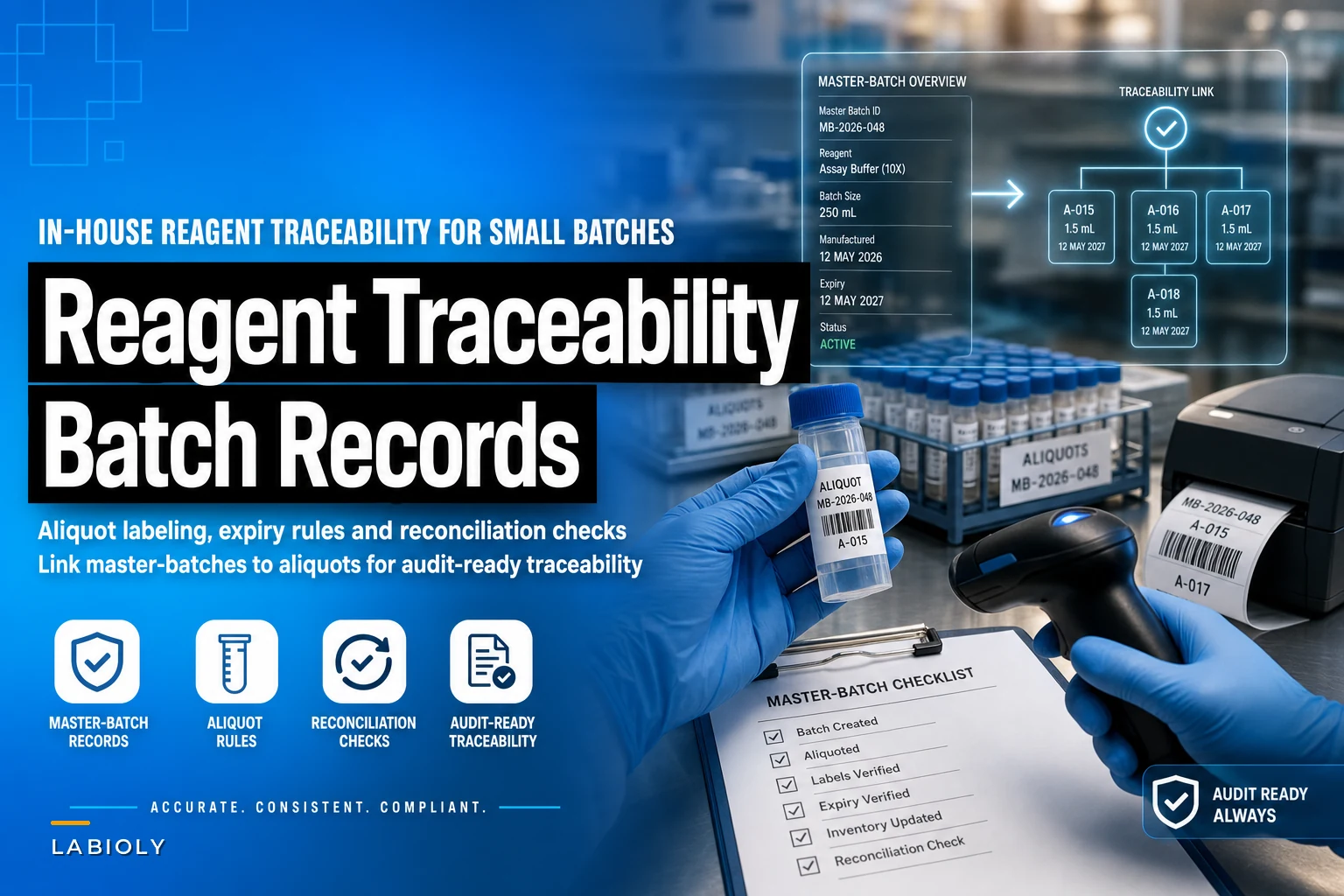

Most labs have their commercial reagent traceability reasonably locked down. Certificates of analysis, lot numbers, expiry dates straight off the vendor label—that stuff flows into the system almost automatically. Where things fall apart is with the reagents you make yourself.
Buffer prepared in-house on a Tuesday afternoon. A working stock of antibody diluted from a concentrated aliquot. A staining solution someone mixed up to get through the run. These are the reagents that show up in a Materials and Methods section but have no paper trail behind them, and they're exactly what an auditor circles when they want to test whether your traceability is real or theater.
The core problem isn't the master batch itself. It's the gap between the master batch and the tiny aliquot that actually touched an experiment. You made 500 mL of something, split it into forty vials, and six months later you're trying to prove that the vial used in Experiment 47 came from a batch that was in date and prepared correctly. If you can't reconstruct that chain, the data downstream inherits the uncertainty.
That's the specific gap worth fixing.
Why the Master-Batch-to-Aliquot Link Breaks
The breakage almost always happens at the moment of aliquoting, and it's a coordination failure, not a knowledge failure.
The pattern is consistent. Someone prepares a master batch and records it—maybe in a notebook, maybe a shared spreadsheet. They assign it a name like "PBS-T 10/14" or "Ab-mix batch 3." Then they fill vials. The vials get a handwritten label with an abbreviation and maybe a date. Nobody writes down how many aliquots were made. Nobody links the vial label back to the master batch record in a way a machine—or a stranger—could follow.
-
Aliquot labels are physically tiny. You can fit a name and a date on a 0.5 mL tube if you're lucky. There's no room for a full batch ID, so people abbreviate, and abbreviations drift.
-
The person aliquoting isn't the person using. The context that lived in one head never made it onto the label.
-
Nobody counts aliquots at creation. Without a known aliquot count, reconciliation is impossible—you can't detect a missing vial if you never knew how many existed.
-
Expiry gets assigned to the master batch but not propagated to aliquots. A frozen aliquot might have a different practical shelf life than the parent stock, and that never gets captured.
Three weeks later, a second person pulls a vial from the -20, uses it, and records "used working antibody dilution" in their ELN. The abbreviation on the vial doesn't quite match the master batch name. The dates are close but not identical. Now you have three records that probably describe the same reagent but can't be mechanically joined.
This is closely related to the lot-handling problems covered in Practical Reagent Expiration and Lot-Traceability Rules for Multi-Batch Studies, but in-house reagents add a wrinkle vendor lots don't have: you are the manufacturer, so you own the record of manufacture too.
What a Master-Batch Record Actually Needs to Contain
A master-batch record for a lab-made reagent should be complete enough that someone who has never met you could remake it and understand its lineage. Most in-house records fail this test because they capture the recipe but not the traceability metadata.
Eliminate lab bottlenecks and errors.
Labioly helps you monitor, manage, and report lab activities efficiently and compliantly.
- Real-time sample tracking
- Inventory and supply alerts
- Staff workflow coordination
No credit card required
Here's a fieldset that holds up under audit without becoming a burden to fill in:
| Field | Why it matters | Common mistake |
|---|---|---|
| Master-batch ID (unique) | The anchor everything links to | Reusing names across months |
| Preparation date + preparer | Establishes who and when | Preparer initials only, no full name |
| Source materials + their lot numbers | Inherits upstream traceability | Recording "PBS" without the source lot |
| Recipe / SOP version used | Ties prep to a controlled method | "Standard protocol" with no version |
| Total volume prepared | Baseline for reconciliation | Left blank |
| Number of aliquots created | Enables count-based checks | Almost never recorded |
| Aliquot volume (nominal) | Detects over/under filling | Assumed, never stated |
| Assigned expiry + basis | Justifies the shelf life | Expiry copied from a vendor, not derived |
| Storage condition | Affects real expiry | Implicit ("in the freezer") |
The two fields that quietly do the most work are number of aliquots created and source lot numbers. The aliquot count is what makes reconciliation mathematically possible later. The source lots are what let you trace a contamination or performance problem backward through your own preparation into a vendor lot—which is often where the actual root cause sits.
One thing worth noting: labs that assign expiry to in-house reagents based on a real rationale—stability data, a conservative default policy, or documented reasoning—almost never get pushed on it in audits. Labs that write a date with no reasoning get asked "why this date?" every single time, and "that's what we usually do" is not an answer that ends the conversation.
Aliquot-Labeling Rules That Survive a -80 and a Stranger
The label on the aliquot is the physical bridge between your master-batch record and the experiment. If that bridge only works when the original preparer is standing there to interpret it, you don't have traceability—you have tribal knowledge.
-
Every aliquot label carries the master-batch ID, verbatim. Not an abbreviation. If space is the problem, the ID itself should be designed short—a brief prefix plus a running number—so it fits.
-
The label carries a sequence position where it matters. For reagents where vial-to-vial variation is possible, numbering vials 1-of-40 through 40-of-40 lets you trace back to fill order.
-
Expiry printed on the aliquot reflects the aliquot's condition, not the parent's. A frozen working stock and its refrigerated parent shouldn't share a date if their stabilities differ.
-
Human-readable and machine-readable agree. If you're using barcodes or QR, the printed text must match what the code encodes—label validation exists precisely because these drift apart under freeze/thaw and solvent exposure.
-
No handwritten master-batch IDs. Handwriting is where "batch 3" becomes "batch 8" at 8am. Printed, or at minimum copied from a printed source.
Pro-tip: design a short master-batch ID format (prefix + running number) so the full ID fits on common aliquot tubes.
The most common single point of failure isn't the label wearing off—it's the label being correct but unlinkable, because the ID on the vial was never entered anywhere as belonging to a specific master batch. The label says "AB-3-014," the master-batch record says "Antibody mix batch 3," and no record on earth says AB-3 means "Antibody mix batch 3." That semantic gap is invisible until an auditor asks you to prove it.
Expiry Policies: The Part Everyone Improvises
Expiry for lab-made reagents is where the most improvisation happens. Because there's no vendor telling you the date, people either copy a number they saw once or assign something arbitrary.
-
Category defaults. A written policy that says aqueous buffers without protein get X, protein-containing working stocks get Y, and anything with a labile component gets Z. This covers routine reagents and stops people inventing dates.
-
Inherited from the shortest-dated component. A reagent can't outlive its most perishable ingredient. Hard ceiling, regardless of category default.
-
Stability-data-backed. For critical reagents where a longer shelf life genuinely matters, actual data justifies the number. Reserve the effort for reagents where it pays off.
The mistake that costs the most isn't setting expiry too short—it's the opposite. A working stock quietly runs months past its real stability window because the aliquot's expiry was never distinguished from the parent's. The reagent still "looks fine," experiments keep running, and the drift shows up as noise in your data that nobody attributes to the reagent because everyone assumed it was in date.
Tying expiry policy to how much of each reagent you actually consume is worth thinking about here too—labs that align batch sizes and aliquot counts to real usage waste far less to expiry. That consumption picture is exactly what protocol-driven reagent demand forecasting gives you, and it's the difference between preparing 40 aliquots that expire before use and preparing the 20-odd you'll actually consume.
Reconciliation: Closing the Loop With a Simple Count
Reconciliation is the check that turns your records from a list into an audit-ready system. The concept is boring, and that's the point: aliquots created should equal aliquots consumed plus aliquots remaining plus aliquots discarded. If the numbers don't close, you have an untracked event.
-
At creation, record total aliquots made against the master-batch ID. This is your opening balance.
-
At each use, the experiment record references the specific aliquot, or at minimum the master-batch ID plus how many vials were pulled.
-
At disposal or expiry, log discarded aliquots against the master batch—expired, contaminated, dropped, whatever.
-
On a schedule (monthly, or when a batch is retired), reconcile
physical count in the freezer plus consumed plus discarded should equal the created total.
-
On any mismatch, open an exception. A missing aliquot with no usage record is either an untracked experiment or a labeling failure—both are worth knowing about before an auditor finds them.
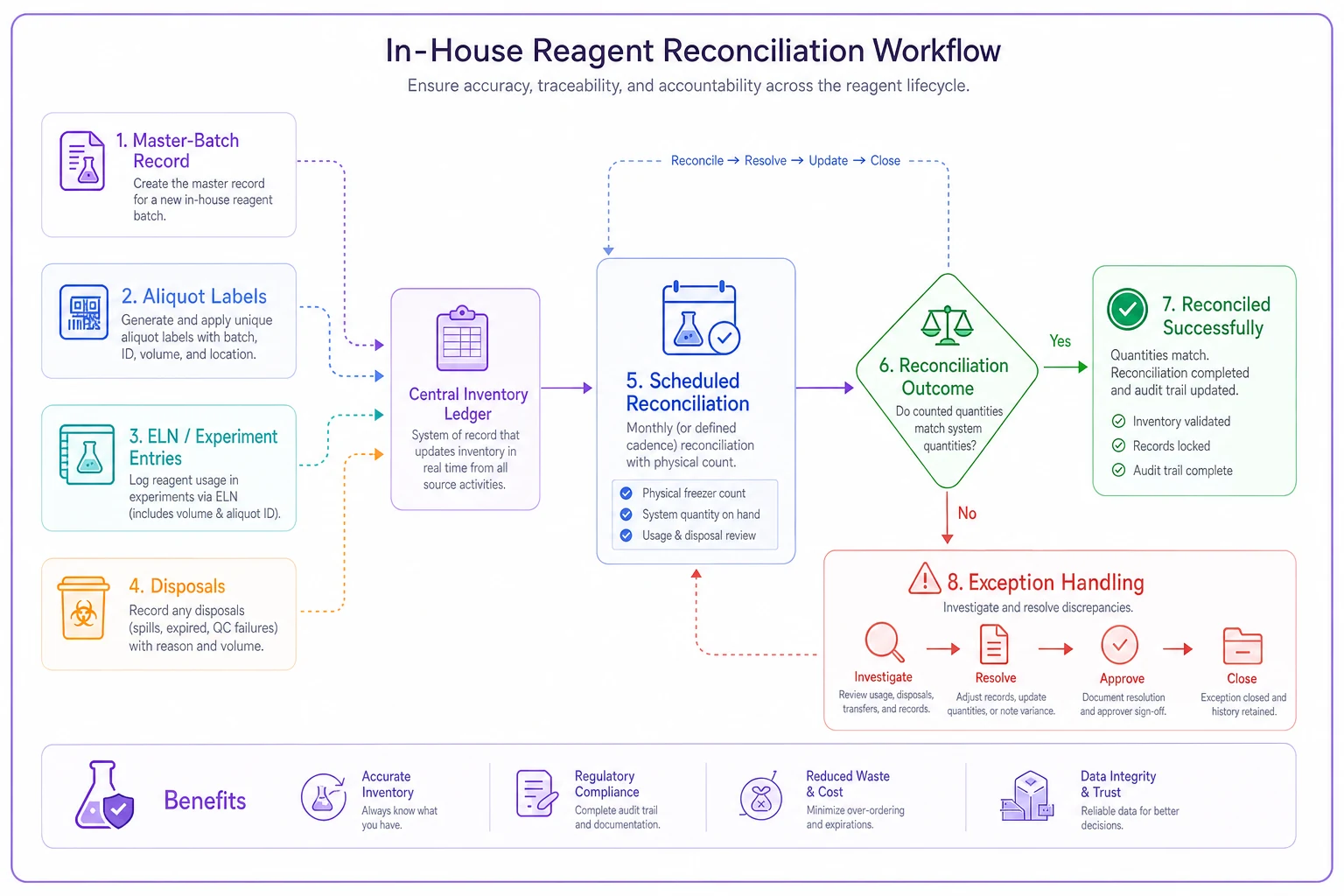
Here's a simple visual of the reconciliation flow to keep next to your SOP for the people doing counts.
A realistic exception looks like this: a batch of 30 aliquots, 18 recorded as used across three experiments, 4 logged as discarded past expiry, and 5 physically present in the freezer. That's 27 accounted for against 30 created. Three vials unaccounted for. Usually the answer is that someone used them and recorded the reagent by a slightly different name—which is exactly the semantic gap from the labeling section, now caught by the count instead of by luck.
A Short Real Scenario
A mid-sized immunology lab—six researchers, heavy on custom antibody working stocks—kept failing the same audit finding two cycles in a row: in-house reagents cited in experiments couldn't be conclusively linked to a preparation record. Not because records didn't exist, but because vial labels used personal abbreviations that didn't map cleanly to batch names.
They didn't buy anything fancy. They standardized master-batch IDs to a short printed format, made "number of aliquots created" a mandatory field, and started a monthly count reconciliation on active batches. First month, reconciliation flagged roughly a dozen aliquots across several batches that couldn't be tied to a use record. Within two months, mismatches dropped to a handful, and those were nearly always genuine labeling drift they could correct at the source.
The audit finding closed on the next cycle. The quieter win was that they cut prepared-reagent waste noticeably—once they could see how many aliquots actually got used per batch, they stopped defaulting to "make a full plate's worth" every time and prepared closer to real demand.
When This Level of Rigor Makes Sense—and When It Doesn't
Not every reagent deserves a full master-batch record. Over-engineering traceability for a wash buffer you remake weekly and consume within days just creates records nobody reads.
This makes sense when:
-
The reagent is prepared in a batch and split into aliquots used across multiple experiments or over weeks/months.
-
The reagent is critical to a result—anything that, if wrong, invalidates data.
-
You operate in a regulated or audited environment where in-house reagents get scrutinized.
-
Vial-to-vial or batch-to-batch variation could plausibly affect outcomes.
This is overkill when:
-
The reagent is made and fully consumed in a single session by one person.
-
It's non-critical and easily remade if there's any doubt.
-
The traceability cost exceeds the risk of just remaking it.
Who should be careful not to skip it: any lab where the person aliquoting and the person using are frequently different people, or where reagents cross projects. That separation is the exact condition under which tribal knowledge fails and a formal link becomes non-optional.
Where Software Quietly Earns Its Place
You can run all of this on paper and spreadsheets, and plenty of small labs do. Where it starts to hurt is the reconciliation step—manually counting aliquots and cross-referencing them against usage records scattered across notebooks and ELN entries is tedious enough that people skip it until an audit forces the issue.
This is where an AI-assisted operational platform earns its keep without much drama. Master-batch records that generate consistent, printable aliquot IDs at creation. Usage automatically decrementing the count when an experiment references an aliquot. Reconciliation mismatches surfacing as exceptions instead of waiting for a manual count. The point isn't automation for its own sake—it's that the semantic gap between "AB-3-014" and "Antibody mix batch 3" simply can't open if the label and the record were generated from the same source, and untracked usage gets flagged the day it happens rather than months later.
The goal is boring, and boring is the goal: any aliquot in any experiment traces back to a complete preparation record, the counts close, and you can prove it to someone who has never set foot in your lab. Get the master-batch-to-aliquot link right at the moment of creation, and every downstream check becomes a formality instead of a fire drill.
Ready to upgrade your lab operations?
Join 500+ labs using Labioly to save time, reduce errors, and enhance productivity and compliance.