
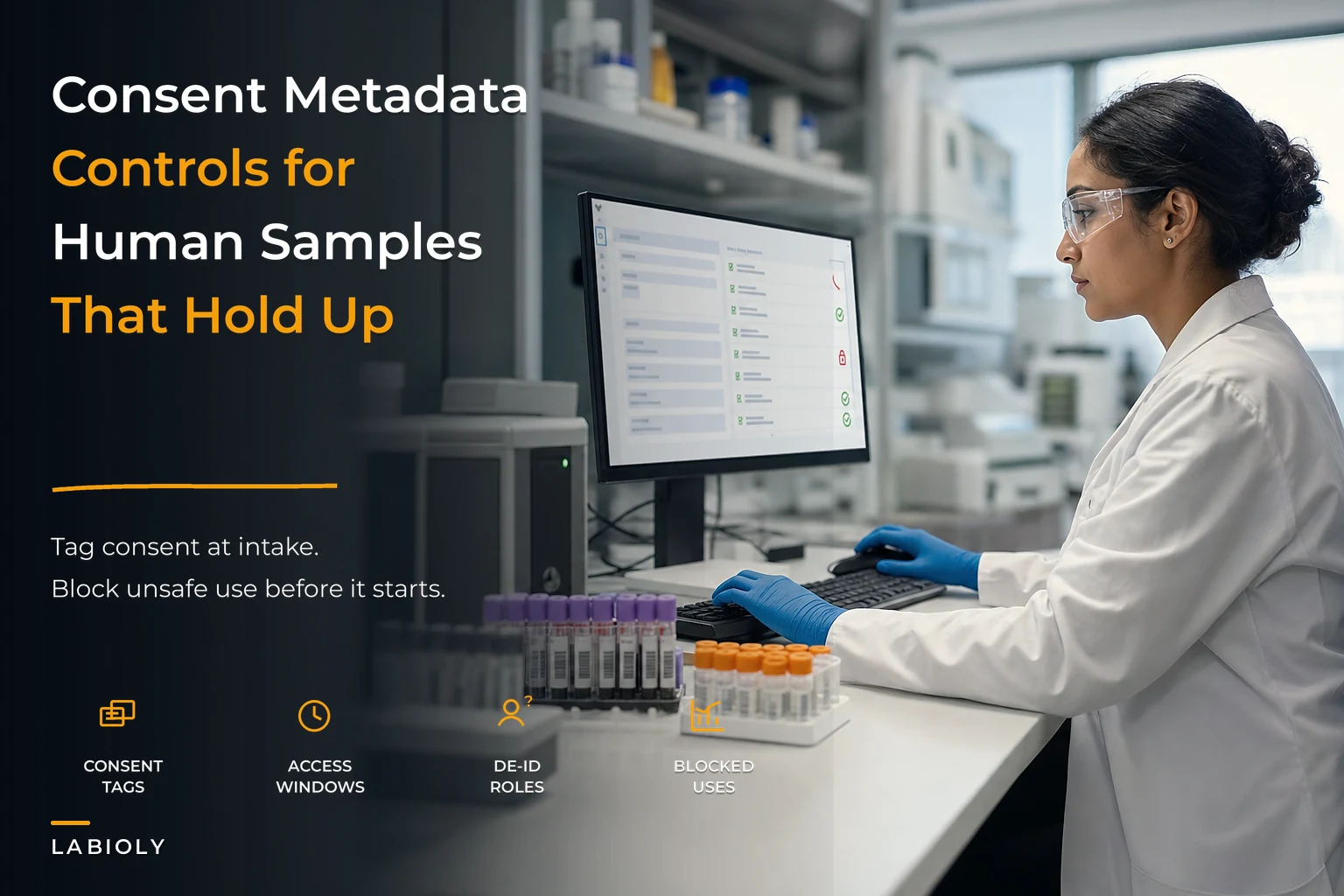

Last month, a clinical research lab got hit with a $280,000 fine. Not because they leaked patient data or had a breach. They simply couldn't prove which samples had proper consent for genomic sequencing versus basic blood work. Their LIMS tracked everything except the one thing that mattered during the audit—consent metadata tied to downstream uses.
This happens more than most people realize. Labs spend millions on equipment, hire PhDs to run protocols, implement expensive LIMS systems, then completely botch the privacy framework because nobody maps consent types to actual operational workflows.
The Consent Metadata Problem Nobody Talks About
Most labs treat consent as a checkbox. Patient signs form, sample gets processed, data goes wherever it needs to go. But modern research—especially anything touching genomics, proteomics, or longitudinal studies—requires tracking multiple consent layers that determine what you can actually do with each sample.
Take a typical biobank operation. One blood draw might generate:
-
Plasma for immediate testing (basic consent)
-
Buffy coat for DNA extraction (genetic consent required)
-
Serum aliquots for future research (broad consent with restrictions)
-
Cell pellets for immortalization (specific consent with re-contact provisions)
Each derivative needs different access controls. The same sample that's fine for cholesterol testing might be completely off-limits for ancestry analysis. Yet most LIMS systems treat all aliquots the same once they're in the freezer.
What really breaks this at scale is pretty straightforward. A 10-sample pilot study? You can track consent in a spreadsheet. But when you're processing 400 samples daily across 12 studies with different IRB protocols, manual tracking falls apart. The metadata has to live in the system, enforceable at every decision point.
Building Enforceable Consent Rules into Your LIMS
Here's the framework that works in production labs handling human samples at scale.
Eliminate lab bottlenecks and errors.
Labioly helps you monitor, manage, and report lab activities efficiently and compliantly.
- Real-time sample tracking
- Inventory and supply alerts
- Staff workflow coordination
No credit card required
| Consent Level | Permitted | Blocked | Metadata tag | LIMS rule |
|---|---|---|---|---|
| Consent Level 1: Clinical Testing Only | Permitted: Diagnostic assays, clinical chemistry panels | Blocked: Research protocols, genetic testing, sample sharing | CONSENT_CLINICAL | Block sample selection for any workflow tagged RESEARCH |
| Consent Level 2: Disease-Specific Research | Permitted: Studies related to documented condition | Blocked: Unrelated research, commercial development | CONSENTDISEASE:{conditioncode} | Require condition match for protocol enrollment |
| Consent Level 3: Broad Biomedical Research | Permitted: Academic research, publication | Blocked: Commercial product development, ancestry/forensic use | CONSENTRESEARCHBROAD | Flag for review if selected for industry collaboration |
| Consent Level 4: Unrestricted Research | Permitted: All research including commercial development | Still blocked: Re-identification attempts | CONSENT_UNRESTRICTED | No blocks except de-identification protocols |
The critical piece is making these rules enforceable, not suggestions.
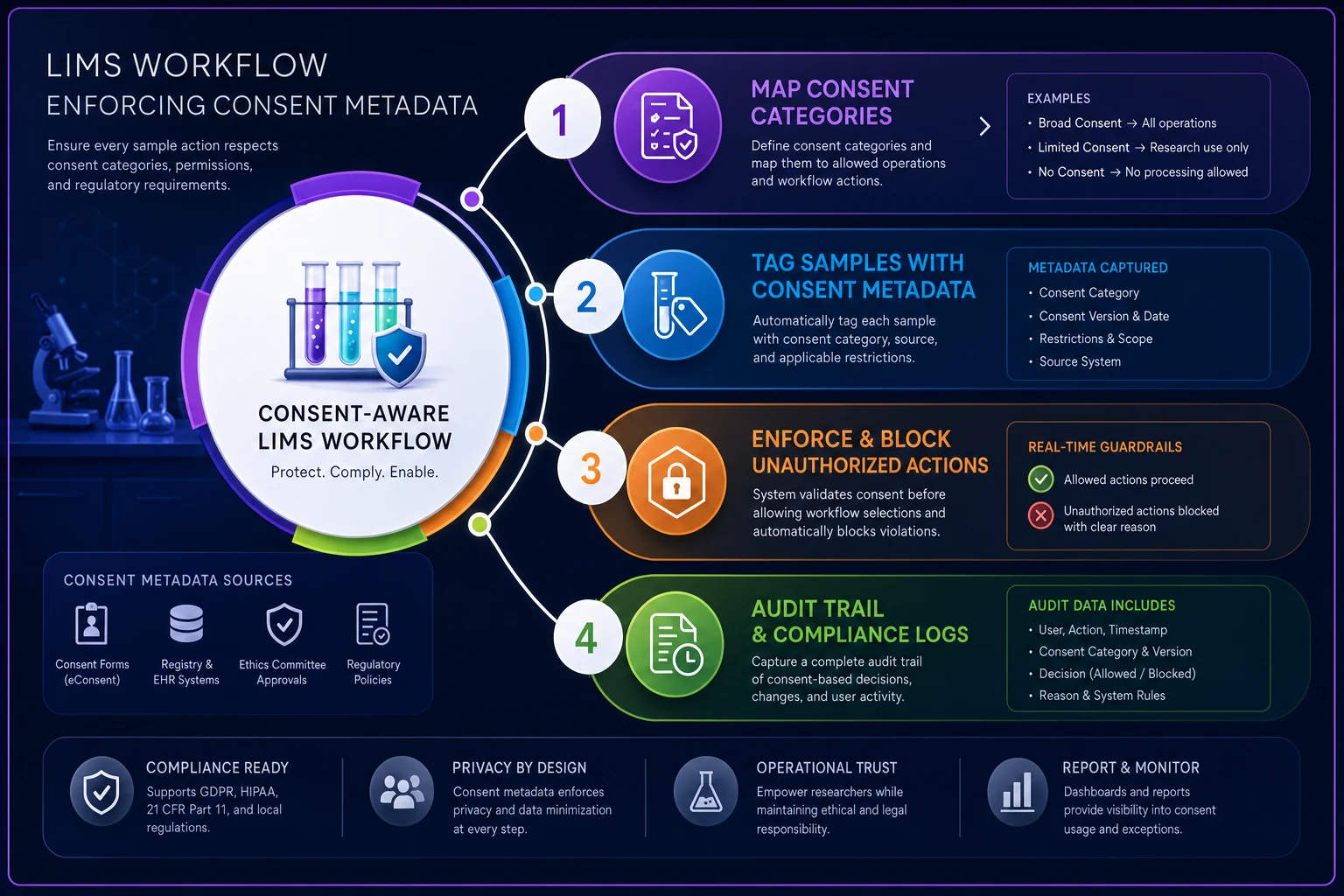
When someone tries to add a Level 1 sample to a research worklist, the system should physically prevent it—not just show a warning.
Access Control Patterns That Scale
Access control in labs usually means "who can log into the LIMS." That's not enough when dealing with human samples. You need role-based permissions that understand both the user and the sample's consent status.
One lab I worked with had this fail badly when a tech accidentally included restricted samples in a batch shipment to a commercial partner. They had full LIMS access, could see all samples, and nothing stopped them from selecting the wrong ones. The audit afterward found 47 samples used outside their consent scope.
Research Technician Role
-
Can view
All samples in assigned studies
-
Can process
Only samples with matching study consent
-
Cannot access
Identified patient data, samples outside assigned studies
Principal Investigator Role
-
Can view
All samples in their studies plus available biobank samples
-
Can process
Samples matching their IRB protocol
-
Can request
Consent expansion (triggers re-consent workflow)
Biobank Manager Role
-
Can view
All samples, consent status, usage history
-
Can process
Sample transfers only with consent verification
-
Can override
With documented justification and ethics review
Enforcement happens at the query level. When a research tech searches for available samples, the system automatically filters out anything their role shouldn't see. They literally can't select samples they shouldn't touch.
This is where AI-powered operational platforms make a real difference. Instead of relying on people to remember complex consent rules, the system enforces them automatically—every query, every workflow, every sample selection gets checked against consent metadata in real time.
De-identification That Survives Re-identification Attacks
De-identification isn't just removing names. Modern re-identification attacks can link samples using combinations of age, diagnosis date, zip code, and treatment history. Labs need a systematic approach that goes beyond basic PHI removal.
A common failure point: labs de-identify at the wrong stage of the workflow. They'll strip identifiers when generating reports but keep everything linked in the LIMS. One database query and you've got full patient histories attached to supposedly anonymous samples.
Tier 1: Direct Identifiers Remove immediately upon sample receipt:
-
Names, addresses, phone numbers, email
-
Social security numbers, medical record numbers
-
Replace with
Study-specific participant ID (non-sequential)
Tier 2: Quasi-Identifiers Transform based on use case:
-
Dates → Age at event or time intervals
-
Zip codes → First 3 digits only
-
Diagnoses → Category codes not specific conditions
Tier 3: Genomic Data Special handling required:
-
Never store raw sequence data with any identifiers
-
Use homomorphic encryption for analysis
-
Implement access logging for every query
Tier 4: Longitudinal Data Break linkages between time points:
-
Generate new IDs for each collection event
-
Maintain linking table in separated, encrypted system
-
Require two-person authorization for linkage access
The metadata schema needs to track de-identification status at each tier. A sample might be Tier 1 compliant but still contain quasi-identifiers that block certain uses.
Secondary Use Protocols—The Silent Compliance Killer
Secondary use causes more compliance issues than primary research. A sample collected for diabetes research gets selected for a cardiovascular study. Allowed? Depends on the original consent language, the relationship between conditions, and whether the new use introduces additional risks.
Most labs handle this with email chains and memory. "Hey, can we use the Johnson study samples for the new protocol?" Someone checks a consent form from three years ago, says yes, and samples get transferred. Six months later during an audit, nobody can explain who approved what.
What you need: documented decision trees with evidence requirements.
Secondary Use Decision Framework
Scenario 1: Same disease, similar methods
-
Required evidence
Original consent form, method comparison
-
Approval level
Lab director sign-off
-
Documentation
Add usage note to sample metadata
Scenario 2: Different disease, same risk level
-
Required evidence
Consent review by compliance officer
-
Approval level
IRB notification or approval
-
Documentation
Formal transfer agreement
Scenario 3: Commercial development from research samples
-
Required evidence
Explicit commercial clause in consent
-
Approval level
Full IRB review plus participant re-consent
-
Documentation
New consent forms, benefit-sharing agreement
Scenario 4: International transfer
-
Required evidence
Export permits, receiving country compliance
-
Approval level
Institutional approval plus legal review
-
Documentation
Material transfer agreement, tracking logs
These requirements need to surface during sample selection, not after samples are already allocated. Your LIMS should flag secondary use scenarios automatically.
Metadata Rules That Actually Get Followed
I've audited labs with beautiful metadata schemas—30 fields per sample, detailed consent tracking, comprehensive audit trails. Half the fields empty because nobody fills them out consistently.
Effective metadata rules focus on the minimum viable set that enables compliance:
Required at Sample Receipt
-
Consent version identifier (links to specific form version)
-
Collection date and time
-
Study protocol ID
-
Participant ID (de-identified)
-
Sample type
Required for Processing
-
Consent permissions (encoded as machine-readable tags)
-
De-identification tier achieved
-
Processing restrictions (e.g., "no genetic analysis")
-
Expiration date for consent if applicable
Require the consent permissions tag before allowing any processing step to enforce compliance at the point of use.
Required for Transfer/Sharing
-
Receiving institution
-
Purpose of transfer
-
Consent verification timestamp
-
Data use agreement ID
-
Planned destruction date
Don't try to capture everything. One lab required 47 metadata fields per sample. Technicians started copying data between samples just to save time. When the audit came, hundreds of samples had identical metadata—including supposedly unique identifiers.
Real-World Implementation: Academic Medical Center Lab
Here's how this played out at a 500-bed academic medical center processing roughly 1,200 human samples daily across research and clinical testing.
Their original system: an Excel sheet with patient names, study enrollments, and a "consent Y/N" column. When they grew from 3 studies to 45 studies with 12 different consent tiers, Excel broke down completely.
The operational changes they made:
First, they mapped every consent form to specific permissions—not just "research allowed" but exactly which types of research. Their genomics consent form alone had 7 different options participants could select or decline.
Second, they built consent checking into the LIMS migration they were already planning. Instead of just moving data, they restructured it around consent-based access controls. Every sample got tagged with its consent permissions during migration.
Third, they implemented automated de-identification workflows. When samples moved from clinical to research, the system automatically stripped identifiers based on the destination study's requirements. Different studies needed different de-identification levels, all handled by workflow rules.
-
Zero consent violations (down from 3-4 per quarter)
-
Sample selection time dropped roughly 40% (no more manual consent checking)
-
Passed joint CAP/CLIA inspection with zero findings on privacy controls
-
Enabled participation in 6 new multi-site studies that required proven consent tracking
The critical success factor wasn't the technology—it was encoding consent rules as system-enforced metadata rather than human-remembered policies.
Audit-Ready Evidence Patterns
When auditors show up, they want to trace a specific sample through your entire workflow. "Show me evidence that Sample X had proper consent for genomic sequencing performed on Date Y and shared with Institution Z."
Most labs scramble through email, paper forms, and multiple databases trying to reconstruct the authorization chain. Here's the evidence pattern that makes audits manageable:
Level 1: Consent Documentation
-
Original consent form (versioned, dated)
-
IRB approval for the specific consent version
-
Link between participant ID and consent version in system
Level 2: Processing Authorization
-
Timestamp when sample was selected for procedure
-
User who authorized selection
-
System verification that consent permitted the procedure
-
Protocol that required the procedure
Level 3: Transfer Documentation
-
Material transfer agreement
-
Consent verification for secondary use
-
De-identification certificate
-
Chain of custody record with timestamps
Store this evidence in a structured audit repository, not scattered across systems. When auditors request documentation for specific samples, you should be able to generate complete evidence packages in minutes, not days.
This connects directly to chain-of-custody documentation requirements but extends beyond simple tracking to include consent verification at each transfer point.
The Hidden Cost of Manual Consent Management
Here's what manual consent tracking actually costs beyond compliance risk.
A researcher wants to identify samples for a new cardiovascular study. With manual tracking, they email the biobank manager. The manager checks Excel, cross-references paper consent forms, realizes some consents are unclear, contacts the original study coordinator, waits a few days for a response, manually builds a list, sends it back. Total time: five to seven days of back-and-forth.
With properly structured consent metadata, the same query becomes: search LIMS for samples with CONSENTCARDIORESEARCH tag, age 45–65, collected within 2 years. Results in 30 seconds. The researcher sees only samples they can actually use.
Multiply that by dozens of queries weekly and manual consent management becomes a serious operational bottleneck. One biobank calculated they spent around 31 hours weekly just answering "can I use these samples?" questions. That's close to a full-time position dedicated entirely to consent verification.
Making Privacy Controls Operational, Not Aspirational
The mistake labs make is treating privacy as a compliance checkbox rather than an operational requirement. They implement controls to pass audits, not to protect participant privacy during daily operations.
-
Consent metadata that travels with samples
-
Access controls that prevent inappropriate use
-
De-identification workflows that run automatically
-
Secondary use protocols that require documentation
-
Audit trails that capture actual evidence
Modern AI-assisted platforms can encode these rules directly into laboratory workflows. Instead of hoping technicians remember which samples have genomic consent, the system enforces it. Instead of manually de-identifying data exports, the workflow applies the right transformations automatically based on destination requirements.
The goal isn't perfect documentation—it's making privacy protection so embedded in operations that violations become technically difficult.
When your LIMS physically prevents adding restricted samples to unauthorized protocols, compliance becomes the path of least resistance.
For labs processing human samples, privacy isn't just about avoiding fines. It's about maintaining the trust that makes research participation possible in the first place. Build the operational framework right, and privacy protection becomes automatic rather than aspirational.
Ready to upgrade your lab operations?
Join 500+ labs using Labioly to save time, reduce errors, and enhance productivity and compliance.