

Most ELN-to-LIMS integrations don't fail on the day you flip the switch. They fail three weeks later, when a bench scientist notices that sample aliquots from Experiment ELN-4471 are showing up under a completely different parent study in the LIMS — and nobody can explain when the split happened. By then you've got two systems that both look authoritative, and neither one agrees on which samples belong to which experiment.
That's the specific problem this piece is about: validating experiment-to-sample linkage before you trust a full integration. Not the whole migration, not the connector architecture, not audit retention. Just the one thing that quietly destroys data integrity when it goes wrong — the join between "this experiment happened" (ELN) and "these physical tubes exist" (LIMS).
If you want the broader move — replatforming your LIMS entirely — that's a different exercise and we've written the LIMS Migration Playbook for it. This is narrower. This is the pilot you run first, before anyone commits to a real connector.
Why linkage breaks specifically (and why it's invisible for weeks)
ELN and LIMS were almost never designed to agree on identity. The ELN thinks in terms of experiments, protocols, and observations. The LIMS thinks in terms of samples, aliquots, containers, and locations. The link between them is usually a single field — a sample ID typed into an ELN table, or an experiment reference pasted into a LIMS custom attribute.
-
Free-text sample IDs in the ELN. Someone types
4471-A2where the LIMS canonical ID isEXP4471_A02. The integration matches on exact string, finds nothing, and either drops the record silently or creates a duplicate. -
One-to-many splits that only exist on one side. A scientist aliquots one sample into six tubes at the bench. The LIMS knows about six children. The ELN still references the one parent. Now your linkage is ambiguous — which of the six does the observation apply to?
-
Timing drift. The ELN entry is created before the sample is registered in LIMS. The integration runs, finds no matching sample, and the record falls into an error queue that nobody checks.
-
Re-used IDs across projects.
Plate-1in Project Alpha andPlate-1in Project Beta. Without a project scope in the key, the join is a coin flip.
None of this throws a hard error. The systems keep running. Reports keep generating. It's only when someone reconciles by hand — usually during an audit or a paper submission — that the mismatch surfaces, and at that point you're reconstructing months of history from memory and lab notebooks.
The core idea: prove the join on a small dataset before you scale it
The mistake most teams make is treating the pilot as a technical test — "does data flow from A to B?" It almost always does. Data flowing is easy. Data flowing correctly linked is the hard part, and you can't prove it by watching records move. You prove it by reconciling.
Eliminate lab bottlenecks and errors.
Labioly helps you monitor, manage, and report lab activities efficiently and compliantly.
- Real-time sample tracking
- Inventory and supply alerts
- Staff workflow coordination
No credit card required
-
A minimal canonical fieldset — the smallest set of fields that fully defines the experiment-sample link.
-
A pilot dataset — a deliberately chosen slice of real experiments, not a synthetic one.
-
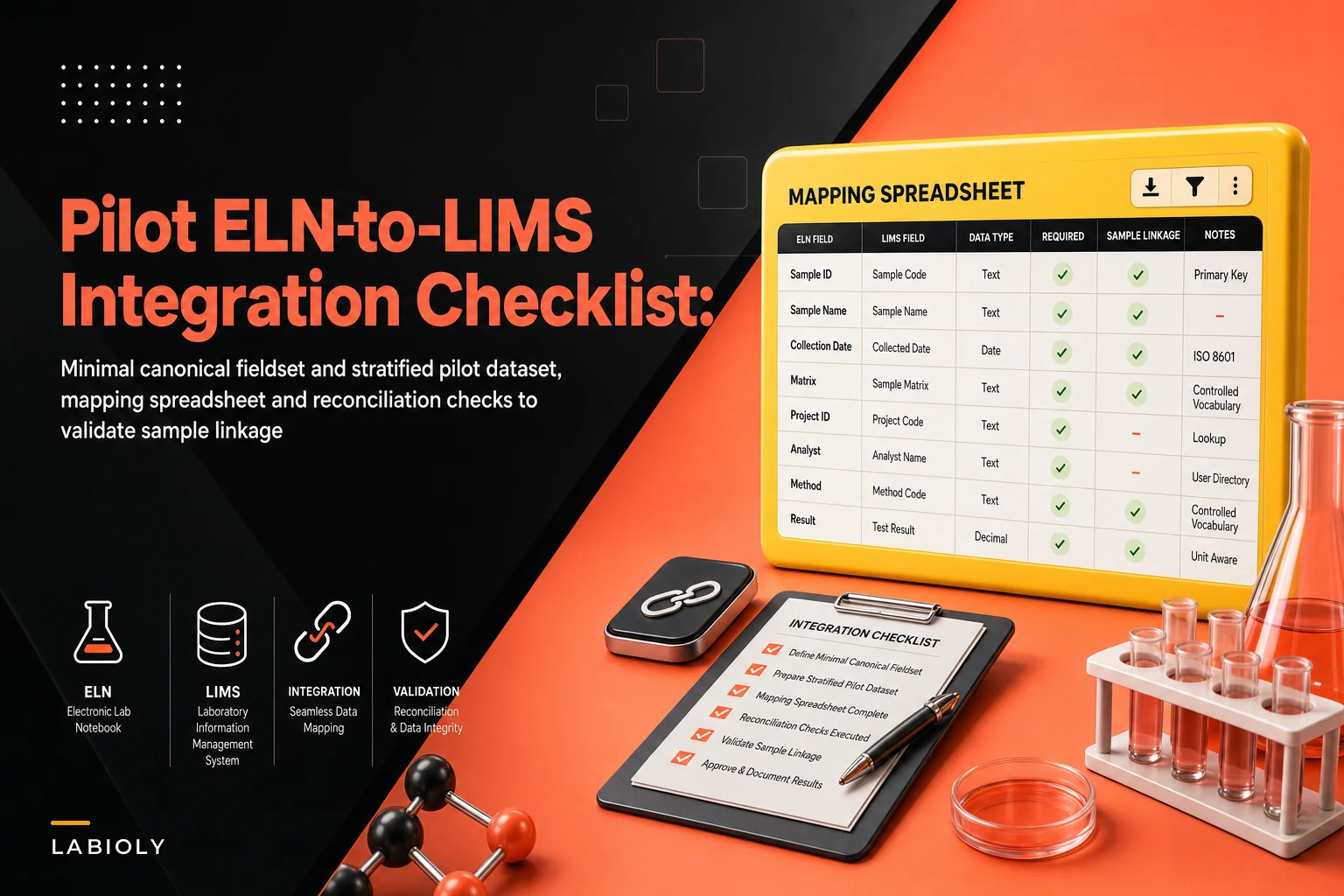
A mapping spreadsheet — the explicit, human-readable translation between ELN fields and LIMS fields.
-
Reconciliation tests — the checks that tell you whether the link survived the round trip.
Keep it to these four. The temptation to pull in reagent lots, instrument metadata, and QC results during the pilot is real. Resist it. Every extra field you add is another thing that can fail for reasons unrelated to linkage, and it muddies the one signal you're trying to isolate.
The whole ELN to LIMS pilot checklist approach here rests on four artifacts, and nothing more:
The minimal canonical fieldset
The canonical fieldset is the neutral vocabulary both systems map into. It's not the ELN's schema and not the LIMS's schema — it's the contract between them. For linkage validation, you need far fewer fields than people assume.
| Canonical field | Purpose | Common failure if missing |
|---|---|---|
experiment_id | Stable, unique experiment key | Free-text refs match nothing |
sample_id | Canonical physical sample key | Duplicates or dropped records |
parentsampleid | Handles aliquot/split lineage | One-to-many joins become ambiguous |
project_scope | Disambiguates re-used local IDs | Cross-project mismatches |
linkcreatedat | Timestamp the link was asserted | Timing drift goes undetected |
link_source | Which system asserted the link | Can't resolve conflicts later |
Six fields. That's usually enough to catch the vast majority of linkage failures. The two teams most often skip — parentsampleid and link_source — are the two that cause the worst downstream pain, because they're what you need when a conflict appears and you have to decide which system wins.
A note on link_source: when both systems can assert a link, you will eventually get disagreements. Deciding the authority rule up front ("LIMS is authoritative for sample identity, ELN is authoritative for experiment identity") is a five-minute conversation now and a two-week forensic project later if you skip it.
Choosing the pilot dataset (this is where people get lazy)
The single biggest determinant of whether your pilot means anything is the dataset you pick. Teams default to "grab the last 50 experiments" or, worse, a clean synthetic set. Both are useless. Clean data always passes.
-
20–30 experiments total — enough to see patterns, small enough to reconcile by hand.
-
At least a handful with aliquot splits (one sample → many tubes).
-
A couple with historically known ID typos or free-text entries.
-
Experiments from at least two different projects so
project_scopegets exercised. -
One or two with a timing gap — where the ELN entry predates LIMS registration.
-
If possible, one experiment you know has a linkage problem already. It's your positive control.
A pilot that passes cleanly on the first run is usually a sign you picked the wrong data, not that your integration is sound. You want the pilot to surface problems. A clean pass on hard data is a real result; a clean pass on easy data tells you nothing.
The mapping spreadsheet
The mapping spreadsheet is boring and it is the most valuable document in the whole exercise. It's the explicit, line-by-line record of how each canonical field is derived from each system. Keep it in plain columns:
-
Canonical field
-
ELN source field (and the transform, if any)
-
LIMS source field (and the transform, if any)
-
Match rule (exact / normalized / fuzzy-flagged)
-
Owner (who confirmed this mapping is correct)
The transform column is where the real work lives. EXP4471_A02 vs 4471-A2 isn't a mapping problem, it's a normalization problem — strip separators, uppercase, zero-pad the aliquot index. Write that rule down explicitly. If a mapping needs fuzzy matching to work, that's a red flag, not a solution: flag those rows for human review rather than letting an algorithm guess at sample identity. You do not want probabilistic matching deciding which physical tube an observation belongs to.
Put explicit normalization examples in the transform column so reviewers can quickly validate mappings.
If you've read our take on connector patterns for reliable instrument data capture, the same principle applies here — the connector should be dumb and deterministic. All the intelligence belongs in an explicit, reviewable mapping, not buried in transformation code nobody can audit.
The reconciliation tests
Here's the checklist you actually run against the pilot dataset. Each test is a yes/no question with a defined pass condition — no interpretation.
-
- [ ] Count reconciliation. Number of experiment-sample links in ELN = number materialized in LIMS after mapping. Any gap gets itemized.
-
- [ ] Bidirectional match. Every ELN link resolves to exactly one LIMS sample, and every piloted LIMS sample resolves back to its experiment. Both directions, not just one.
-
- [ ] Aliquot lineage integrity. For split samples, the parent-child tree in LIMS matches what the ELN implies. No orphaned children, no lost parents.
-
- [ ] Project-scope isolation. No link crosses project boundaries.
Plate-1in Alpha never resolves to a sample in Beta. -
- [ ] Timing-gap handling. For experiments logged before sample registration, the link either resolves correctly on re-run or lands in a visible error queue — never silently dropped.
-
- [ ] Duplicate detection. No sample_id maps to more than one experiment unless that relationship is legitimately expected and documented.
-
- [ ] Positive-control catch. The experiment you seeded with a known problem gets flagged. If it passes clean, your tests are broken.
That last one is the quiet quality check on your own test suite. If a reconciliation run can't catch a problem you deliberately planted, it won't catch the ones you didn't.
A realistic scenario
A mid-sized translational research group — three benches, roughly 60–70 active experiments a month — decided to connect their ELN to a newer LIMS. The vendor demo showed data flowing beautifully. The team was ready to go live in a week.
Instead they ran a pilot on 24 experiments, deliberately weighted toward aliquot-heavy work. Count reconciliation came back with 24 experiments but 118 sample links instead of the expected 96. The extra 22 were duplicate children created because the free-text aliquot IDs in the ELN (A1 through A6) weren't zero-padded, so the normalizer treated A1 and A10 inconsistently and generated phantom splits on a couple of the larger experiments.
That's a bug that would have been nearly invisible at full scale — a few percent of samples quietly duplicated, surfacing months later as inventory that didn't match reality. Caught in the pilot, it was a one-line fix to the normalization rule in the mapping spreadsheet. They re-ran, hit 96 links exactly, passed the positive control, and then scaled up. The whole pilot took about two days of one person's time.
The number that matters isn't the 22 duplicates. It's the several weeks of forensic reconciliation they didn't have to do later.
When this pilot approach makes sense
You're connecting two systems that were configured independently and have never had to agree on sample identity.
-
You're connecting two systems that were configured independently and have never had to agree on sample identity.
-
You have aliquoting, pooling, or splitting workflows — anything that creates one-to-many sample relationships.
-
Multiple projects share a LIMS and local IDs get re-used.
-
You're under any regime where you'll eventually have to prove linkage during an audit.
You're under any regime where you'll eventually have to prove linkage during an audit.
When it's overkill
You're linking two systems that already share a canonical sample ID scheme by design. If both sides genuinely use the same keys, the join is trivial and a full pilot is ceremony.
-
You're linking two systems that already share a canonical sample ID scheme by design. If both sides genuinely use the same keys, the join is trivial and a full pilot is ceremony.
-
You're doing a tiny one-directional export for a single throwaway analysis. Reconcile by eye and move on.
-
The ELN and LIMS are from the same vendor with a pre-built, pre-validated linkage. Verify it once on real data, but you don't need the full apparatus.
The ELN and LIMS are from the same vendor with a pre-built, pre-validated linkage. Verify it once on real data, but you don't need the full apparatus.
Who should not run this the way described
If your ELN sample references are still fully free-text with no consistent structure at all, don't start with a pilot integration — start by fixing data entry. A pilot on genuinely chaotic identifiers just tells you what you already know: you can't reliably link what was never captured consistently. Get a minimal ID discipline in place first, even if it's just a required format and a validation rule at entry, then pilot.
Similarly, if you don't have anyone who can own the mapping spreadsheet and actually confirm each row is correct, the pilot will produce a document nobody trusts. This exercise needs a human who understands both the bench workflow and both schemas. That role can't be automated away, because the whole value is in someone deciding what "correct linkage" even means for your specific splits and pooling.
Bringing it together
The reason this narrow pilot beats a big-bang integration is that it isolates one failure mode — broken experiment-to-sample linkage — and forces it to surface on a small, controllable dataset where a fix costs an hour instead of a quarter. The four artifacts do the work: a minimal canonical fieldset keeps the signal clean, a deliberately messy pilot dataset makes real problems visible, a plain mapping spreadsheet makes every transform reviewable, and reconciliation tests turn "it looks fine" into a set of yes/no answers you can actually defend.
Here's a concise pilot workflow diagram.
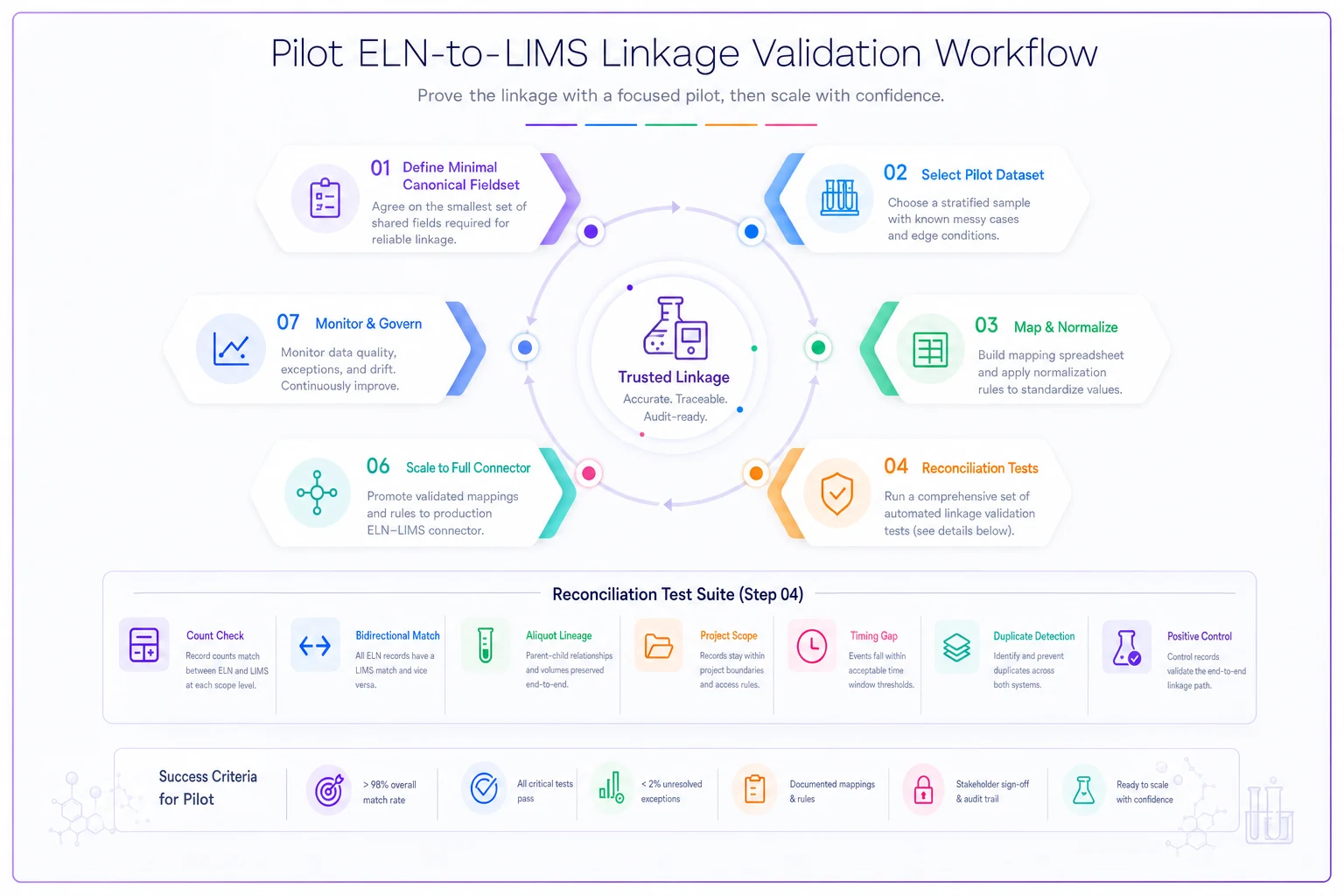
Run it before you build the full connector, not after. The teams that skip this step almost always end up doing the reconciliation eventually — just under worse conditions, at larger scale, with more history to untangle and an auditor watching. A two-day pilot on two dozen experiments is genuinely cheap insurance against that.
Run it before you build the full connector, not after. The teams that skip this step almost always end up doing the reconciliation eventually — just under worse conditions, at larger scale, with more history to untangle and an auditor watching. A two-day pilot on two dozen experiments is genuinely cheap insurance against that.
Ready to upgrade your lab operations?
Join 500+ labs using Labioly to save time, reduce errors, and enhance productivity and compliance.