
A shared –80°C freezer is one of the few places in a lab where a five-minute mistake costs you a sample nobody can replace. Someone shoves a rack into the wrong shelf, another person "temporarily" borrows a slot, and by the time a grad student is digging for a tumor lysate aliquot at 11pm, the whole map has drifted from whatever spreadsheet claims to describe reality.
This post is narrow on purpose. It's only about one thing: how to assign, map, and maintain rack positions in a freezer shared across multiple projects so samples stop disappearing. Not inventory strategy in general. Not LIMS design. Just the physical-to-record link that breaks constantly and quietly.
The specific failure: the map and the freezer diverge within weeks
The pattern shows up almost identically across labs. You start with a clean freezer. Shelf 1 is the cardiac project, shelf 2 is oncology, shelf 3 is shared overflow. Everyone agrees. Someone even makes a laminated diagram taped to the door.
-
A rack fills up, so someone puts the overflow box on a neighboring shelf "for now."
-
A tech pulls a rack for a sort, leaves the empty slot, and someone else claims it thinking it was abandoned.
-
A new project joins, and nobody formally assigns them space, so they colonize whatever looks empty.
None of this gets recorded anywhere. The door diagram is now fiction. Two weeks later a box of 96 plasma aliquots is "missing" — except it isn't missing. It's in shelf 4, position 3, filed under a rack ID that belongs on paper to a completely different study.
The freezer itself is never the problem. It holds exactly what someone put in it. The problem is that placing a sample and recording its location are two separate steps, performed at different times by different people, and the second step is the one that gets skipped when someone's cold-chain window is closing.
Why the usual fixes don't hold
Most labs have already tried the obvious things and watched them fail. Worth being honest about why.
Eliminate lab bottlenecks and errors.
Labioly helps you monitor, manage, and report lab activities efficiently and compliantly.
- Real-time sample tracking
- Inventory and supply alerts
- Staff workflow coordination
No credit card required
Freezer maps in a spreadsheet. These work for exactly one person — the one who maintains them. The moment a second team edits the file, or edits nothing and just moves a rack, the spreadsheet becomes a historical document rather than a live map. There's no way to force the physical move and the record update to happen together.
"Everyone use the LIMS" mandates. The LIMS knows a sample exists and might even have a location field. But location fields in most LIMS deployments are entered once at accessioning and almost never updated when a rack physically moves during a defrost, a consolidation, or an equipment failure transfer. The field goes stale silently.
Assigned shelves by project. Reasonable until utilization is uneven. The cardiac team fills their shelf and needs room; the dormant project's shelf sits half-empty. Rigid assignment wastes the most expensive storage you own, so people quietly violate it — and now you're back to chaos with extra steps.
The underlying issue is that none of these give you a reproducible way to decide where a new rack goes, or a verifiable way to confirm the map still matches the freezer. Those are two different problems, and you need to solve both.
A rack-assignment algorithm you can actually reproduce
The point of having an algorithm here isn't sophistication. It's that any two people, given the same freezer state, place a new rack in the same position. Reproducibility kills the "I thought this slot was free" failure mode.
Here's a working version. Adjust the field names, keep the determinism.
Every position gets a canonical address: Freezer > Shelf > Rack-slot. So F3-S2-R05 means freezer 3, shelf 2, rack slot 5. Every rack gets a stable rack ID that never changes even when the rack moves — think of it like a license plate, not a parking space.
The assignment procedure:
-
Determine the project's home zone. Each project has a preferred shelf, not an exclusive one. Recorded once, soft assignment.
-
Scan for the lowest-numbered empty slot in the home zone. Fill home zones densely, lowest address first. No spreading out "to keep things organized" — separation is what wastes space.
-
If the home zone is full, overflow to the shared shelf, lowest slot first. Overflow placements get flagged so you can rebalance later.
-
Record the rack ID → address binding immediately, at the freezer, before you close the door. Non-negotiable.
-
If a rack is being pulled temporarily, mark its slot as
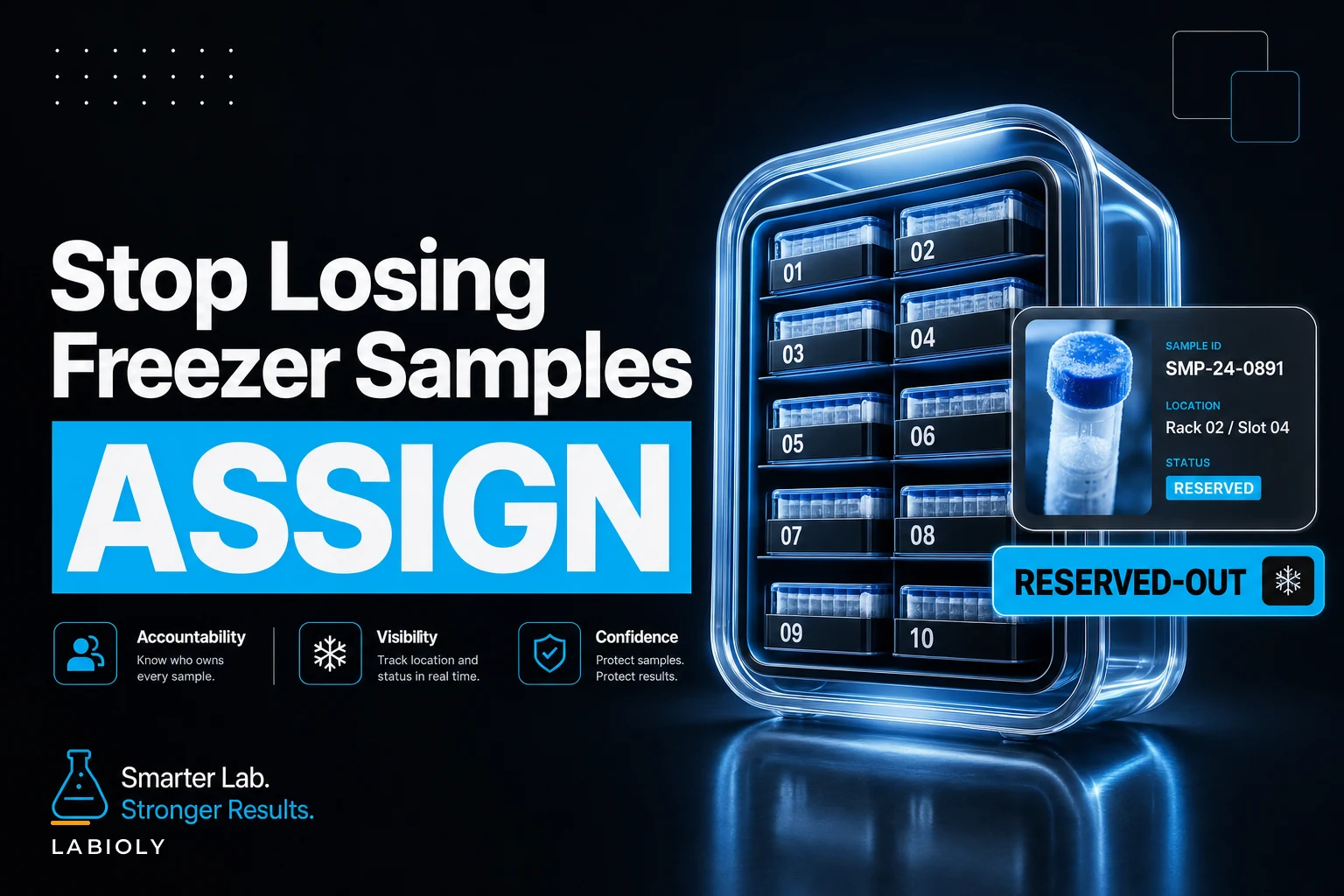
RESERVED-OUTwith the person and expected return date — notEMPTY. This single rule eliminates the most common cause of slot theft.
The RESERVED-OUT versus EMPTY distinction sounds minor. In practice it's the highest-leverage rule in the whole system. An empty-looking slot with no record is an invitation. A slot marked "out for FACS, back Thursday, K.L." gets left alone.
| Slot state | Physically | Allowed action by others | Common failure it prevents |
|---|---|---|---|
OCCUPIED | Rack present, bound to ID | None | Overwrite / stacking |
RESERVED-OUT | Empty, rack pulled temporarily | Do not use, wait | Slot theft during sorts |
EMPTY | No rack, unassigned | Available per algorithm | Random colonization |
QUARANTINE | Rack present, flagged | Do not touch | Moving compromised samples |
The QUARANTINE state matters most when a freezer is recovering from a temperature excursion and you don't yet know which racks are still viable. You absolutely don't want someone consolidating those into general storage.
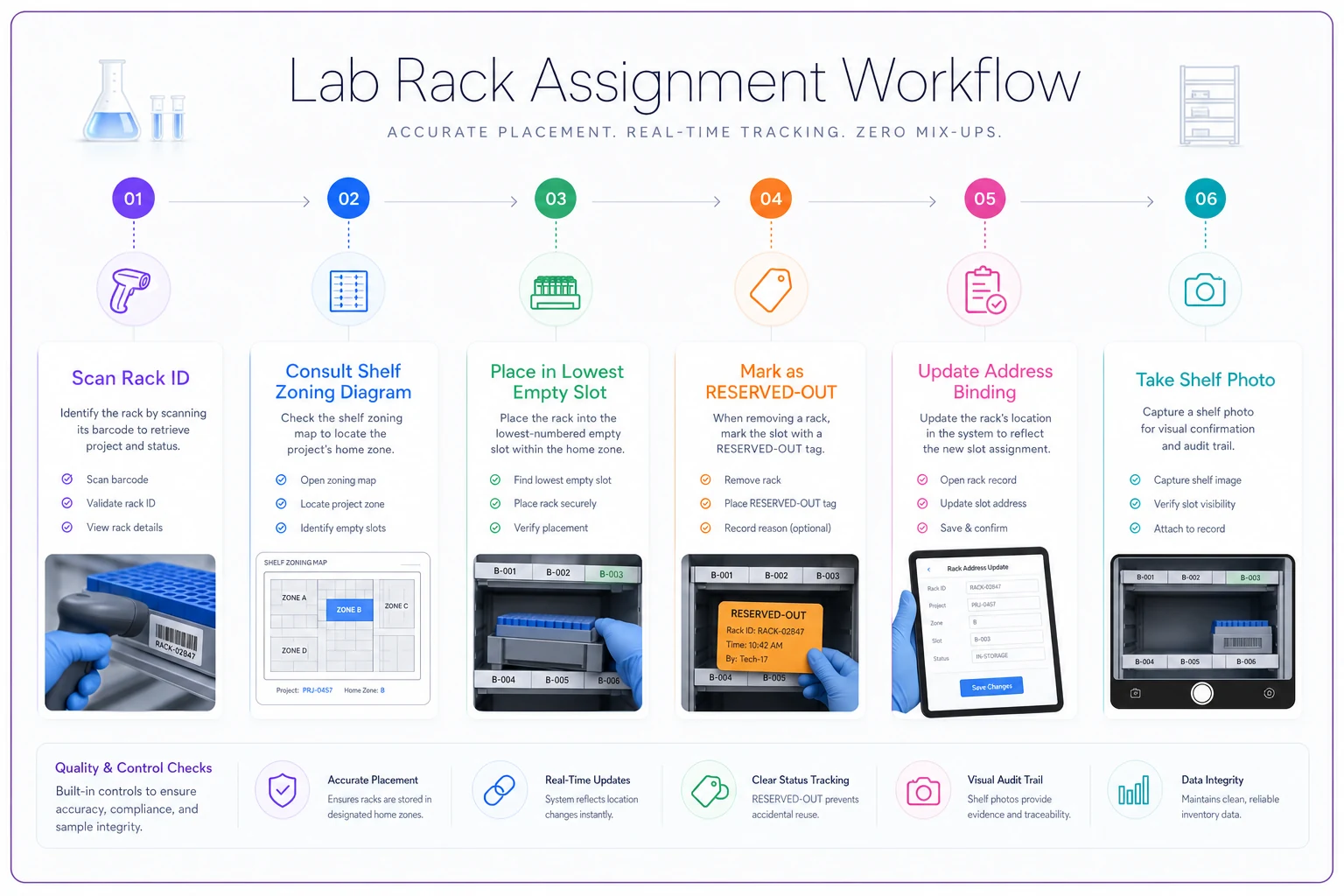
The RESERVED-OUT versus EMPTY distinction sounds minor. In practice it's the highest-leverage rule in the whole system. An empty-looking slot with no record is an invitation. A slot marked "out for FACS, back Thursday, K.L." gets left alone.
Photographic mapping templates that survive a real defrost
Written maps drift. Photos don't lie about what's physically on a shelf. But a phone full of random freezer pictures is useless — you need a template so every photo is comparable and mappable back to your addresses.
-
One photo per shelf, shot straight on, same angle every time. Tape a small angle guide or mark a floor position so the shot is repeatable.
-
A visible shelf-ID card in frame — a laminated
F3-S2card clipped to the shelf front, so the photo self-identifies without relying on filename discipline. -
Rack slot numbers visible or inferable from a printed slot grid on the shelf liner. Cheap to make, and it makes photo-to-address mapping trivial.
-
A date/initial card in the corner of every shot, so you know when it was taken and by whom.
The workflow is deliberately simple:
Open the freezer. For each shelf you touched, snap the standard shot with the shelf-ID card in frame. Upload to the shared album named for that freezer. Done. No annotation in the moment. The photo is the record of physical state, and it takes maybe fifteen seconds.
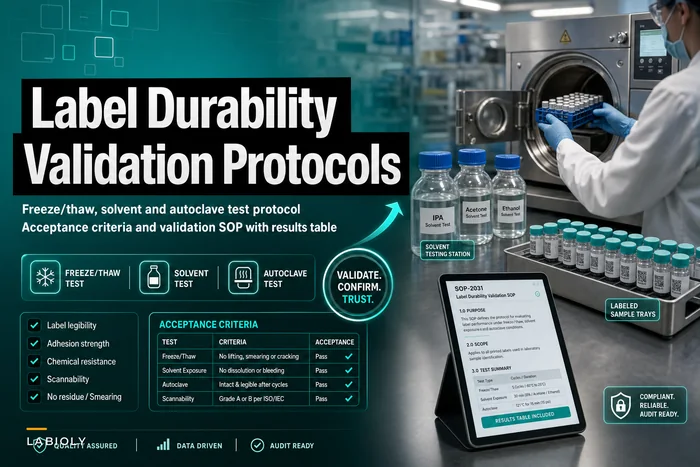
Stress-test your rack labels for freeze/thaw durability before relying on photo mapping.
The reason this works better than manual annotation is that annotation requires judgment and time — exactly what people don't have during a cold-chain move. A photo captures ground truth without asking anyone to interpret anything on the spot. Interpretation happens later, calmly, when someone reconciles the album against the address records.
This is also where label quality becomes a real dependency. If your rack labels are illegible after freeze/thaw cycles, the photos are worthless. If you haven't stress-tested your labels for those conditions, that's a prerequisite worth sorting out before building any of this. Our notes on how to validate labels for extreme lab conditions cover the freeze/thaw acceptance testing you'd want in place first.
The weekly maintenance checklist, with worked examples
A map is only as good as the cadence that keeps it honest. Weekly is the right frequency for shared research freezers — daily gets abandoned, monthly lets too much drift accumulate.
-
[ ] Pull standard photos for each shelf (five-minute door-open budget, batch it).
-
[ ] Compare each shelf photo against address records
does every
OCCUPIEDslot show a rack, and does every rack in the photo have a binding? -
[ ] Resolve every
RESERVED-OUTolder than its expected return — chase down the person or reclaim the slot with a note. -
[ ] Flag any rack physically present but not in records as an orphan; open an exception.
-
[ ] Flag any record with no matching rack in the photo as a ghost; open an exception.
-
[ ] Check overflow shelf utilization; if a home zone has freed up, schedule a rebalance move.
-
[ ] Log the reconciliation with date, initials, and count of exceptions.
A worked example — the orphan. During Tuesday reconciliation, the shelf 2 photo shows a rack in F3-S2-R07. Records say R07 is EMPTY. Pull the rack, read the rack ID off its label — it's bound to F3-S4-R02 in the records. Someone moved it and never updated the binding. Fix: correct the binding to R07 or move the rack back, then note who last had shelf 4 activity. Ten minutes, and a box of samples that was effectively unfindable is back in the system.
A worked example — the ghost. Records list rack RK-0442 at F3-S1-R03, oncology plasma. The photo shows R03 empty. Before anyone panics, check the RESERVED-OUT logs — it was pulled for an assay two days ago and the reservation flag never got set. Update the state, confirm with the tech, and the "missing" samples were never missing. Most ghosts resolve exactly this way, which is why logging reservations matters more than trusting memory.
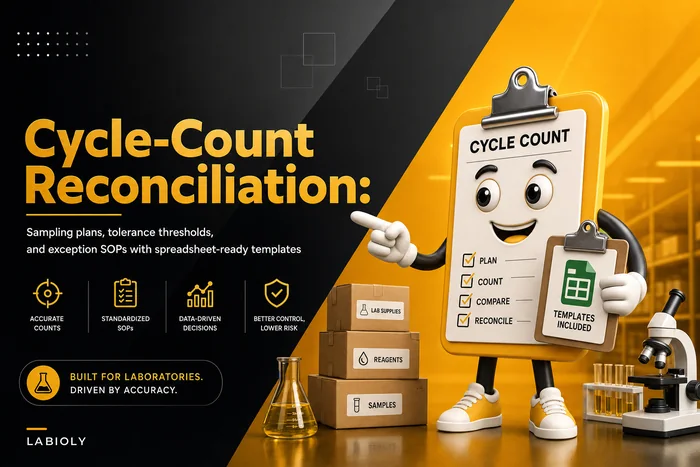
The exception-handling discipline here mirrors general inventory practice. If you want the underlying statistics on sampling and tolerance thresholds — why weekly reconciliation catches drift before it compounds rather than letting it stack — the mechanics in cycle-count reconciliation for labs transfer directly to freezer positions.
A short real scenario
A mid-sized translational lab ran three funded projects across two shared –80°C freezers, roughly 60 racks total. Before any of this, they were logging one or two "lost sample" incidents a month — usually samples that existed but couldn't be located quickly, forcing repeat blood draws or, worse, re-consenting participants.
They put in the address scheme, the RESERVED-OUT rule, and the standard-shot photo template. The first month of weekly reconciliation surfaced around nine orphans and four ghosts — all of which resolved without a single genuinely lost sample once the records were corrected. Within about two months, unlocatable-sample incidents had dropped to near zero, and the average time to physically find a specific aliquot went from "ask three people and dig" to under a couple of minutes using the photo album and address record together.
Nothing about that outcome was clever. It came entirely from making placement reproducible and making verification a fixed weekly habit.
When this is worth it, and when it isn't
When it makes sense: any freezer touched by more than one team, freezers holding irreplaceable or hard-to-recollect samples, and any facility that will face an audit asking where sample X is and whether you can prove it. The multi-project shared freezer is exactly the case this solves.
When it's overkill: a single-user freezer where one person places, retrieves, and remembers everything. The overhead of photo templates and weekly reconciliation isn't justified when there's one hand on the door.
Who should not adopt this as-is: labs that haven't first fixed their rack labeling durability. If labels smear or peel after a few freeze/thaw cycles, every photo and every binding downstream inherits that ambiguity. You'll end up building a precise system on top of unreadable labels. Fix labels first, then the map.
Where automation quietly helps
Everything above works on a shared photo album and a spreadsheet of bindings — no software required, and plenty of labs run it exactly that way. The friction shows up at scale. Reconciling dozens of photos against records by eye every week gets tedious, and stale RESERVED-OUT flags need someone to actively notice them.
That's the narrow place where an operational platform with some AI automation actually earns its keep — matching weekly shelf photos against expected address records, surfacing only the orphans and ghosts that need human attention, and flagging when a reservation passes its expected return date. The judgment stays with your team. The tedious comparison work and the "did anyone forget to update this" monitoring is what gets handled for you, so reconciliation becomes reviewing a short exception list rather than scanning sixty slots by hand.
The system is the point, though — not the tooling. A reproducible assignment rule, a photo template that captures ground truth, and a weekly reconciliation habit will stop you losing samples whether you run it on paper or on a platform. Build the discipline first. The freezer stops eating your samples the moment placement and record can no longer drift apart unnoticed.
Ready to upgrade your lab operations?
Join 500+ labs using Labioly to save time, reduce errors, and enhance productivity and compliance.