


Most labs don't actually have a prioritization system. They have a hierarchy of personalities. The PI who emails three times a day gets their samples run first. The quiet postdoc with fragile primary cells that degrade in six hours waits behind a batch of stable serum aliquots that could sit in the freezer another two weeks. Nobody wrote this down. It's just how the queue sorts itself out, and everyone knows it's wrong but nobody wants to be the one who formalizes it.
The problem with informal prioritization isn't just that it's unfair. It's that it's not auditable. When a sample gets bumped and something goes wrong, there's no record of why the decision was made, who approved it, or whether the right trade-off was even considered. That's the gap a numeric priority-scoring matrix fills — not to make the lab feel more corporate, but to make bumping decisions explainable after the fact.
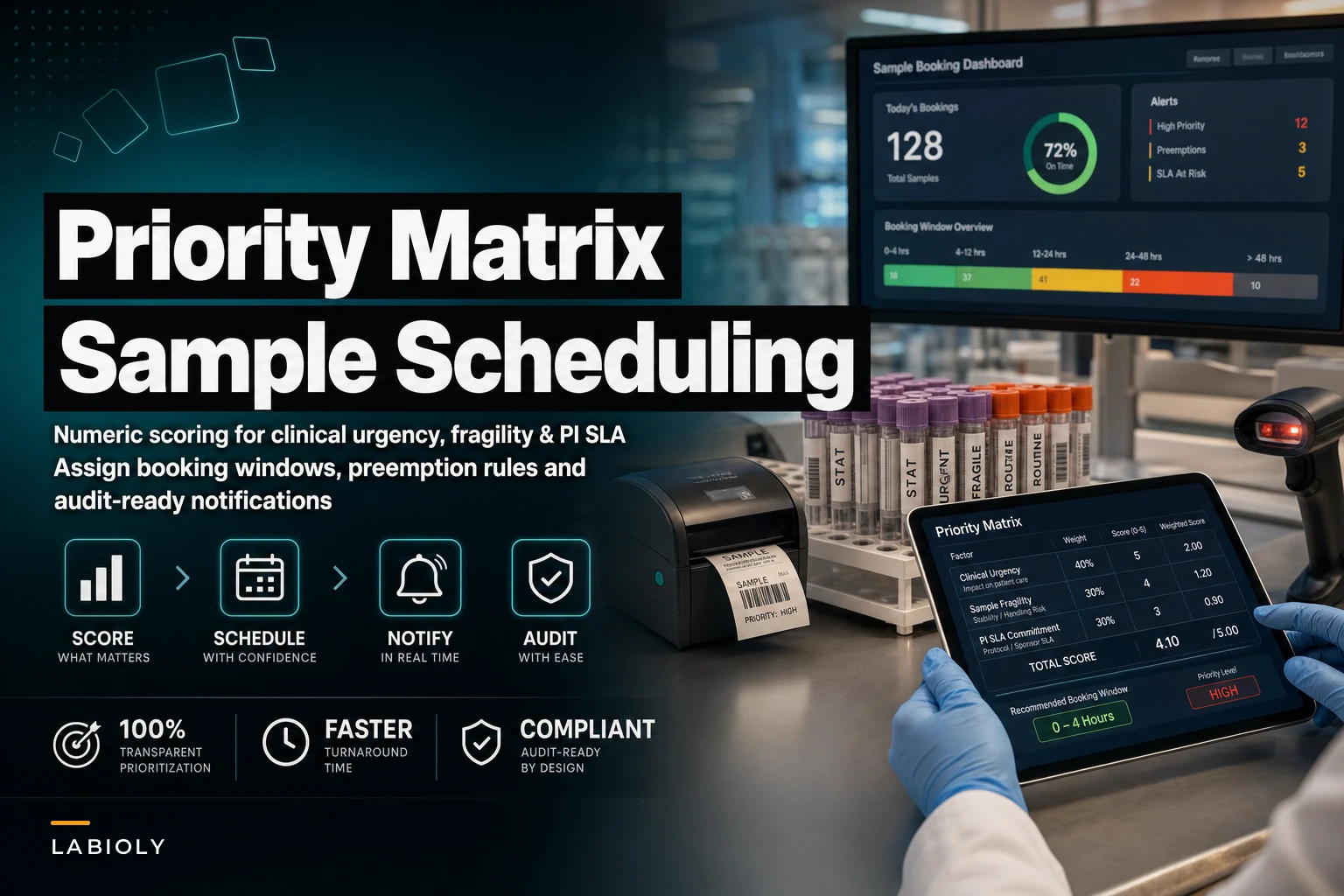
This is a practical walkthrough of how to build a scoring matrix that maps three dimensions — clinical urgency, sample fragility, and PI/sponsor SLA — onto booking windows, preemption rules, and notification templates that hold up in an audit.
Why three dimensions, and why they fight each other
Most lab attempts at a sample prioritization framework fail because they collapse everything into one axis. "Priority 1, 2, 3." The problem is that urgency and fragility are genuinely different things, and they pull in opposite directions constantly.
A clinical sample tied to a patient treatment decision is urgent but might be chemically stable for days. A research cell line slated for a routine experiment isn't urgent at all, but it degrades fast — miss the window and the sample is worthless. If you only score "priority," you can't distinguish these two, and your queue keeps making the wrong call: running the stable urgent sample first while the fragile non-urgent one sits there dying.
The matrix needs three independent scores that get combined, not one blended guess:
-
Clinical urgency — does a decision depend on this result, and how soon?
-
Sample fragility — how fast does it degrade, and is it irreplaceable?
-
PI/sponsor SLA — what turnaround was contractually or grant-committed?
The whole point is that these three can conflict, and the matrix resolves that conflict with numbers instead of email volume.
Building the scoring scales
Keep each scale to 1–5. Anything wider and your scorers won't agree on what a "7" means versus an "8." Narrow scales force consistency.
Eliminate lab bottlenecks and errors.
Labioly helps you monitor, manage, and report lab activities efficiently and compliantly.
- Real-time sample tracking
- Inventory and supply alerts
- Staff workflow coordination
No credit card required
Here's a working version. Adjust the anchors to your lab's reality, but keep the structure.
| Score | Clinical Urgency | Sample Fragility | PI / Sponsor SLA |
|---|---|---|---|
| 5 | Result drives an active treatment decision within 24h | Degrades <6h, irreplaceable (primary patient tissue) | Hard contractual TAT with penalty clause |
| 4 | Clinical decision within 72h | Degrades 6–24h, hard to re-collect | Grant milestone deadline this week |
| 3 | Informs care, not time-critical | Stable 1–3 days, re-collectable with effort | Committed internal TAT, flexible |
| 2 | Research with external deadline | Stable up to 1 week | Standard queue, no specific commitment |
| 1 | Routine research, no deadline | Stable weeks+, easily replaced | No SLA |
The anchors matter more than the numbers. A fragility score of 5 shouldn't be "very fragile" — that's subjective and two techs will score it differently. It should be "degrades in under six hours and cannot be re-collected." Concrete, testable, defensible.
One thing worth flagging: labs often mix up fragility with value. An irreplaceable sample isn't automatically fragile. A $4,000 antibody panel is expensive but stable. Keep value out of the fragility axis — if sample value matters to your prioritization, it belongs in the SLA/sponsor dimension where cost and commitment actually live.
Combining the scores without hiding the trade-off
Most people reach for a weighted average here and quietly break everything. If you average urgency, fragility, and SLA, a fragility-5 sample that degrades in four hours gets diluted by a low urgency score and ends up as a middling "3.3" — buried in the queue until it's gone.
Fragility deserves a non-linear role because fragility is a clock. Once it runs out, nothing else matters.
A cleaner approach is a two-part rule:
-
Compute a base priority score as a weighted sum. A reasonable default:
Priority = (2 × Urgency) + (1.5 × SLA) + (1 × Fragility). This orders normal cases. -
Apply fragility as a hard deadline override. Any sample with Fragility ≥ 4 gets a stability-based booking deadline computed from receipt time, independent of its base score. That deadline can jump it ahead of higher-scored samples if those samples have slack.
The base score sorts the queue. The fragility clock can preempt the sort. This mirrors how good schedulers actually think — run the long-shelf-life samples whenever, but never let a short-clock sample miss its window just because something else scored higher.
Mapping scores to booking windows
A score is useless until it maps to a committed booking window — an actual promise about when the sample enters processing. This is where the matrix stops being a spreadsheet and starts changing behavior.
A workable mapping:
-
Base score ≥ 11, or any Fragility-5 booked within same-day working window, latest 4 hours from receipt
-
Base score 8–10 booked within 24 hours
-
Base score 5–7 booked within 72 hours
-
Base score ≤ 4 next standard batch, within 1 week
Fragility-5 short-circuits the whole thing. A fragility-5 primary cell sample with a mediocre urgency score still gets the same-day window, because the override says it must.
If you're already thinking about how booking windows interact with instrument time and chargebacks, that's its own rabbit hole — we covered a lot of those booking-and-chargeback failure modes in Core Facility SLA Mistakes That Cost Time and Samples. The matrix here sits on top of that booking layer, not in place of it.
Preemption rules: the part people avoid writing down
Everyone's comfortable with a priority queue. Nobody wants to write the rule that says "sample A can kick sample B off the instrument." But preemption is exactly where informal systems cause the most damage, because it happens invisibly and gets blamed on individuals later.
Write the rules explicitly. A defensible set:
-
Fragility-5 preempts anything with ≥12h of booking slack. If the queued sample can still make its window after a delay, the fragile sample jumps it.
-
Urgency-5 clinical samples preempt all research-only samples, regardless of research SLA, unless the research sample is itself Fragility ≥ 4.
-
No sample preempts a sample already in active processing — preemption only applies to queued, not in-flight, work. Interrupting a run mid-stream usually destroys both samples.
-
Every preemption generates a logged event with the scores of both samples and the rule that triggered it.
Rule 3 is the one people forget, and it's the most important. During a crisis, the temptation is to yank something off a running instrument. In practice that produces two failed samples instead of one delayed one. Preemption is a queue operation, not a run operation.
Rule 4 is what makes the system auditable. A preemption without a logged reason is indistinguishable from favoritism. A preemption with the two scores and the triggering rule attached is a defensible operational decision.
A real scenario
A mid-size translational lab — roughly 40 researchers across six PIs, running a shared flow cytometry and genomics core — had a recurring fight every Monday. Clinical-adjacent samples from a biomarker study kept getting delayed behind a high-output PI's routine research batches, simply because that PI booked slots weeks in advance and defended them aggressively.
Before the matrix, they were losing around one irreplaceable primary sample a month to window misses — somewhere in the range of 10–14 samples a year, each representing a patient draw that couldn't be repeated. The re-collection cost wasn't trivial, but the bigger problem was that when a sample died in queue, nobody could explain why it hadn't been prioritized.
After implementing a three-axis score with a fragility override and the four preemption rules above, missed-window sample loss dropped to one or two across the same period — not per month, total. The high-output PI pushed back at first, but because every preemption now came with a logged score comparison, the conversation shifted from "you bumped my samples" to "a fragility-5 sample with a 5-hour clock preempted a stable sample with four days of slack." That's a hard argument to lose.
The uncomfortable part: the matrix didn't give anyone more total throughput. It just reallocated who waited. The win was that the waiting was now explainable and defensible, not that the lab suddenly got faster.
Notification templates that hold up in an audit
A preemption or priority decision that nobody was notified about is an operational landmine. The affected PI finds out when their sample is late, assumes incompetence, and escalates. Consistent notification templates close that loop.
Each notification should carry the same core fields so it reads consistently and can be reconstructed later:
-
Sample ID(s) affected and the sample owner
-
The computed scores on all three axes
-
The booking window assigned or revised
-
The specific rule that triggered any preemption
-
Timestamp and the person/role who authorized it
-
A link back to the chain-of-custody record
> Sample [ID] (Urgency 3 / Fragility 2 / SLA 3, base score 9) has been delayed from the 10:00 genomics slot to the next-day window. It was preempted by Sample [ID] (Fragility 5, 5-hour stability clock) under Preemption Rule 1. Authorized by [Core Manager] at [timestamp]. New committed window: [date/time].
That's the whole thing. It's boring, which is the point. Boring notifications don't get escalated, and they reconstruct cleanly when someone asks six weeks later why a sample was bumped. Tying each notice back to the custody record also means the prioritization decision lives alongside the sample's lifecycle rather than buried in someone's inbox — the approach to custody documentation in Minimal Audit-Ready Chain-of-Custody Documentation for Translational Samples pairs naturally with this.
Where this fits in the sample lifecycle
Scoring only works if the three inputs are captured at the right moment. Urgency and SLA need to be set at intake — by whoever submits the sample, validated by the core. Fragility usually comes from the sample type and protocol, which means it can often be auto-populated from a lookup table rather than scored by hand each time.
That auto-population detail matters more than it sounds. If techs have to manually score fragility on every sample, they'll default to "3" out of fatigue, and the whole override mechanism quietly dies. Fragility should be a property of the sample type, pulled automatically from a reference table, so the clock starts correctly without anyone having to remember to set it. The intake and metadata standards that make this reliable are the same ones covered in Designing an End-to-End Sample Lifecycle for Multi-Project Labs — the matrix is basically a decision layer sitting on top of a clean lifecycle.
A workflow that actually holds together looks like this: sample arrives → type lookup auto-populates fragility and starts the stability clock → submitter-provided urgency and SLA get validated at intake → base score computed → booking window assigned → if fragility override or preemption fires, the logged event and notification generate automatically → scores attach to the custody record.
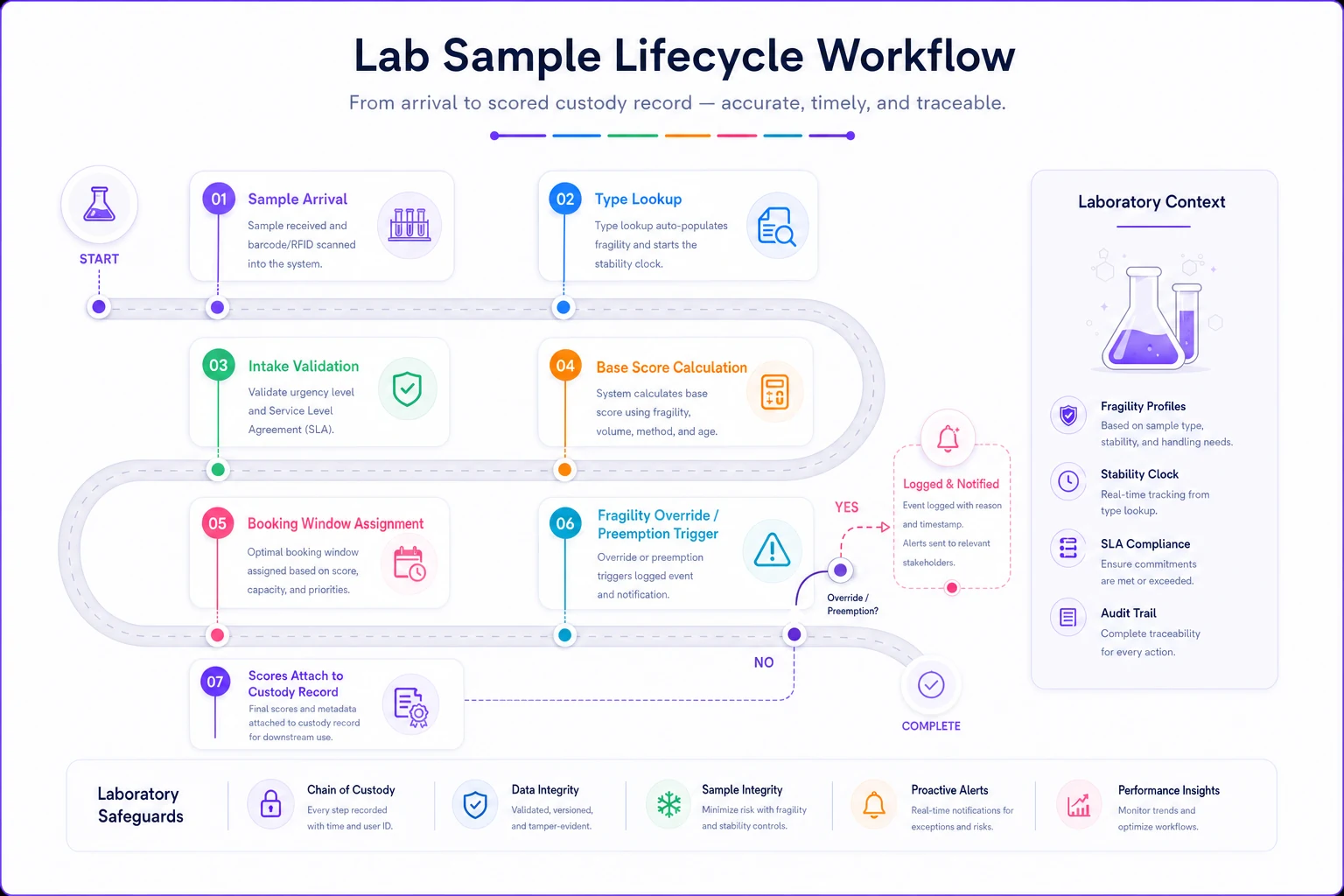
That workflow ties the scoring logic to intake and custody, so decisions are reconstructable rather than buried in email.
When this matrix makes sense — and when it doesn't
It makes sense when you have genuine contention. Multiple PIs, shared instruments, a mix of fragile and stable samples, and recurring arguments about who goes first. If samples with incompatible needs compete for the same limited capacity, you need a defensible tiebreaker, and scores beat personalities.
It's overkill for a single-PI lab running one sample type on dedicated equipment. No contention means nothing to prioritize, and the matrix is just paperwork. Don't build governance for a problem you don't have.
It's actively a bad idea if you won't enforce the preemption logging. A scoring matrix without logged preemption events is worse than no matrix — it gives the appearance of fairness while still letting the loudest PI win, except now you have a paper trail showing you had a system and ignored it. That's a worse audit position than honest informality. If you're not going to log the decisions, don't pretend to have the system.
Getting started without over-engineering it
You don't need software or a committee to pilot this. Start with the three scales, pick weightings, and run the scoring on paper for a few weeks against your actual incoming samples. Compare what the matrix would have prioritized against what you actually did. The disagreements are where the value is — they show you exactly where personality was overriding fragility and urgency.
Start with the three scales, pick weightings, and run the scoring on paper for a few weeks against your actual incoming samples.
Once the scales feel right and the preemption rules reflect decisions you'd actually defend, then worry about automating the fragility lookup and notification generation. The scoring logic is cheap to build. The hard part is the organizational agreement that a logged score beats an email, and that's a conversation, not a tool.
The real shift a prioritization matrix delivers isn't speed. It's that every bumped sample now comes with a reason, a score, and a timestamp — so when something goes wrong, you're reconstructing a decision instead of defending a personality.
Ready to upgrade your lab operations?
Join 500+ labs using Labioly to save time, reduce errors, and enhance productivity and compliance.