

Most labs treat integrations as a wiring problem. Connect the ELN to the LIMS, map a few fields, run a couple of test records, call it done. The connector works, samples flow, everyone moves on. Then eighteen months later someone updates the instrument firmware, a field that used to be a string starts coming through as a nested object, and half your overnight sync jobs fail silently. Nobody notices until a PI asks why three weeks of results never made it into the LIMS.
That gap — between "the connector works today" and "the integration stays trustworthy for years" — is what governance fills. And it's the part almost nobody plans for.
If you've already worked through connector reliability at the transport level, this picks up where that leaves off. Less about how to move data, more about who controls the rules, what happens when those rules change, and how you catch breakage before it corrupts a dataset.
The core problem: integrations decay, and nobody owns the decay
A connector is a snapshot. It reflects what two systems agreed on at the moment someone built it. But labs don't stand still. Vendors push updates. Assays get revised. A new instrument arrives and the vendor's export format is "almost" the same as the old one. Someone renames a field in the ELN because it made sense for a new project.
Each change is small. None of them individually feels like it should break anything. But integrations don't fail from one big event — they fail from accumulated drift. What tends to happen across labs is that the integration keeps running long after it stops being correct. The pipes stay connected; the meaning leaks out.
The reason this happens so consistently is ownership. Ask a lab "who owns the ELN-to-LIMS integration?" and you'll usually get a shrug, or "IT," or the name of someone who left last year. The connector has an author but no custodian. There's no one whose job is to say "this field means this, always, and if it changes, here's what has to happen."
Governance is basically the answer to that ownership vacuum, expressed as policy plus templates rather than tribal knowledge.
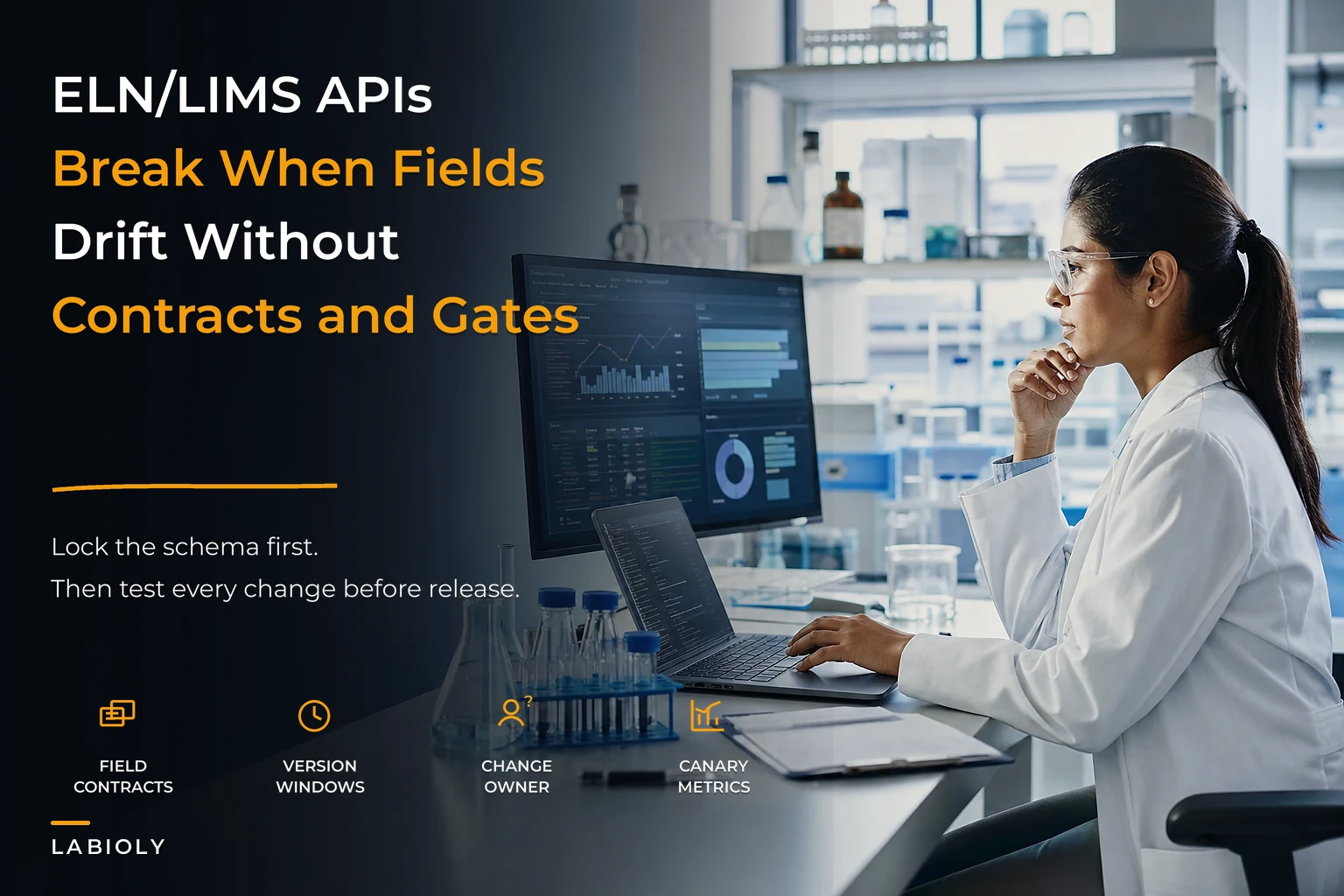
Field contracts: the thing you should build before the connector
The single highest-leverage artifact in integration governance is a canonical field contract. Not a mapping spreadsheet — a contract. The distinction matters.
Eliminate lab bottlenecks and errors.
Labioly helps you monitor, manage, and report lab activities efficiently and compliantly.
- Real-time sample tracking
- Inventory and supply alerts
- Staff workflow coordination
No credit card required
A mapping says: ELN field sampleid goes to LIMS field SPECIMENID.
A contract says: sample_id is a canonical field. It's a string, 6–24 characters, matches this pattern, is required at ingest, is immutable after creation, and is the join key for reconciliation. Any system that emits or consumes it must honor these rules. If any rule changes, that's a versioned event.
The mapping tells you where data goes. The contract tells you what's true about the data no matter where it goes. When you have contracts, a connector becomes just one implementation of the contract — swappable, testable, and accountable to something outside itself.
A workable field contract usually captures:
-
Canonical name and definition — the single agreed meaning, written in plain language
-
Type and format — data type, length limits, allowed values, regex where relevant
-
Cardinality and nullability — required, optional, repeatable
-
Mutability — can it change after creation, and who's allowed to change it
-
Source of truth — which system is authoritative when values disagree
-
Unit and precision — especially for numeric measurement fields
-
Reconciliation role — is this a join key, a checksum input, or a payload field
-
Sensitivity — does it carry PHI or consent-linked metadata
That last one connects to broader data governance concerns, but even from a pure integration standpoint, knowing source of truth per field prevents the most common category of dispute: two systems both "correct," both disagreeing, and no rule to break the tie.
The mistake most labs make is writing contracts after something breaks, as a post-mortem artifact. By then you're reverse-engineering intent from data that's already inconsistent. Contracts are cheap to write before the connector and expensive to reconstruct after.
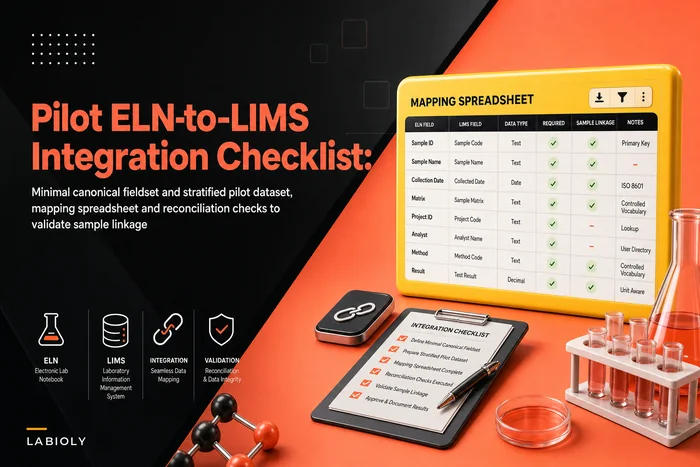
If you're at the earliest stage of an integration, the minimal-fieldset approach in the ELN-to-LIMS pilot guide pairs naturally with this — start with a small contract-backed fieldset rather than trying to govern fifty fields on day one.
Versioning policy: how contracts are allowed to change
Contracts that can't change are useless — labs evolve. Contracts that change without rules are worse than no contracts, because they create false confidence. The versioning policy sits between those two failure modes.
The core idea is borrowed from software API versioning but adapted for lab reality: classify every proposed change by its blast radius.
| Change type | Example | Blast radius | Required action |
|---|---|---|---|
| Additive (backward-compatible) | New optional field added to export | Low | Minor version bump, consumers unaffected |
| Widening | Field length limit increased, new allowed enum value | Low–medium | Minor bump, verify consumers don't over-validate |
| Semantic change | Same field name, meaning changes (e.g. "date" now means collection vs receipt) | High | Major version, full re-test, migration note |
| Type/format change | String becomes nested object, unit changes | High | Major version, staged rollout, dual-run period |
| Removal / rename | Field dropped or renamed | High | Major version, deprecation window, consumer sign-off |
The dangerous row is the semantic change. Type changes usually break loudly — the parser throws, someone gets paged. Semantic changes break quietly. The field still validates, data still flows, and the numbers are just... wrong. A "date" column that silently shifts from receipt-date to collection-date won't error anywhere. It'll just poison every downstream calculation that assumed the old meaning, and you might not catch it for months.
A versioning policy that only guards against structural breakage misses the changes that actually cause the worst incidents. Your policy needs to force a human classification step: does this change alter what the field means? That question can't be automated away, and it's the one that saves you.
-
A change proposal template — what's changing, which contract, which classification, who's affected
-
A required approver list per contract — usually the source-of-truth owner plus each consuming system's custodian
-
A deprecation window for breaking changes — old and new coexist for a defined period
-
A dual-run requirement for high-blast-radius changes — both versions emit in parallel while you compare
-
A changelog attached to the contract itself, not buried in a ticket system nobody reads
The connector-level failure modes worth designing around are covered in more depth in the integration pitfalls and connector patterns write-up — governance sits on top of those patterns rather than replacing them.
Staged integration tests: catching breakage before it reaches production data
The operational truth that separates mature integrations from fragile ones: you cannot trust an integration you only test manually, once, at build time. Changes happen continuously, so validation has to happen continuously too — in stages, with clear gates between them.
A staged testing model usually looks like four progressively realistic environments:
Stage 1 — Contract validation (synthetic). Before anything touches real data, you validate that emitted payloads conform to the field contract. Types, formats, required fields, allowed values. This is fast, runs on every connector change, and catches the common stuff — the truncated field, the missing required key, the wrong date format.
Stage 2 — Reference dataset (fixed, known-good). A frozen set of records with known-correct outputs. You run the integration end to end and diff against expected results. The value here is regression detection: when someone "improves" the connector, this stage tells you immediately if the improvement changed behavior it shouldn't have. Reconciliation logic — checksums, join-key matching, count balancing — belongs here.
Stage 3 — Shadow / dual-run (real data, no writes). The integration processes live production data but writes to a staging target instead of the real LIMS. You compare the shadow output against the current production output. This is where semantic drift and edge cases from real data surface — the weird sample IDs, the null values nobody expected, the instrument that exports slightly differently on Mondays. Dual-running is the most underused safeguard in lab integrations, and it's the one that would prevent most silent-corruption incidents.
Stage 4 — Canary in production. Route a small slice of real traffic — one instrument, one project, one workflow — through the new version while everything else stays on the old one. Monitor closely, then widen.
The pattern most labs actually run is Stage 1 informally, skip 2 and 3 entirely, and treat Stage 4 as "we turned it on and watched for an hour." That's not a testing strategy — it's optimism with a timer.
You don't need all four stages for every change. A backward-compatible additive change can go through Stages 1–2 and ship. A semantic or type change must clear Stage 3 dual-run. Tie the required stages directly to the versioning classification above, so the policy answers "how much testing?" automatically.
The connector-level failure modes worth designing around are covered in more depth in the integration pitfalls and connector patterns write-up — governance sits on top of those patterns rather than replacing them.
Monitoring rules: governance doesn't stop at deployment
Testing verifies a change at a point in time. Monitoring verifies that reality keeps matching the contract after you stop looking. The two aren't interchangeable, and labs that invest heavily in the first while ignoring the second get blindsided anyway.
-
Volume anomalies — record counts that deviate from expected ranges. If an instrument normally emits 40–60 results a day and today it's 4, something upstream broke even if no error fired.
-
Contract-conformance drift — fields that start violating the contract over time (a length limit quietly being exceeded, an enum value nobody registered appearing).
-
Reconciliation gaps — records that leave one system and never arrive, or arrive with mismatched join keys. This is your last line against silent data loss.
-
Latency and freshness — data that's technically flowing but arriving late enough to be operationally useless.
-
Semantic tripwires — targeted checks on high-risk fields, like flagging when a date field's distribution shifts abruptly (a proxy for the receipt-vs-collection meaning change).
Most integration incidents get detected by users rather than systems, and by then the damage window is already weeks wide. A monitoring rule as simple as "alert if daily reconciliation shows more than N unmatched records" turns a three-week silent failure into a next-morning ticket. That single rule is often worth more than an elaborate dashboard nobody checks.
A monitoring rule as simple as "alert if daily reconciliation shows more than N unmatched records" turns a three-week silent failure into a next-morning ticket.
Monitoring output also feeds your audit story. The same conformance and reconciliation signals you use operationally double as evidence that the integration behaved correctly during any given period — which connects directly to how you'd structure a canonical audit-evidence architecture so that integration health isn't a separate silo from your evidence trail.
How it holds together as a system
Individually, contracts, versioning, staged tests, and monitoring are each just good practice. The value comes from how they reinforce each other.
The field contract defines truth. The versioning policy governs how that truth is allowed to change and forces a blast-radius classification. That classification drives which test stages a change must clear before shipping. And monitoring continuously checks that production still matches the contract, feeding failures back into the change process as new proposals.
Here's a simple diagram of how these pieces loop together.
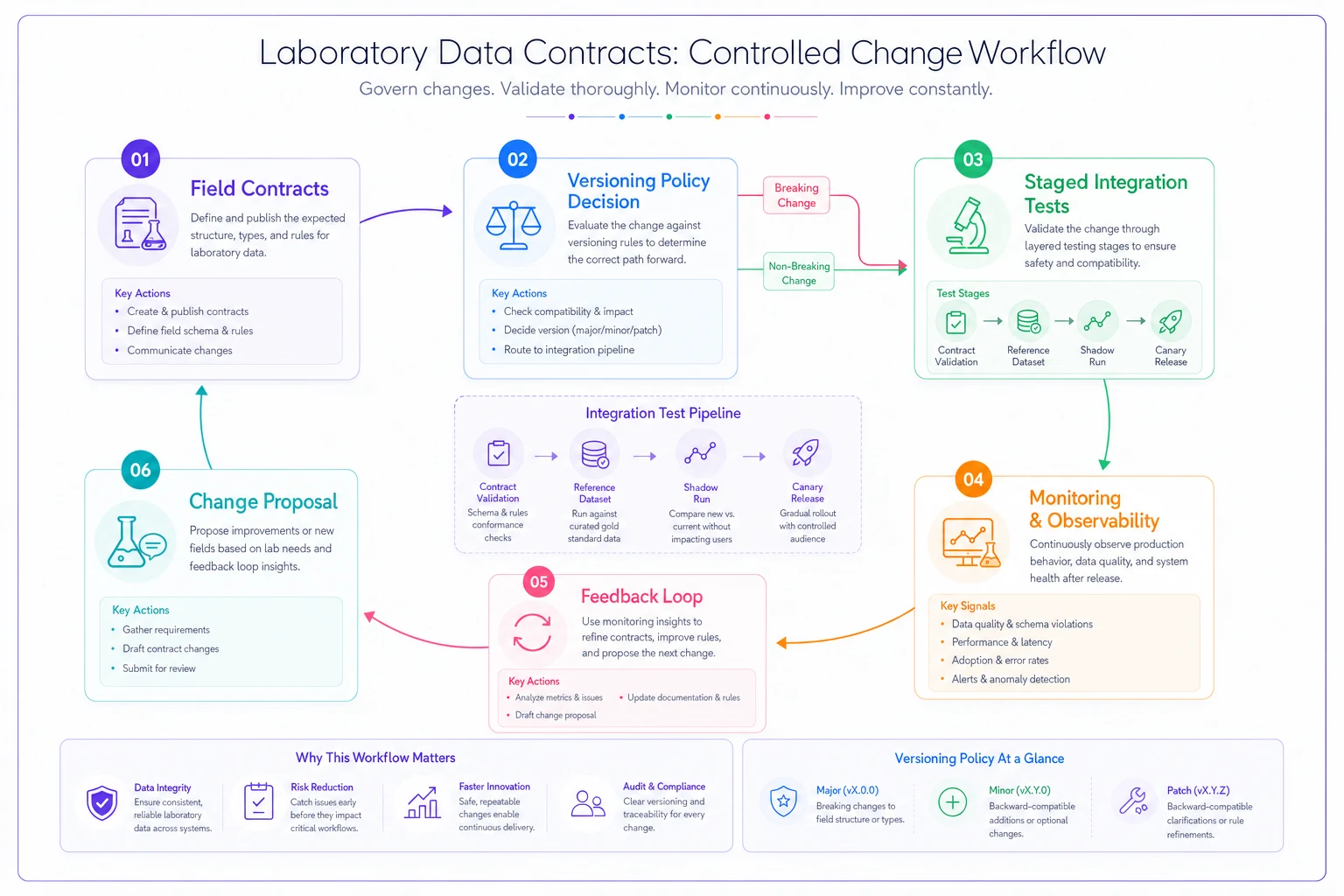
It's a loop, not a checklist. A field contract with no versioning policy gets ignored the first time someone's in a hurry. A versioning policy with no staged tests is just paperwork. Staged tests with no monitoring verify the past but not the present. Monitoring with no contract to compare against can only detect crashes, not corruption. Remove any one piece and the others degrade.
A useful way to think about maturity: a fragile integration knows that it's connected. A governed integration knows what is flowing, what it means, how it's allowed to change, and whether it's still true right now.
When this level of governance actually makes sense
Full policy-plus-template governance is real work. It's not always justified.
It makes sense when:
-
You have more than two systems exchanging data, or more than one instrument type feeding the LIMS
-
Data from the integration feeds regulated, audited, or published results
-
Multiple people or teams depend on the integration and nobody currently owns it
-
You've already been burned by at least one silent-failure incident — most labs adopt governance right after the first painful one
It's overkill when:
-
You have a single, stable, low-volume connector between two systems that rarely change
-
The integration feeds only exploratory work where scientists review every result anyway
-
You're still at the pilot stage and haven't validated the basic fieldset yet — govern after the pilot proves the mapping, not before
Who should not do this yet: a lab that hasn't run a successful integration pilot at all. Governance structures a thing that already works; it can't rescue a connection that was never validated. Get the minimal fieldset flowing and reconciled first, then wrap governance around it.
A short real scenario
A mid-sized translational research group ran an ELN-to-LIMS integration across three instrument types, feeding roughly 300–400 result records a week. It had worked fine for over a year, built by a postdoc who'd since moved on. No contracts, no versioning, informal testing.
A vendor firmware update changed one numeric field's decimal precision and, on one instrument, subtly shifted a timestamp field from local time to UTC. Nothing errored. Data kept flowing. The problem surfaced about five weeks later when a reviewer noticed a batch of results whose timestamps didn't line up with the freezer logs — and unwinding which records were affected took the better part of two weeks, because there was no reconciliation baseline to diff against.
After that incident, they did the boring work: wrote field contracts for the roughly 20 fields that mattered, classified change types, and stood up a nightly reconciliation check with a simple unmatched-record alert plus a freshness check per instrument. The next vendor update — which again changed a field format — was caught in the shadow-run stage before it ever touched the production LIMS. The change that previously cost weeks of forensic cleanup became a one-line entry in a changelog and a same-day fix.
The interesting part isn't that governance prevented the second incident. It's that the second change was the same kind of change as the first. The difference was entirely in whether anyone had defined what "correct" meant ahead of time.
Closing thought
Connector how-tos get you an integration that works on the day you build it. Governance is what keeps it correct on every other day — through firmware updates, staff turnover, assay revisions, and the slow accumulation of small changes that no single person notices. The labs that avoid multi-week forensic cleanups aren't the ones with the fanciest connectors. They're the ones who decided, in advance, what each field means, who's allowed to change it, how changes get tested, and how they'd know if reality stopped matching the plan. Not glamorous engineering. But it's the difference between an integration you trust and one you just hope is still working.
Ready to upgrade your lab operations?
Join 500+ labs using Labioly to save time, reduce errors, and enhance productivity and compliance.