
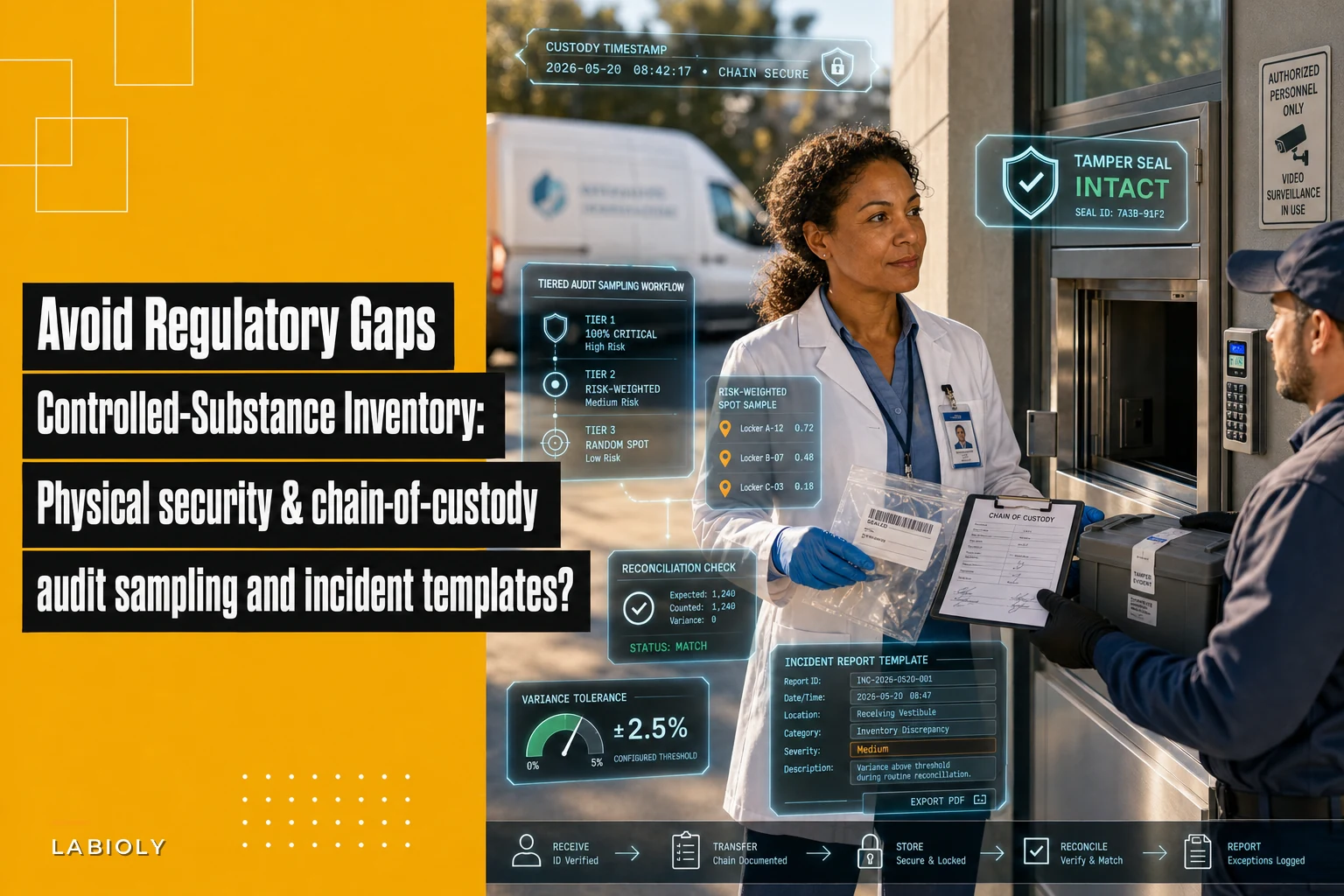

Most controlled-substance findings aren't dramatic. Nobody steals a vial of fentanyl standard off the bench. What gets labs cited is quieter: a logbook entry that doesn't match the sealed container count, a receiving signature that's missing, a vial that evaporated below its recorded mass and nobody documented why. The gap lives in the paperwork, not the safe.
That's what a solid controlled substance inventory SOP has to actually get right. It's not about buying a bigger cabinet. It's about making sure every gram that enters the building has an unbroken, defensible record from the loading dock to final disposal — and that your audit sampling catches drift before an inspector does.
This post covers the parts labs most often get wrong: physical security that holds up under scrutiny, chain-of-custody fields people forget to capture, how to sample for periodic audits without counting everything every time, what variance tolerances are realistic for solvents and solids, and an incident-report template you can actually fill out at 4pm on a Friday.
Where the records actually break
Before the checklist, it helps to understand the failure patterns, because they're surprisingly consistent.
The first break point is receiving. A shipment of a Schedule II reference standard arrives, someone signs for the parcel at the general shipping desk, and it sits in a non-secured area for two hours before the authorized custodian logs it in. On paper, there's a gap between carrier handoff and secured storage where nobody can say who had access. An auditor doesn't need proof of theft — the undocumented window itself is the finding.
The second is partial use. An analyst draws 2 mL from a 10 mL ampoule of a controlled liquid, uses 1.3 mL in a method, and the rest evaporates or stays in the syringe. The logbook says "2 mL removed" but the reconciliation math never accounts for the working loss. Over a few months, the running balance and the physical container drift apart with no documented reason.
The third — and the one that quietly sinks small labs — is custodian turnover. The one person who knew the logbook system leaves, the backup never got trained properly, and six weeks of entries get reconstructed from memory. Reconstructed records are the easiest thing in the world for an inspector to pick apart.
None of these are security failures in the "someone broke in" sense. They're documentation discipline failures. The fix is operational, not physical.
Physical security: what inspectors actually check
Storage requirements vary by schedule and jurisdiction — DEA has its own standards, state and institutional rules often stack on top — so treat the following as a baseline to adapt, not a universal checklist. That said, physical-security findings cluster around a few predictable items.
Eliminate lab bottlenecks and errors.
Labioly helps you monitor, manage, and report lab activities efficiently and compliantly.
- Real-time sample tracking
- Inventory and supply alerts
- Staff workflow coordination
No credit card required
-
Storage rating matches the schedule. Schedule II substances generally require a securely locked, substantially constructed cabinet or safe. A plywood drawer with a padlock doesn't qualify. Check that your container is rated, not just locked.
-
Access list is current and minimal. Every name with key, code, or badge access to controlled storage must be authorized, documented, and still employed. Dormant access for people who've left is the single most common physical-security citation.
-
Dual control where required. For high-risk substances, two authorized people should be needed to access — or at minimum to witness — transactions. Solo access to a Schedule II safe with no witness trail is a weak point.
-
Key and combination management. Combinations changed when a custodian leaves. Keys signed out, not floating in a shared drawer. If three people can open the safe and nobody knows who opened it last, your chain-of-custody is already broken before any substance moves.
-
Alarm and access logging. Badge-reader logs or a manual access log recording who opened the storage and when. The point isn't surveillance — it's that your access record and your inventory record should corroborate each other.
Physical security only counts if it generates a record. A perfect safe with no access log is worse, from a compliance standpoint, than a mediocre cabinet with a disciplined sign-in sheet. Inspectors trust records, not hardware.
The chain-of-custody fields people forget
A controlled-substance record has to answer one question at every point in the lifecycle: who had this, how much, and when? Most logbooks capture quantity and date. They skip the rest.
| Field | Why it matters |
|---|---|
| Unique container/lot ID | Lets you reconcile a specific physical item, not just a running total |
| Substance + schedule | Determines which rules apply; mixed-schedule logs cause confusion |
| Carrier → custodian handoff timestamp | Closes the receiving gap that creates undocumented access windows |
| Receiving signature (authorized custodian) | Establishes who took responsibility, not just who signed the parcel |
| Running balance (theoretical) | The number reconciliation compares against |
| Quantity removed + working loss | Partial-use loss must be recorded, or the balance drifts |
| Purpose / method reference | Ties usage to an actual experiment for traceability |
| Witness signature (for Sched II / dual control) | Required where two-person control applies |
| Disposal record + manifest reference | Disposal is where a lot of records die quietly; link to the manifest |
The working-loss field deserves extra attention because it's the one that silently wrecks reconciliation. If your method consumes a controlled solvent and 0.2 mL stays wetting the glassware every time, that's a predictable, documentable loss. Record it. A balance that's always "short" with no explanation reads to an auditor exactly like diversion.
For a deeper look at structuring custody fields so they survive an audit rather than just exist, the approach in minimal audit-ready chain-of-custody documentation carries over well — the principle of capturing the minimum defensible field set, consistently, applies directly to regulated substances.
Periodic audit sampling: you don't have to count everything
A common mistake is treating controlled-substance audits as all-or-nothing: either a full 100% physical count every time (which nobody sustains, so it slips) or nothing until an inspection forces a panic count.
The better model is tiered sampling by risk — a full reconciliation at a defined interval with lighter spot-checks in between.
-
Full reconciliation of all controlled items — quarterly at minimum, monthly for Schedule II. Every container physically verified against the logbook balance.
-
Risk-weighted spot sampling between full counts. Pull a sample skewed toward high-abuse-potential, high-value, or high-turnover items. A slow-moving Schedule V item doesn't need the same frequency as a frequently accessed Schedule II standard.
-
Trigger-based counts on top of the schedule — any time a custodian changes, after a suspected discrepancy, or when a container transitions custody.
For spot sampling, bias your sample intentionally. If you have 60 controlled items but 8 of them account for most of the movement, those 8 should show up in nearly every sample. The slow-movers can rotate through less often. The statistical sampling logic in cycle-count reconciliation for labs maps cleanly onto this — the difference is that for controlled substances your tolerance is tighter and an unexplained variance can't just be adjusted away. It has to be investigated.
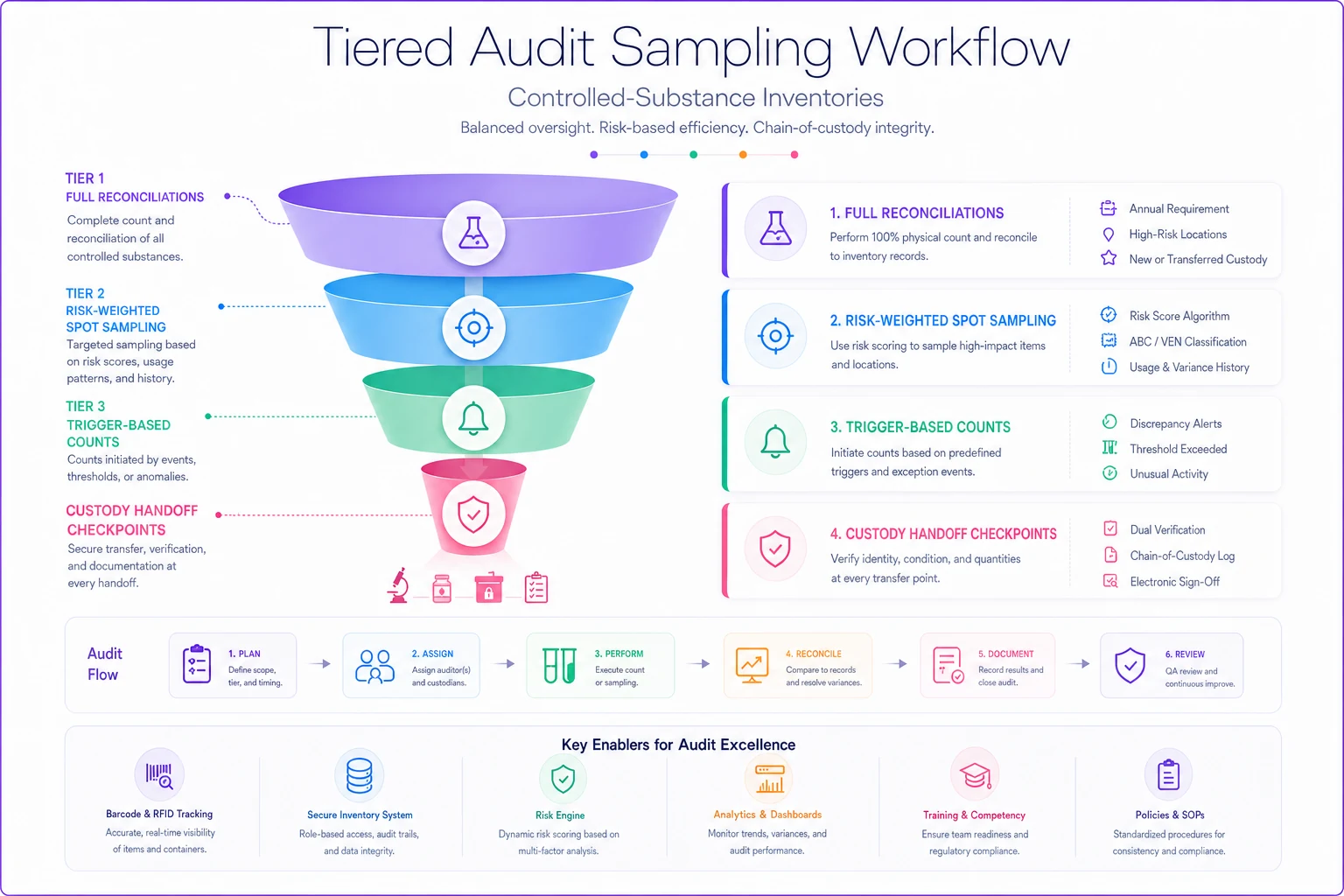
This diagram shows the sampling cadence and the custody checkpoints that should be recorded at each step.
Variance tolerances: what counts as a discrepancy
For most inventory, a small variance is a rounding issue you adjust and move on. For controlled substances, the question is different: at what point does a difference stop being measurement noise and start being a reportable discrepancy?
| Item type | Reasonable tolerance basis | Outside tolerance → |
|---|---|---|
| Solid, weighable (e.g., a powder standard) | Tight — balance precision plus handling loss, often a fraction of a percent | Investigate, document, possibly report |
| Controlled liquid / solvent | Wider — accounts for evaporation and working loss, but must be justified | Investigate before adjusting |
| Sealed, unopened container | Essentially zero — it's either there intact or it isn't | Immediate incident, no tolerance |
| Multi-use ampoule | Based on documented per-use working loss | Reconcile against usage log first |
The sealed-container row matters most. A sealed Schedule II container has no legitimate variance. It's present and intact, or you have an incident. Labs that apply a "small variance is fine" mindset uniformly across all inventory get burned here — there's no tolerance to spend on a container nobody should have opened.
One more thing worth stating directly: a tolerance you set after seeing the count is worthless. If you decide what's acceptable based on how far off you already are, you've defeated the entire control. Set it in the SOP, tie it to the measurement method, and then live with it.
Incident-report template that actually gets filled out
When a variance falls outside tolerance — or anything else goes wrong, like a missing signature discovered during audit or a broken container — you need a report that captures what matters without being so heavy that people avoid writing it.
-
What was discovered — the specific discrepancy, missing record, or event, in plain terms
-
When and by whom — discovery date/time and the person who found it
-
Substance, schedule, container ID, expected vs. actual — the hard numbers
-
Immediate containment actions — what was done to secure the area, stop use, or isolate the item
-
Initial assessment — measurement error, documented loss, procedural miss, or possible diversion
-
Notifications made — custodian, supervisor, compliance officer, and any regulatory notification with timestamps
-
Investigation outcome and corrective action — root cause and what changed
-
Sign-offs — investigator and responsible authority
The practical failure mode isn't that labs lack a template. It's that the template is three pages long and nobody fills it out while the details are fresh. Keep the discovery-time section short enough to complete in five minutes, and let the investigation section grow over the following days. A fast, partial report filed the day of discovery beats a perfect report filed a week later from memory.
Keep the discovery-time section short enough to complete in five minutes, and let the investigation section grow over the following days.
One thing people consistently skip: notification timestamps. If your regulatory context requires reporting a loss or discrepancy within a set window, the report has to show when you knew and when you notified. A report that documents the discrepancy but not the notification timeline leaves you exposed on the one thing an inspector will absolutely check.
A short real scenario
A mid-size university analytical lab handling around 40 controlled items across Schedules II–V ran into this during an internal pre-inspection review. Their logbook balances looked fine on paper, but a physical count found three liquid controlled standards consistently short by small amounts — a few tenths of a milliliter each. No theft, no alarm. Just no recorded working loss, accumulated over roughly six months of method use.
Unexplained on its own. Under inspection, it would have read as three potential diversions.
The fix wasn't technology. It was two changes to the SOP. First, they added a working-loss field to the usage log tied to each method, so per-use evaporation and glassware loss got recorded as it happened instead of disappearing from the math. Second, they moved from an annual full count to monthly reconciliation on Schedule II items and risk-weighted spot checks on the rest. Within a couple of cycles the "shortages" resolved into documented, explainable losses, and the running balances matched the physical count within tolerance. The reconciliation time went up modestly — maybe an extra hour or two a month — but the lab walked into its next inspection with records that explained themselves.
Where software quietly helps — and where it doesn't
Most of what makes controlled-substance inventory defensible is discipline, not tooling. You can run a perfectly compliant program on paper logs if the people are consistent. The problem is that paper doesn't enforce completeness, and consistency erodes the moment a custodian leaves.
Where an inventory or sample-management platform earns its place is in removing the gaps the SOP can't catch on its own: enforcing required fields so a transaction can't be saved without a witness signature or a working-loss entry, timestamping custody handoffs automatically so the receiving gap closes itself, flagging a running balance that drifts outside tolerance before the next audit, and keeping an access log that corroborates your inventory record. That's less about automation for its own sake and more about making the right record impossible to skip.
If you're thinking about how controlled-substance records fit into the broader control environment — roles, validation checkpoints, audit-ready evidence — it's worth reading this alongside a laboratory data governance framework, because controlled substances are really just the highest-stakes case of the same evidence discipline that should apply everywhere.
The bottom line
The labs that pass controlled-substance inspections aren't the ones with the biggest safes. They're the ones whose records corroborate each other — where the access log matches the inventory log, where every variance has a documented reason, and where the chain from carrier handoff to disposal manifest has no silent gaps.
Build the SOP around that: physical storage that generates access records, chain-of-custody fields that capture handoffs and working loss, risk-weighted sampling so audits actually happen, tolerances set in advance and tied to your measurement method, and an incident report short enough that people actually fill it out on time. Do that consistently, and a controlled-substance audit stops being something you brace for and becomes something your own paperwork answers for you.
Build the SOP around that: physical storage that generates access records, chain-of-custody fields that capture handoffs and working loss, risk-weighted sampling so audits actually happen, tolerances set in advance and tied to your measurement method, and an incident report short enough that people actually fill it out on time. Do that consistently, and a controlled-substance audit stops being something you brace for and becomes something your own paperwork answers for you.
Ready to upgrade your lab operations?
Join 500+ labs using Labioly to save time, reduce errors, and enhance productivity and compliance.