



Most labs don't struggle to find things to buy. They struggle to defend the things they bought. A new automation deck, an LIMS module, an upgraded liquid handler—each one sounded essential during a vendor demo, got approved on a hopeful spreadsheet, and six months later nobody can clearly say whether it actually moved anything. Throughput looks about the same. The backlog is still there. And when the next capital request lands, the conversation starts from scratch.
That gap—between "we bought it" and "it earned its place"—is what lab tech investment governance is actually about. Not approval forms. Not procurement paperwork. A repeatable way to score what you're considering, trigger a purchase at the right moment, and define upfront what a pilot has to prove before it converts to permanent spend.
This article walks through a scoring framework you can actually run, the triggers that tell you when to buy rather than just whether, and pilot success criteria with worked examples. The goal is to make funding decisions boring and defensible instead of political and gut-driven.
Why good labs still make bad tech investments
The pattern is almost always the same, and it's rarely about diligence.
A request originates with the person closest to the pain. The histology core is drowning in manual slide logging, so they want a tracking system. The genomics group keeps losing time to plate reformatting, so they want an automated handler. Each ask is legitimate in isolation. The problem is that isolated asks get evaluated in isolation—whoever makes the most compelling case, or has the most political capital, or happens to ask in a quarter with leftover budget, wins.
What breaks is the comparison. You end up ranking a $12k barcode system against an $80k robotics platform using the same loose gut-feel, when they solve completely different classes of problem at completely different risk levels. Nobody's actually weighing operational value against risk reduction against throughput uplift, because there's no shared yardstick.
The second failure is timing. Even correct purchases get made at the wrong moment—too early, when utilization won't justify the spend for another year, or too late, after the bottleneck has already cost you grant deadlines. Labs rarely define the trigger that says "now." They define the want, then wait for budget to appear.
And the third, quietest failure: pilots that never had a definition of success. A tool gets trialed, everyone's vaguely positive, and it converts to permanent spend on momentum. Two years later it's a line item nobody questions and nobody uses at capacity.
The three dimensions worth scoring
Forget elaborate weighted-criteria matrices with fourteen factors. Almost every lab tech investment earns its keep through some mix of three things:
Eliminate lab bottlenecks and errors.
Labioly helps you monitor, manage, and report lab activities efficiently and compliantly.
- Real-time sample tracking
- Inventory and supply alerts
- Staff workflow coordination
No credit card required
Operational value — Does it reduce manual effort, remove coordination overhead, or centralize information that's currently scattered across inboxes and spreadsheets? A sample-tracking upgrade that eliminates three hours of daily manual reconciliation scores high here even if it never touches throughput.
Risk reduction — Does it lower the probability or cost of something going wrong? Failed runs, lost samples, audit findings, chain-of-custody gaps. A freezer monitoring system might do almost nothing for throughput but score very high on risk because one unnoticed failure wipes out irreplaceable specimens.
Throughput uplift — Does it let you process more work with the same or fewer resources? This is the most seductive axis because it's the easiest to quantify—and the easiest to overstate. More on that shortly.
These three rarely move together, and that's the point of scoring them separately. A purchase that's mediocre on all three is an easy no. Exceptional on one is usually worth a closer look. The dangerous category is the one that's moderate on all three—it feels balanced and reasonable, which is exactly why it slips through without anyone asking whether "moderate everywhere" is worth the capital.
A scoring framework you can run in a meeting
Score each dimension 1–5, then apply a weight that reflects your lab's current situation. A lab fighting audit problems weights risk reduction heavily. A core facility with a six-week backlog weights throughput. The weights are a deliberate statement of priorities, not a universal constant.
| Dimension | Score (1–5) | Weight | Weighted score |
|---|---|---|---|
| Operational value | 1 = minor convenience, 5 = removes a major recurring manual burden | ×0.3 | — |
| Risk reduction | 1 = negligible, 5 = prevents catastrophic or audit-critical failure | ×0.4 | — |
| Throughput uplift | 1 = no measurable gain, 5 = materially expands capacity | ×0.3 | — |
A combined weighted score gives you a ranked list. But the number isn't the decision—it's the start of the conversation. The real value is that two reviewers scoring the same purchase and landing far apart have to explain why, and that explanation surfaces assumptions nobody stated out loud.
A worked example
Say the lab is weighing two requests this quarter.
Request A: Automated aliquoting system — $64k
-
Operational value
4 (removes ~15 hrs/week of manual pipetting across two techs)
-
Risk reduction
3 (fewer transcription and volume errors, but not catastrophic-level)
-
Throughput uplift
4 (frees capacity roughly equivalent to a third of an FTE)
With weights 0.3 / 0.4 / 0.3: (4×0.3) + (3×0.4) + (4×0.3) = 3.6
Request B: Freezer and environmental monitoring platform — $18k
-
Operational value
2 (modest—replaces manual temperature logging)
-
Risk reduction
5 (prevents loss of irreplaceable biobank samples; a past near-miss cost roughly $40k in redraws)
-
Throughput uplift
1 (none)
Same weights: (2×0.3) + (5×0.4) + (1×0.3) = 2.9
On raw score, Request A wins. But look at what the weights are doing. If this lab had a freezer scare last year and is heading into an audit, bumping risk weight to 0.5 flips the ranking entirely. The framework doesn't make the decision for you—it forces you to state which weighting you're standing behind. That's the whole point. A decision you can explain is a decision you can defend when finance pushes back, which ties directly into how you frame these asks in your broader laboratory financial and capacity strategy for budget decisions.
The throughput-uplift trap
One pattern worth flagging because it burns labs repeatedly: throughput projections almost always assume the bottleneck lives where the tool is.
A core facility buys a faster sequencer expecting to double output. Six months later, output is up maybe 20%, because the real constraint was library prep upstream and data analysis downstream—neither of which the sequencer touched. The capital went to the most visible station, not the actual bottleneck.
Before you score throughput uplift above a 3, you should be able to point at the specific step where work currently queues and confirm the investment attacks that step. If you can't identify the queue, the throughput score is a guess dressed up as a number. The honest version of this in practice: measure where samples actually wait before you fund the thing that's supposed to make them wait less.
Procurement triggers: deciding *when*, not just *what*
A scored, ranked list tells you what's worth funding. It doesn't tell you when to pull the trigger. That's a separate discipline, and skipping it is how labs end up with underutilized equipment or last-minute panic buys.
-
Utilization triggers — "When the existing instrument runs above 85% of available hours for three consecutive months, we initiate procurement for added capacity." Stops you from buying ahead of demand and from waiting until you're fully saturated.
-
Backlog triggers — "When queue time for a given assay exceeds X days and stays there for two cycles, the bottleneck tool moves to active evaluation."
-
Failure-cost triggers — "After the second incident of a given type within a rolling 12 months, the mitigating investment auto-enters the scoring queue." One freezer near-miss is bad luck. The second is a signal.
-
Contract/lifecycle triggers — service contract expiry, end-of-support announcements, or a reagent lot change that forces revalidation. These are scheduled events, not surprises, and labs waste real money treating them as the latter.
Writing these down means the decision to consider a purchase becomes automatic, while the decision to approve it still goes through scoring. You separate "this is now on the table" from "this gets funded." Most labs collapse those two into one chaotic conversation, which is why timing always feels reactive.
Pilot success criteria: the part everyone skips
The rule that saves the most money long-term: no pilot converts to permanent spend without pre-defined, measurable exit criteria. You write down what success looks like before the trial starts, in numbers, with a date.
A pilot without defined criteria will always "succeed"—by the end everyone's invested, the vendor's been helpful, and killing it feels like admitting a mistake. Defined criteria remove the emotion.
What a real pilot definition looks like
Tool: Sample-tracking and chain-of-custody system
Justification dimension: Operational value + risk reduction
Pilot duration: 8 weeks, one lab group, ~1,200 samples
Success criteria:
-
Manual reconciliation time drops from ~3 hrs/day to under 45 min/day
-
Zero unresolved custody gaps across the pilot sample set
-
At least 80% of bench staff rate daily use as "easier than current process" (not neutral)
-
Integration with the existing LIMS completes without data-mapping errors in reconciliation testing
Kill criteria (equally important):
-
Reconciliation time fails to improve by week 6
-
More than two custody discrepancies trace back to the tool itself
-
Integration requires custom work exceeding the agreed budget
Pro-tip: Include integration and data-mapping milestones in the pilot success criteria to avoid post-deployment surprises.
Notice the pilot tests the claimed value—and notice the integration criterion specifically. Tools that score beautifully in isolation die on integration, which is exactly why staged pilots with real reconciliation testing matter so much when you roll out LIMS and ELN without losing audit evidence. A pilot that ignores integration is testing a fantasy version of the tool.
A real scenario
A mid-size university research core—four staff, shared across roughly a dozen PI groups—kept hitting the same wall: a multi-week backlog on a high-demand assay and a running argument about whether to spend close to $70k on a second automated platform.
Instead of approving on the backlog alone, they ran the scoring and found the throughput score was weaker than assumed. The queue wasn't at the instrument—it was at intake and QC, where one person manually logged and checked every incoming batch. The platform would've sped up a step that wasn't actually the constraint.
They redirected a fraction of the budget—around $15k—into a tracking-and-intake system with a defined 8-week pilot. Intake handling time dropped by roughly half, the backlog shrank from several weeks to under one, and QC errors triggering reruns fell noticeably. The $70k platform went back into the scoring queue with an honest throughput score and a utilization trigger attached, so it only gets revisited if demand actually saturates the existing instrument.
The outcome wasn't that automation won or lost. It was that the lab stopped funding the most visible problem and started funding the real bottleneck—and had the numbers to explain why to every PI who'd been lobbying for the bigger machine.
When this level of governance makes sense—and when it doesn't
When it's worth it: You're managing multiple competing capital requests per year, you have more than one stakeholder group fighting for the same budget, or you've been burned by a purchase that never delivered. Any lab spending five or six figures annually on tech should have a shared scoring yardstick. The overhead of running it is trivial next to one bad six-figure mistake.
When it's overkill: A tiny lab making one or two small purchases a year doesn't need a weighted matrix. If you can hold every option in your head and the stakes are a few thousand dollars, formal scoring is bureaucracy for its own sake.
Who should be careful with it: Teams that treat the score as the decision rather than the input. The number is a conversation-starter that forces people to state assumptions. A lab that games scores to justify a predetermined purchase gets all the overhead and none of the honesty. If the person requesting the tool is also the only one scoring it, you've built a rubber stamp.
Tying it into how the lab actually runs
Scoring, triggers, and pilot criteria aren't three separate exercises—they're one loop. Triggers decide what enters the queue. Scoring ranks what's in the queue. Pilots validate before anything converts to permanent spend. And pilot outcomes feed back into how you weight future scores, because you learn which dimensions you consistently over- or under-estimate.
Here's a quick visual of how that loop fits together.
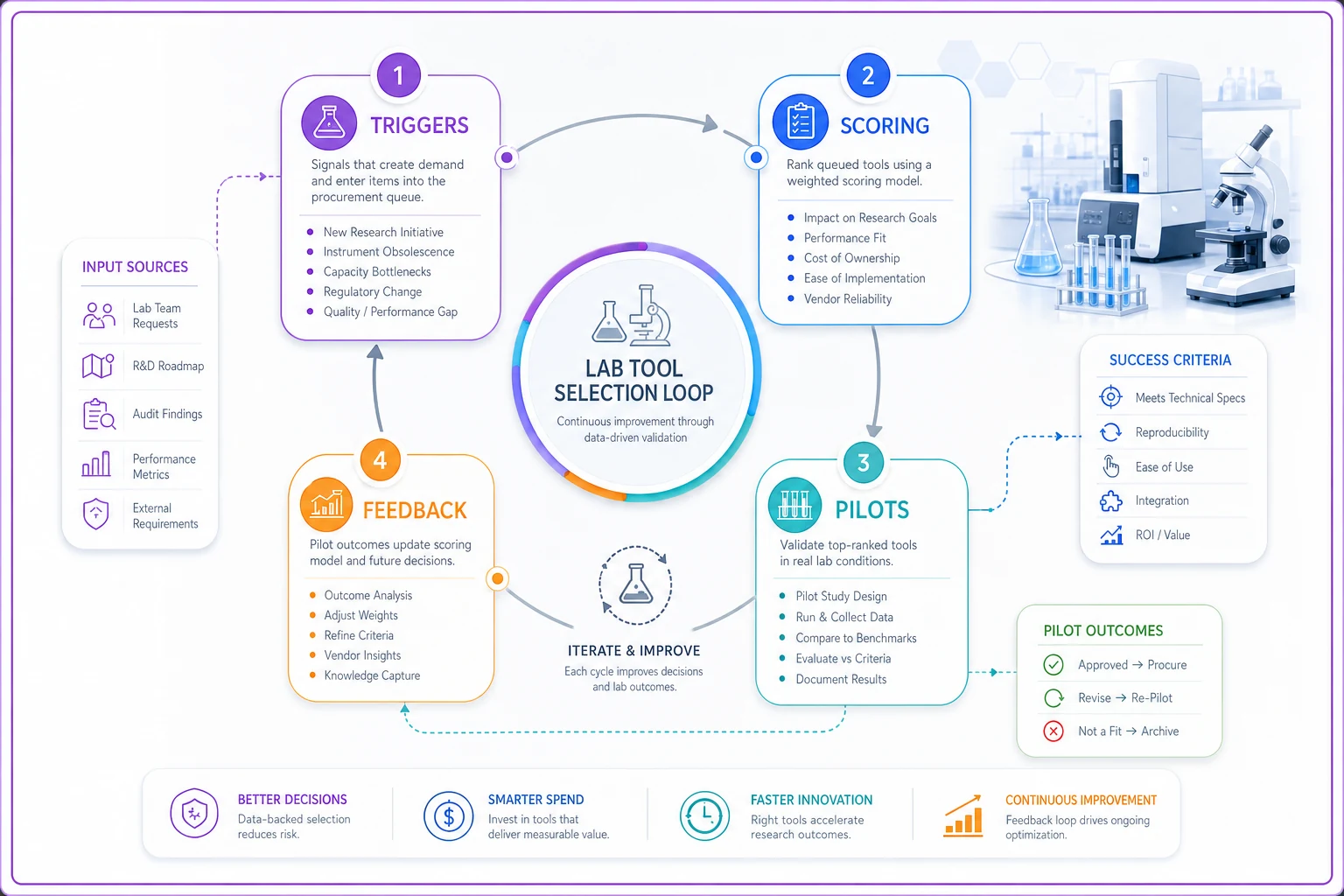
This connects to the rest of your operational governance naturally. The same risk-based thinking that drives procurement and vendor governance for critical lab supplies applies to capital tech—you're weighing probability of failure and cost of being wrong, just at a bigger ticket size.
As the lab grows, this loop is what keeps spend defensible. One bottleneck, one budget line—you can wing it. Multiple sites, competing PI groups, overlapping service contracts, and a backlog that shifts between stations month to month—the first thing that falls apart is comparison. Centralizing how you score, when you trigger, and what pilots must prove is what lets a growing operation keep making coherent decisions instead of reactive ones. A workflow platform that tracks utilization data, incident history, and pilot results in one place makes this quieter in practice—triggers fire on real numbers instead of someone's memory of how bad the backlog felt last quarter.
The labs that get this right aren't the ones with the biggest budgets. They're the ones who can answer, for any tool they own, a simple question: what was this supposed to prove, and did it? If you can answer that for every line item, your governance is working. If you can't, you're not funding tools—you're funding hope.
The labs that get this right aren't the ones with the biggest budgets. They're the ones who can answer, for any tool they own, a simple question: what was this supposed to prove, and did it? If you can answer that for every line item, your governance is working. If you can't, you're not funding tools—you're funding hope.
Ready to upgrade your lab operations?
Join 500+ labs using Labioly to save time, reduce errors, and enhance productivity and compliance.