


Most LIMS and ELN rollouts don't fail because the software is bad. They fail because the lab treats go-live as a date on a calendar instead of a sequence of controlled, verifiable steps. Someone signs the contract, the vendor runs a two-week configuration sprint, a handful of people get a lunch-and-learn, and then everyone is expected to move their real work into the new system on a Monday. By Wednesday, half the team is running a shadow spreadsheet "just to be safe," and the audit trail you were supposed to be strengthening has quietly split into two versions of the truth.
The frustrating part is that this is completely predictable. The gap between "we bought a validated system" and "we actually operate in a validated way" is where audits get uncomfortable. And what closes that gap isn't more training slides — it's designing your onboarding so that every step of testing and every hour of training produces its own evidence as a byproduct. That's really what good LIMS change management UAT onboarding is: a rollout where the proof of readiness is generated as you go, not reconstructed under pressure two weeks before an inspection.
This article walks through how the whole system fits together — executable UAT scripts, a staged pilot-to-scale plan, the sponsorship and governance layer that keeps it from stalling, and training-evidence bundles that survive an auditor's questions.
Why rollouts quietly generate their own evidence gaps
There's a pattern that shows up across labs of very different sizes. Validation happens in a sandbox with clean, invented data. The people doing UAT are the same ones who configured the system, so they test the paths they already know work. Nobody writes down what they tested in a way that maps to an actual acceptance criterion. Then the system goes live, real edge cases appear — a partially consumed aliquot, a re-run that needs to overwrite a result, a sample that skips a workflow state — and none of those were ever exercised.
When the auditor later asks "how do you know this workflow behaves correctly?", the honest answer is often "we've been using it for eight months and it seems fine." That's not evidence. That's survivorship.
-
Testing is separated from documentation. People run through the system, nod, and move on. The record of what passed and who confirmed it lives in someone's memory or a Slack thread.
-
The pilot group is chosen for enthusiasm, not representativeness. You end up validating the happy path of your most tech-comfortable analyst instead of the messy reality of the whole bench.
-
Training completion is tracked as attendance, not competence. "Twelve people attended the session" tells you nothing about whether those twelve can actually execute the workflow correctly under normal conditions.
-
Governance shows up only at the beginning and the end. A sponsor signs the kickoff and the go-live sign-off, but nobody owns the decisions in between when things get stuck.
If you've already built a solid change-approval matrix and mapped change triggers to required evidence, you know this instinct well — the goal is always to make the evidence a natural output of the process rather than a separate chore. Rollouts deserve the same treatment.
Executable UAT scripts: the difference between "we tested it" and provable testing
The single highest-leverage change you can make is to stop treating UAT as a walkthrough and start treating each test as an executable script — a defined set of steps, expected results, actual results, and a signed confirmation, all captured in one place.
Eliminate lab bottlenecks and errors.
Labioly helps you monitor, manage, and report lab activities efficiently and compliantly.
- Real-time sample tracking
- Inventory and supply alerts
- Staff workflow coordination
No credit card required
The word "executable" matters. A test script isn't a paragraph describing what the system should do. It's a step-by-step procedure that a specific person runs, records the outcome of, and signs. The output of running it is your audit evidence.
A good UAT script for a lab workflow has these fields:
| Field | Purpose | Example |
|---|---|---|
| Script ID | Traceability to a requirement | UAT-SAMP-014 |
| Requirement mapped | Ties the test to a real acceptance criterion | "System prevents result entry on a rejected sample" |
| Preconditions | Sets up a realistic starting state | Sample in "Received," QC flag = fail |
| Steps | Exact actions, no ambiguity | 1. Open sample. 2. Attempt result entry. 3. Save. |
| Expected result | The pass condition | Save blocked; error logged with timestamp + user |
| Actual result | What really happened | Recorded by tester |
| Evidence attached | Screenshot, exported log, record ID | Screenshot + audit-log entry ID |
| Tester + date | Who ran it and when | J. Okafor, 2026-03-11 |
| Reviewer sign-off | Independent confirmation | QA reviewer |
The critical discipline here is testing the negative paths, not just the positive ones. Most teams test that a valid result saves correctly. Far fewer test that an invalid action is properly blocked, logged, and attributed. Auditors care enormously about the second category, because that's where data integrity actually lives. If your system silently allows a result to be edited without a reason code, you want to discover that during UAT — not when someone finds an unexplained change in a study dataset.
-
Pull your requirements list and turn every "the system shall…" statement into at least one positive and one negative test.
-
Prioritize by risk. Anything touching result integrity, chain of custody, electronic signatures, or audit-trail behavior gets tested first and most thoroughly.
-
Assign testers who are not the configurers. Independence is what makes the evidence credible.
-
Run each script against realistic data, including deliberately broken inputs.
-
Capture evidence inline — the screenshot or exported log attaches to the script, not a separate folder someone has to hunt through later.
-
Get independent review sign-off on each passed script.
-
Log every failure as a defect with a disposition
fixed and re-tested, accepted with a workaround, or blocking go-live.
That defect log is itself valuable evidence. A rollout with zero recorded defects doesn't look clean to an experienced auditor — it looks like nobody tested hard enough.
Staged pilot → scale: don't validate on your easiest workflow
The instinct with pilots is to pick the simplest workflow and the friendliest team so the pilot "succeeds." This feels safe and teaches you almost nothing. A pilot's job is to surface problems while they're still cheap to fix, which means it needs enough real-world messiness to actually be honest.
Think of the rollout in three distinct stages, each with its own exit criteria.
Stage 1 — Contained pilot. One workflow, one team, real samples, but parallel-run with the old system so nothing is at risk. This is where you find the gaps between your UAT sandbox and reality. Run it long enough to hit your natural variety — if your lab has monthly batch runs, a two-week pilot that never sees a batch run is missing a whole class of behavior.
Stage 2 — Expanded pilot. Add a second, structurally different workflow and a less tech-comfortable group. This is where adoption problems show up. If the second group is quietly keeping spreadsheets, you have a training or usability problem, not a data problem — and it's much better to learn that now.
Stage 3 — Staged scale. Roll out team by team or workflow by workflow, not all at once. Each new group inherits the refined SOPs, the corrected configuration, and the training bundle that actually worked in the earlier stages.
A rough sense of what each stage should prove before you move on:
-
Pilot → Expanded UAT scripts all passed or dispositioned; parallel-run reconciliation shows the new system matches the old within tolerance; no unresolved data-integrity defects.
-
Expanded → Scale The second team reaches competence without heavy hand-holding; SOPs updated to reflect what actually happened; shadow-spreadsheet count is effectively zero.
-
Scale → Complete Every group live; old system in read-only or decommission planning; a full evidence package assembled.
The parallel-run reconciliation step deserves emphasis. Running old and new side by side, then reconciling the outputs, is the same discipline that makes migrations trustworthy — the same logic laid out in the LIMS migration playbook around pilot design and reconciliation tests applies here. If the two systems disagree on a result, a status, or a timestamp, you want to know why before you scale, not after.
When a staged rollout is the wrong call
-
A very small lab with one workflow and three people, where a "pilot" and "full rollout" would be nearly identical.
-
A hard external deadline (a regulatory change, a facility move) where parallel-running is logistically impossible.
-
A like-for-like system replacement where the workflow itself isn't changing, only the platform underneath it.
Even in those cases, you still run the UAT scripts and still capture training evidence. You just compress the staging. The one situation where you should not compress: any rollout where sample integrity, patient data, or regulated results are in play and the workflow is genuinely changing. That's exactly where the extra weeks pay for themselves.
The sponsorship and governance layer that keeps it moving
Rollouts stall in the middle. The kickoff is exciting, go-live is a milestone everyone rallies around, but the long ambiguous stretch in between — where a configuration decision is stuck, or two teams disagree on a field definition — is where projects quietly die. That's a governance failure, not a technical one.
You need a decision-making structure that's active throughout, not just at the endpoints. At minimum:
-
An executive sponsor with the authority to reallocate people's time and settle cross-team disputes. Not a figurehead — someone who actually shows up when a decision is blocked.
-
A project owner who runs the day-to-day and owns the schedule.
-
A QA/validation lead who owns the evidence standard and has veto power over go-live.
-
Workflow owners for each area being onboarded, responsible for their own UAT scripts and SOP updates.
A working sponsorship and governance checklist:
-
[ ] Named executive sponsor with documented authority to resolve resource conflicts
-
[ ] Defined decision-escalation path (who decides when a config choice is contested, and how fast)
-
[ ] Go/no-go criteria agreed in writing before the pilot, not negotiated at go-live
-
[ ] QA sign-off required at each stage gate, with authority to hold the rollout
-
[ ] Regular cadence (weekly during active stages) with a decision log
-
[ ] Budget and time explicitly allocated for parallel-running and re-testing
-
[ ] A defined owner for post-go-live defects and change requests
-
[ ] Sign-off records stored where they're retrievable for audit, not in personal inboxes
Keep the decision log dated and searchable so auditors can find who approved what.
That decision log is underrated. When an auditor asks why a workflow was configured a particular way, a dated log of the decision, the alternatives considered, and who approved it answers the question immediately. Without it, you're reconstructing rationale from memory a year later.
Training-evidence bundles: attendance is not competence
The weakest link in most rollouts is training that proves attendance rather than capability. A sign-in sheet tells an auditor nobody skipped the session. It doesn't tell them the person can correctly log a sample, apply an electronic signature, or handle a rejected result.
A training-evidence bundle ties three things together for each person and each role:
-
What they were trained on — specific SOPs and system functions, versioned so you know they were trained on the current process.
-
How competence was verified — a short practical check where the person actually performs the task in the system, observed and signed off, not just a slide deck they clicked through.
-
When and by whom — dated records with the trainer and the assessor identified.
The practical assessment is the piece people skip and the piece that matters most. Watching an analyst actually create a record, attempt an invalid action, and handle the error correctly tells you far more than any quiz score. It also generates real evidence — a signed competency confirmation tied to a specific system version.
This connects directly to how you should already be thinking about staff capability. If you've built role-based competency programs with matrices and audit-ready evidence, your rollout training should plug straight into that framework rather than existing as a one-off event. The rollout becomes one more entry in a competency record that's already maintained, not a separate binder that goes stale the moment the project ends.
One pattern worth flagging: training too early. Teams sometimes train everyone during Stage 1 to "get it out of the way," then the configuration changes twice before those people go live. Now their training records reference a version of the system that no longer exists. Train each group just before their stage goes live, against the configuration they'll actually use.
A real scenario: mid-size genomics lab, staged over a quarter
A genomics core with around 25 people replaced a mix of spreadsheets and an aging LIMS with a combined LIMS/ELN platform. Their first plan was a single big-bang cutover over a long weekend. QA pushed back, and they restructured into a staged rollout.
They built roughly 60 UAT scripts, weighted heavily toward result-integrity and audit-trail behavior. During the contained pilot they found something the vendor demo never surfaced: the system allowed a result to be amended without forcing a reason code in one specific workflow state. That's precisely the kind of defect that turns into an audit finding. Because it was caught during scripted testing, it was a two-day configuration fix and a re-test — not a data-integrity investigation months later.
The expanded pilot exposed a different problem. The sample-receiving team kept a shadow spreadsheet because the new intake screen took too many clicks for high-volume days. That was a usability and training issue, and it got fixed with a configuration tweak plus a targeted competency check before that group went live.
The whole rollout ran about a quarter instead of a weekend. It cost more up front in calendar time and parallel-running effort. But when their next audit came, the assembled package — dispositioned UAT scripts, the defect log, stage-gate sign-offs, the decision log, and per-person competency records — meant the evidence review was largely a matter of handing over documents that already existed. No scramble, no reconstruction. The team's own estimate was that they saved several weeks of pre-audit panic and avoided at least one likely finding.
Pulling the system together
The pieces reinforce each other, and that's the whole point. Executable UAT scripts give you provable functional readiness. The staged pilot-to-scale plan makes sure you're validating against reality instead of a friendly demo path. The sponsorship and governance layer keeps decisions moving and logged so momentum doesn't die in the middle. And the training-evidence bundles connect the system's correctness to the people's competence — which is where real-world data integrity actually lives.
The labs that struggle are usually the ones that pick one of these and skip the rest: great testing but no governance, or strong sponsorship but training that's just attendance sheets. The evidence gap always opens at the weakest link.
Where operational software genuinely helps is in removing the manual overhead of stitching all this together — attaching test evidence to the right script automatically, keeping training records tied to the current SOP version, maintaining a decision log that's actually retrievable, and flagging when a group's competency check predates a configuration change. Not because the tooling replaces the discipline, but because it makes the disciplined path the path of least resistance.
A simple workflow diagram helps see how the pieces fit.
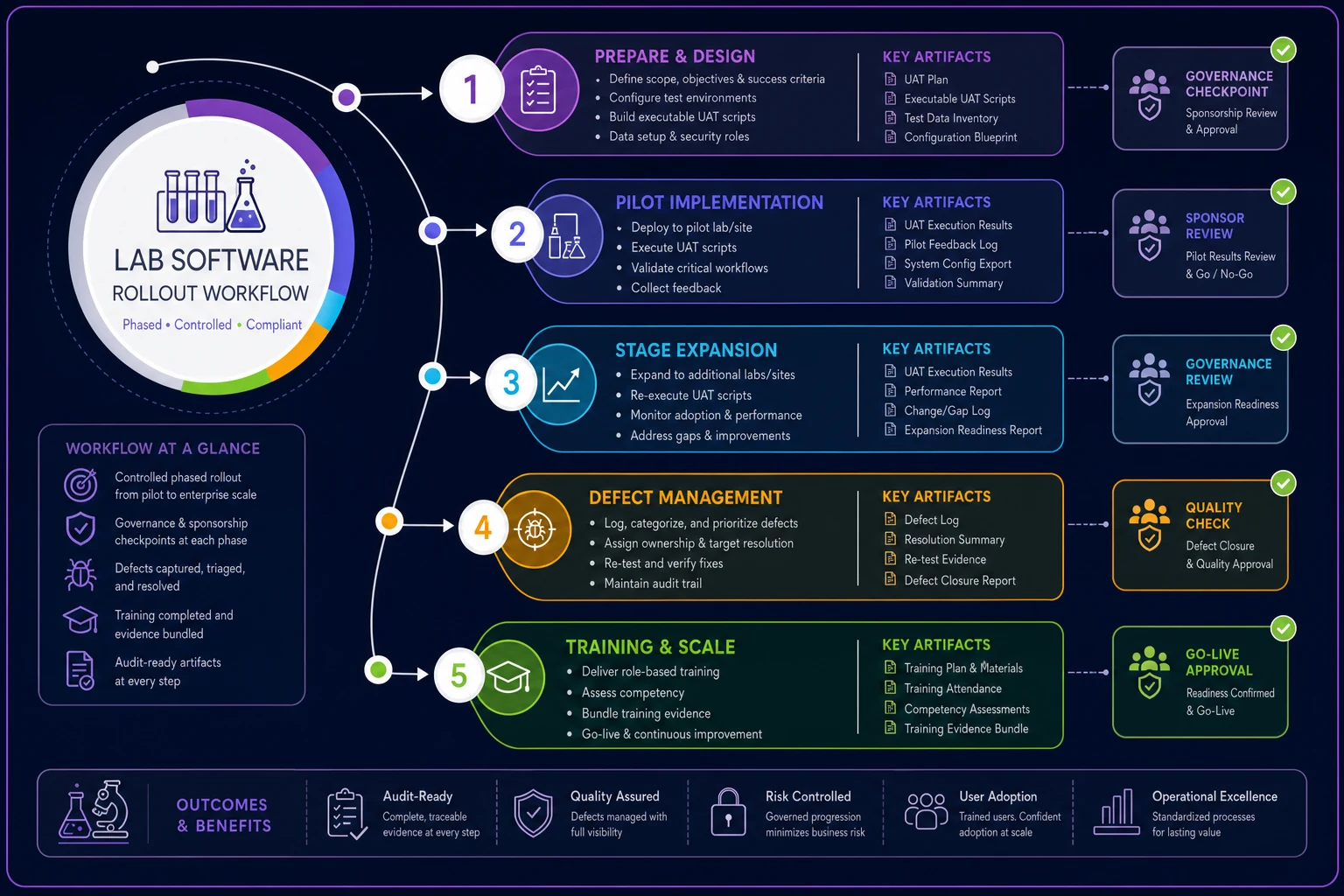
When capturing evidence is a byproduct of doing the work rather than a separate task, people actually do it — and that's the whole difference between a rollout that looks validated and one that provably is.
When capturing evidence is a byproduct of doing the work rather than a separate task, people actually do it — and that's the whole difference between a rollout that looks validated and one that provably is.
Ready to upgrade your lab operations?
Join 500+ labs using Labioly to save time, reduce errors, and enhance productivity and compliance.