

Most collaboration problems don't show up at the handshake stage. They show up eighteen months later, when a sponsor asks who had access to the raw spectra, or a postdoc leaves for a competitor and someone realizes nobody tracked which datasets they exported. By then the agreements are signed, the samples are shipped, and the paper trail is whatever happened to land in people's inboxes.
A data sharing playbook for labs isn't a legal document. It's the operational layer that sits between the signed agreement and the actual day-to-day movement of samples, raw files, derived data, and metadata. The agreement says what's allowed. The playbook makes sure what's allowed is what actually happens — and that you can prove it later.
This piece is about the system, not the paperwork. Specifically, the templates and workflows that keep intellectual-property-aware governance from collapsing the moment a collaboration grows past two people who trust each other.
Why Collaboration Governance Breaks (and It's Almost Never the Lawyers)
The signed MTA or data use agreement is usually fine. The failure happens downstream, in the gap between the clauses and the bench.
A typical pattern: two labs sign an MTA. Derived data belongs to the originating institution, background IP stays with whoever brought it, foreground IP gets jointly owned. Clear enough on paper. Then a grad student drops a shared folder link in Slack, another student forks a copy to their personal Google Drive "just to run the analysis faster," and six months later there are four versions of the dataset spread across three jurisdictions with no record of which one the publication was actually based on.
Nobody did anything malicious. The agreement simply never translated into a workflow. There was no clause mapping "derived data belongs to originating institution" to an actual access rule. No redaction step before the file left the building. No audit trail, because nobody decided what counted as an auditable event.
What separates labs that handle this well from those that don't isn't the quality of their legal review — it's whether they have reusable operational templates that turn every agreement into the same predictable set of workflows. Labs that struggle treat each collaboration as a unique situation. Labs that scale treat each one as a new instance of a known pattern.
The Three Layers You're Actually Governing
People lump "data sharing" into one bucket, which is why their controls end up so leaky. In practice you're governing three different things that move at different speeds and carry different IP risk.
Eliminate lab bottlenecks and errors.
Labioly helps you monitor, manage, and report lab activities efficiently and compliantly.
- Real-time sample tracking
- Inventory and supply alerts
- Staff workflow coordination
No credit card required
| Layer | What it is | IP sensitivity | Who usually mishandles it |
|---|---|---|---|
| Physical samples | Tubes, slides, extracts, cell lines | High if the sample is the IP (engineered lines, rare cohorts) | Shipping coordinators treating it as logistics only |
| Raw data | Instrument output, spectra, sequencing reads, images | Medium-high; often the hardest to redact after the fact | Analysts who copy files locally to work faster |
| Derived data & metadata | Processed results, annotations, consent flags, provenance | Variable; metadata leaks consent and cohort info silently | Everyone, because nobody thinks metadata is "data" |
The mistake almost everyone makes is governing the sample tightly and the metadata not at all. A shipment of de-identified samples feels controlled because there's a manifest and a courier. Meanwhile the accompanying spreadsheet has collection dates, site codes, and a free-text "notes" column that re-identifies half the cohort.
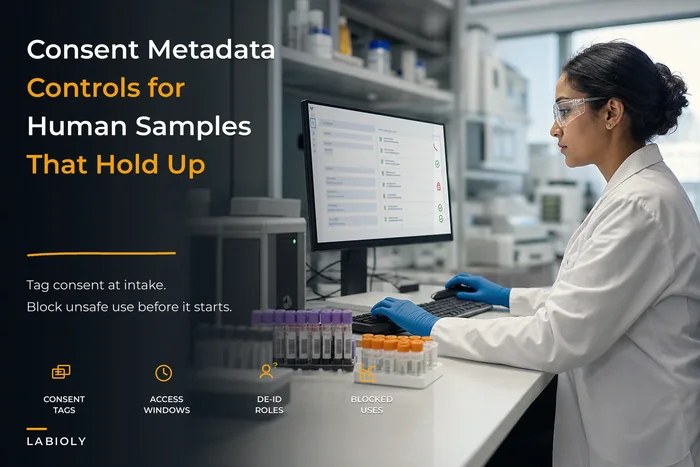
If you're moving human-derived material, the governance of consent and de-identification needs to be wired directly into the sharing workflow, not treated as a separate compliance box. The mechanics of that — consent metadata, access controls, de-identification SOPs — are worth working through in detail in our operational framework for human-sample privacy, because a data-sharing playbook assumes those foundations already exist.
Clause Snippets: The Bridge Between Legal and Operational
Most labs miss this entirely. You don't need to re-read the whole agreement every time someone wants to share a file. You need a library of clause snippets — short, reusable fragments that each map a common legal provision to a specific operational control.
Think of it as a translation table your team maintains. Each snippet has three parts: the legal intent in plain language, the operational rule it triggers, and the evidence it requires.
A few examples of what these look like in practice:
-
"Derived data owned by originating institution" → Access rule: derived datasets tagged to originating institution, external collaborators get read-only, no export without logged approval. Evidence: export request log with approver name and timestamp.
-
"Background IP remains with contributing party" → Operational rule: pre-existing datasets flagged as background, stored in a separate access tier, excluded from the shared workspace by default. Evidence: a background-IP inventory signed at project kickoff.
-
"Publication requires 30-day review window" → Workflow trigger: any dataset marked for manuscript use locks into review status, notifies all parties, starts a countdown. Evidence: review-release record with all sign-offs.
-
"Samples returned or destroyed at project end" → Transfer SOP trigger: end-of-project disposition checklist, with destruction certificates or return manifests. Evidence: disposition record linked to the original transfer.
Once you've built maybe fifteen to twenty of these snippets, new collaborations stop feeling bespoke. Someone reads the signed agreement once, picks the matching snippets, and the operational controls fall into place. The clause snippet is what makes an agreement executable rather than aspirational.
The common failure: snippets get written and then never maintained. An agreement introduces a clause your library doesn't cover, someone improvises, and the improvisation never gets added back. Treat the snippet library like code — every new pattern gets committed back so the next person inherits it.
Redaction and Access Workflows: What Leaves, and What It Looks Like When It Does
Access control and redaction are two different jobs and labs constantly conflate them. Access control decides who can touch a dataset. Redaction decides what the dataset contains when it moves to a lower-trust context.
The access side is straightforward in principle: tiered permissions mapped to the clause snippets above. Where it breaks down is the assumption that access tiers are static. In a real collaboration they're not. A collaborator who had read-only access during data generation might need export rights during analysis and then lose all access after publication. If your access model can't change state across the project lifecycle, people route around it — and that's how the personal-Drive copies appear.
Redaction is messier and more consequential, because it's usually irreversible in the wrong direction. Once you've shared raw spectra with embedded instrument metadata containing operator IDs and internal sample codes, you can't un-share it.
A workable redaction workflow runs through a small number of gates before anything crosses an institutional boundary:
-
Classify the outbound package against the clause snippets — what IP tier does it fall under, and what's the destination's trust level?
-
Strip identifying metadata — operator names, internal batch codes, file paths that reveal directory structure, free-text notes fields. This is the step everyone forgets.
-
Apply field-level redaction to derived datasets — mask or remove columns the agreement doesn't permit sharing.
-
Generate a redaction manifest — a record of exactly what was removed or masked, so the originating lab retains a map between the full and shared versions.
-
Record the release — who approved it, when, under which agreement, to whom, and a checksum of the file that actually left.
That fourth step, the redaction manifest, is what separates labs that survive audits from labs that panic during them. If you've masked a column and six months later someone asks whether a cohort's collection-site data was shared, the manifest answers it in seconds instead of requiring a forensic reconstruction.
When heavy redaction workflows don't make sense
Not every collaboration needs this. If you're sharing fully public reference data, or working inside a single institution under one governance regime, a five-gate redaction pipeline is overhead with no payoff. These workflows earn their keep when data crosses institutional or national boundaries, when the dataset contains human-derived or commercially sensitive material, or when the agreement specifies asymmetric IP ownership. Outside those conditions, a lighter access-control model is usually enough — and over-engineering it just trains your team to click through controls they've learned to ignore.
This diagram summarizes the redaction and release gates.
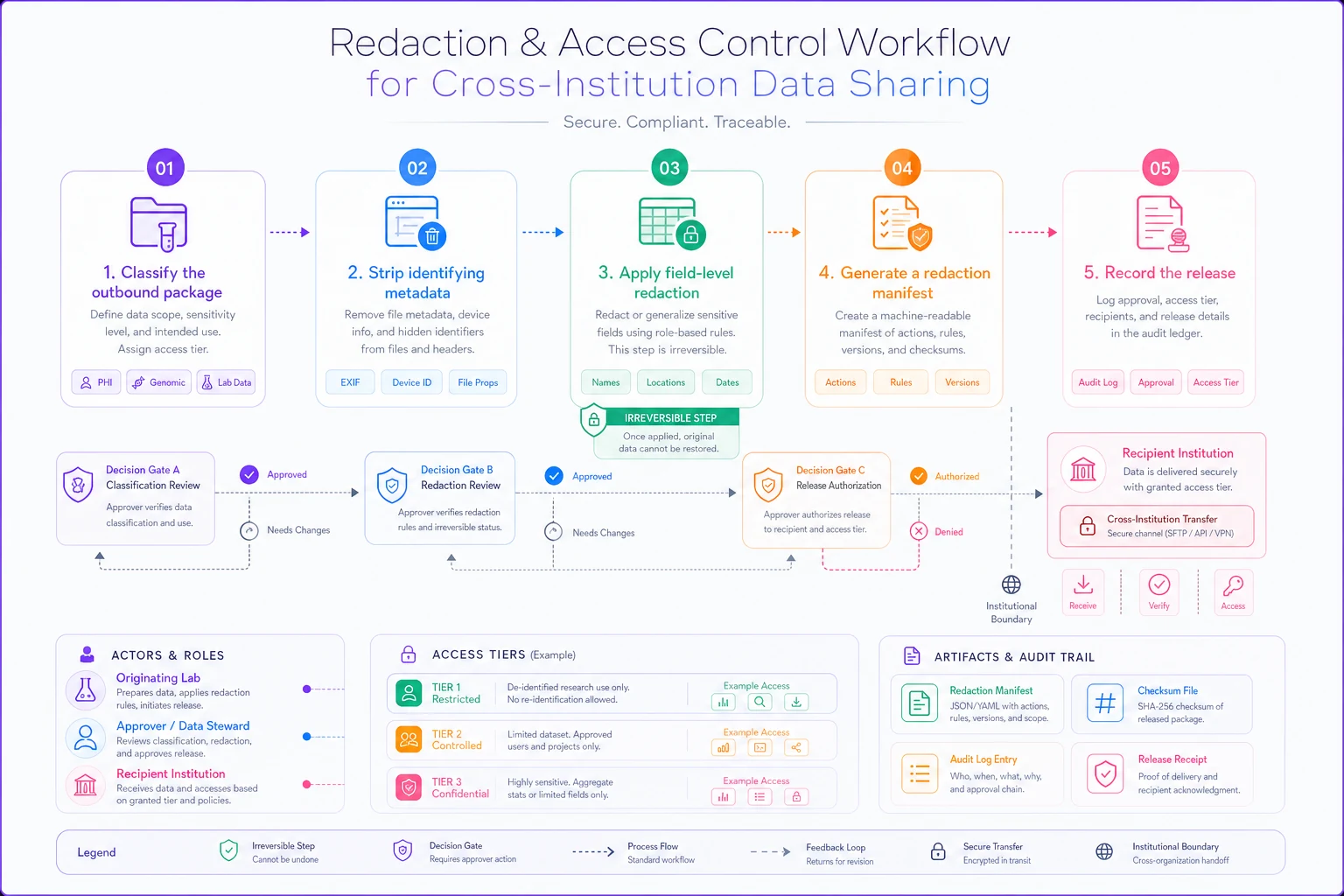
The diagram shows the gates any outbound package should pass before release.
Transfer SOPs: Where Samples and Custody Actually Move
Sample and data transfers fail at the handoffs, not in the middle. The sample leaves lab A in good order and arrives at lab B in good order, but the custody record has a four-day gap where it sat on a shipping dock and nobody logged the temperature excursion or the receipt confirmation.
A transfer SOP for collaborations has to do something an internal SOP doesn't: maintain an unbroken custody record across an organizational boundary you don't control. That's the hard part. You can enforce logging inside your own walls. You can't force the receiving lab to scan a package the moment it arrives — unless your SOP and agreement make that receipt confirmation a condition of the transfer.
The structural pattern that works:
-
Pre-transfer
disposition approved against the clause snippets, manifest generated, redaction for accompanying data completed, transfer logged as "initiated."
-
In-transit
shipment reference, carrier, and conditions logged. If it's temperature-sensitive, the monitor is part of the custody chain, not a separate record.
-
Receipt
the receiving party confirms receipt against the manifest. Discrepancies — missing tubes, broken seals, temperature breaches — get logged as exceptions before anything enters the receiving inventory.
-
Reconciliation
the transfer record closes only when sent and received quantities match, or the exception is documented and resolved.
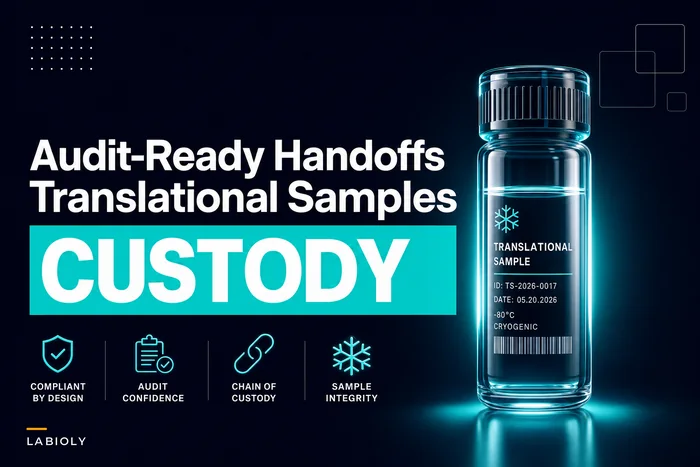
This is chain-of-custody discipline applied across institutions, which is genuinely harder than the internal version. The baseline mechanics of building minimal, audit-ready custody records are worth getting right first; our write-up on minimal audit-ready chain-of-custody documentation for translational samples covers the internal foundation that cross-institutional transfers extend.
Require receipt confirmation as a condition of the transfer to enforce cross-institution custody.
The structural pattern that works when enforced across agreements is what closes the gaps that turn into disputes later.
Evidence Trails: Designing for the Audit You Haven't Had Yet
The uncomfortable truth about audit trails in collaborations: you're almost never building them for an audit you can see coming. You're building them for the question someone asks two years out, usually under pressure — a disputed inventorship claim, a sponsor compliance review, a data-integrity query on a published figure.
Labs that handle these calmly made one decision early: they defined what counts as an auditable event before anything happened, rather than trying to reconstruct events from scattered logs afterward.
At minimum, an evidence trail for a collaboration should capture:
-
Every access-tier change, with who authorized it and under which clause.
-
Every outbound release, with the redaction manifest and file checksum.
-
Every sample transfer, with the custody chain and receipt confirmation.
-
Every disposition event — destruction certificates, return manifests, end-of-project closeouts.
-
Every approval decision, linked to the person and the agreement provision it satisfies.
The mistake that quietly ruins evidence trails is storing these events across five different systems — the ELN has some, email has others, the shipping portal has the rest, and a spreadsheet somebody maintains holds the approvals. When a question comes in, reconstructing a single timeline takes weeks. The value isn't just in logging events. It's in logging them somewhere they can be assembled into one coherent narrative per collaboration.
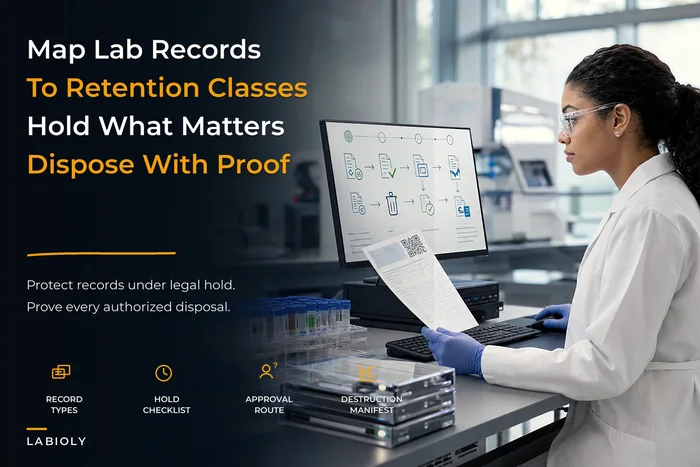
Evidence trails also need a defined lifespan. Different records carry different retention obligations, and a collaboration ending doesn't mean the evidence can be deleted — often the opposite, especially when IP or publications are involved. Mapping each record type to its retention class and disposal rule is its own discipline; the approach in our guide to mapping lab records to retention classes applies directly to collaboration evidence, because legal holds on disputed IP can freeze records you'd otherwise have cleared.
A Real Scenario: Three-Site Consortium, One Near-Miss
A mid-sized academic lab joined a three-institution consortium studying a patient-derived sample set — roughly 280 samples, with sequencing and imaging generated at two of the three sites. The consortium agreement had reasonable IP terms: derived data owned by the generating site, joint ownership of consortium-level findings, mandatory destruction of samples at study end.
For the first year, sharing happened informally. Shared drives, ad-hoc exports, email approvals. It worked, more or less, until one site's lead investigator moved institutions and took a laptop with local copies of datasets generated at the other two sites. No log existed of what had been exported, to where, or under what authority. The question "what left, and was any of it the other sites' derived data?" had no clean answer.
The near-miss became a rebuild. They built a clause-snippet library from the consortium agreement — about a dozen snippets. Shared datasets moved into tiered access with lifecycle states instead of flat folders. Every outbound release ran through a redaction and manifest step. Sample transfers got a receipt-confirmation requirement written into the next amendment.
The measurable shift wasn't dramatic. Setup for a new sub-study dropped from a couple of weeks of back-and-forth to a few days, because the controls assembled from the snippet library instead of being negotiated from scratch. More importantly, when the consortium underwent a sponsor compliance review about eight months later, assembling the evidence for one dataset's full history took an afternoon rather than the multi-week scramble everyone had braced for. No fines, no findings — but the earlier near-miss couldn't have happened again silently.
Where Software Fits Without Taking Over
None of this requires a platform. Plenty of small collaborations run these controls on disciplined spreadsheets and well-structured shared drives, and that's genuinely fine at two or three people.
The point where manual governance starts cracking is coordination across boundaries at volume — multiple active collaborations, each with its own agreement, access tiers, redaction rules, and evidence requirements, all being enforced by the same people trying to run experiments. That's where operational software earns its place: not to replace judgment, but to make the clause snippets enforce themselves, log auditable events as they happen rather than relying on someone to remember, and assemble a single evidence timeline per collaboration without a manual reconstruction.
AI-assisted workflows help specifically with the parts humans are bad at doing consistently — flagging a metadata field that looks like it re-identifies a cohort before a release goes out, catching an access-tier change that contradicts the governing clause, noticing that a sample transfer was initiated but never confirmed received. Those are the quiet gaps where governance leaks, and they're exactly the kind of pattern-matching that doesn't need a human watching every transaction.
The goal is never to automate the decisions. It's to make sure no required step gets silently skipped when everyone's busy.
The System View
A data-sharing playbook isn't a folder of signed PDFs. It's a connected system: agreements translated into clause snippets, snippets driving access and redaction workflows, workflows producing transfer records, and all of it feeding one evidence trail you can actually assemble when someone asks a hard question.
Labs that get burned treat each piece separately — legal handles the agreement, shipping handles the samples, IT handles access, and nobody owns the connections between them. The connections are where everything leaks. Build the translation layer between the agreement and the bench, decide upfront what counts as evidence, and make the controls reusable across collaborations instead of reinventing them each time. A collaboration that starts with two trusting people and grows into a twelve-person, three-institution consortium shouldn't have to outgrow its own governance — but it will, unless the system was designed for that from the start.
Design the operational layer that makes agreements executable, not aspirational, and you'll stop being surprised by audits, departures, and data leaks.
Ready to upgrade your lab operations?
Join 500+ labs using Labioly to save time, reduce errors, and enhance productivity and compliance.