

Most labs don't have a retention policy problem. They have a classification problem that only looks like a retention problem.
Ask a lab manager how long they keep raw instrument files and you'll usually get one of two answers: "forever, just in case" or "I think seven years?" Neither answer holds up when someone actually needs it — not the auditor asking why a specific chromatogram from three years ago no longer exists, and not the IT lead staring down 40 TB of duplicated .d folders that nobody will let them touch.
The gap between those two answers is where the real work lives. A data retention policy lab records system isn't a single number you apply to everything. It's a mapping — data type to retention class to enforcement rule to disposal evidence — and the labs that get burned are almost always the ones that skipped straight to "how long" without first nailing down "what kind."
Here's how the whole thing connects, where it breaks as you scale, and what a defensible version actually looks like on the ground.
Why one retention number never survives contact with a real lab
The instinct to apply a single retention period comes from a reasonable place. Simplicity is defensible. "We keep everything ten years" sounds clean in a policy document.
-
Raw acquisition files — large, instrument-proprietary, the true source of record
-
Processed/integrated data — peak tables, quantitation results, derived values
-
QC reports — control charts, system suitability, pass/fail summaries
-
Method and sequence files — the parameters that make the raw data interpretable
-
Audit trails and metadata — who touched what, when
These have wildly different lifespans, legal weight, and storage costs. Raw files might be your legal source of truth but eat 90% of your storage. Processed data is small but loses meaning if you delete the method that generated it. QC reports might be tied to a batch-release decision that carries its own regulatory clock, entirely separate from the study.
Treat them as one class and you get the worst of both worlds: you over-retain the expensive stuff and under-protect the interpretive context that makes the expensive stuff usable. In practice, this usually surfaces during an audit when someone pulls a five-year-old raw file and discovers the processing method that generated the reported result was deleted two years ago because "it was just a config file."
The four moving parts of a retention system
A retention system that actually works has four connected components. Miss any one and the others quietly become useless.
Eliminate lab bottlenecks and errors.
Labioly helps you monitor, manage, and report lab activities efficiently and compliantly.
- Real-time sample tracking
- Inventory and supply alerts
- Staff workflow coordination
No credit card required
-
Classification — mapping each data type to a retention class
-
Retention rules — the clock (how long, starting from what event)
-
Enforcement — the mechanism that applies the rule without a human remembering to
-
Disposal evidence — proof of what you destroyed, when, and under what authority
The mistake most labs make is building component 2 — the policy document with the numbers — and calling it done. The policy exists. Enforcement doesn't. So the real retention behavior of the lab is whatever individual scientists happen to do, which means nothing gets deleted, storage grows forever, and when a legal hold does land, nobody can prove the state of anything.
The connective tissue matters more than any single number. Your retention clock has to trigger off an event — study close, batch release, last-patient-last-visit, publication — not a file's creation date. A raw file created in January for a study that closes in November doesn't start its clock in January. If your enforcement mechanism keys off file timestamps instead of study-lifecycle events, your whole system deletes things early or late, and both are failures.
A worked classification map
Here's a concrete example of how data types map to classes. The numbers are illustrative starting points — your regulatory context (GLP, GMP, CLIA, sponsor contracts) sets the actual floors.
| Data type | Retention class | Clock starts at | Typical retention | Disposal method |
|---|---|---|---|---|
| Raw instrument files | Source-of-record | Study close | 10–15 yrs | Cryptographic erase + manifest |
| Processed/quant data | Derived-critical | Study close | Match raw | Secure delete + manifest |
| QC / system suitability | Batch-evidence | Batch release | 7–10 yrs | Secure delete + manifest |
| Method & sequence files | Interpretive-context | Retire raw of last dependent study | = longest dependent raw | Secure delete + manifest |
| Audit trails / metadata | Compliance-evidence | Record close | ≥ associated record | Immutable → archive |
| Working/scratch files | Transient | Creation | 90 days | Standard delete |
The row that trips people up is method & sequence files. Their retention isn't independent — it's a dependency. A method file has to outlive the last raw dataset that relies on it to be interpretable. Labs that classify methods on their own fixed schedule end up orphaning raw data. This is exactly the kind of relationship a canonical evidence model handles well, and it's worth reading how a canonical audit-evidence architecture links records so these dependencies are explicit rather than tribal knowledge.
The transient row matters too. Scratch files, re-exports, and analyst working copies are where storage quietly balloons. If you don't give them an explicit short-lived class, they inherit the source-of-record class by default and you're paying 15-year storage costs on somebody's temp folder.
What breaks as you scale
At two instruments and one study, none of this is hard. You could run retention off a spreadsheet and a quarterly cleanup afternoon. The system holds because one person holds it in their head.
Break point one — the person leaves. The moment your informal retention lives in one analyst's habits, their departure resets your defensibility to zero. New people don't delete anything because they don't know what's safe to delete. Storage growth accelerates.
Break point two — data volume outpaces manual review. Somewhere around 15–20 active studies, nobody can manually track which files belong to which lifecycle event. Retention decisions stop happening entirely. You're now in accidental "keep forever" mode, which is a policy — just not one you chose or can defend.
Break point three — the first legal hold. A hold lands on Study 47, and you discover you can't cleanly isolate its records from the shared instrument output folders. Files from held and non-held studies are interleaved. Now you can't safely dispose of anything on that instrument because you can't prove you didn't touch held material. One hold freezes disposal across a whole system.
Break point four — the audit that asks about deletion. Auditors increasingly ask not just "do you keep records long enough" but "can you prove what you destroyed and that it was authorized." Labs that only ever thought about retention as keeping things have no answer. There's no disposal evidence because disposal was informal — someone emptied a folder, no record survived.
Each break point is a coordination failure, not a technology failure. The files were fine. The mapping between files, lifecycle events, and authority to act on them was missing.
The legal-hold checklist
A legal hold is a full stop on the normal retention clock for a defined scope. When one lands, enforcement must be able to exempt the held scope from any automated disposal — instantly and provably. The operational checklist that keeps a hold from becoming a mess:
-
Define the scope precisely — which studies, batches, instruments, date ranges, and data types are covered. Vague scope means over-freezing everything or missing material.
-
Snapshot the current state — record exactly what exists at the moment the hold takes effect, with checksums. This becomes your baseline.
-
Suspend automated enforcement for the scope — the disposal engine must recognize a hold flag and skip held records, not delete-then-apologize.
-
Notify custodians in writing — every person with access to the scoped data acknowledges the hold. Keep the acknowledgments.
-
Block modification, not just deletion — held raw files should move to read-only or immutable storage so nobody "cleans up" or reprocesses them.
-
Log every access during the hold — who opened what, when. A hold that isn't audited is a hold that gets quietly violated.
-
Define release criteria up front — who can lift the hold, on what authority, and what evidence gets recorded when they do.
The single biggest hold failure is the one nobody notices: an automated cleanup job that doesn't know about the hold and deletes scoped files on schedule. If your enforcement and your hold flags aren't wired to the same system, you will eventually spoliate evidence automatically. That's the scenario that turns a routine dispute into sanctions.
Secure-disposal SOP with evidence manifests
Disposal is the half of retention nobody documents until an auditor forces them to. The principle is simple: you must be able to prove what you destroyed as rigorously as you prove what you kept.
An evidence manifest is the artifact that makes disposal defensible. It's a record generated at the moment of destruction that captures:
-
The list of records/files destroyed, each with a checksum captured before deletion
-
The retention class and rule that authorized the disposal
-
The lifecycle event that started the clock and the date the clock expired
-
Confirmation that no legal hold covered any listed item
-
The disposal method used (secure delete, cryptographic erase, media destruction)
-
Who authorized it, who executed it, timestamps for both
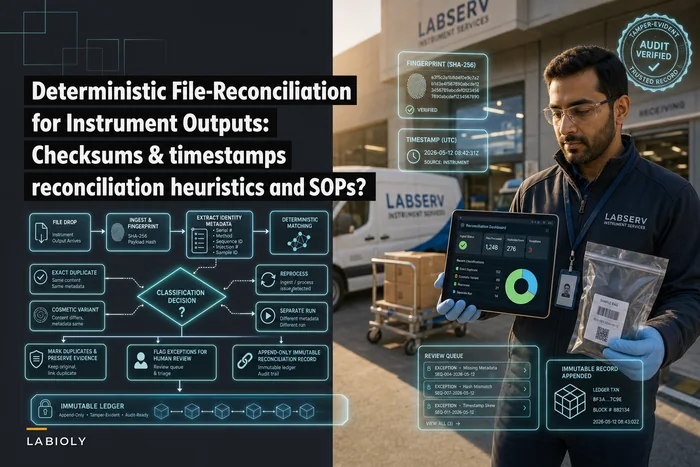
The checksums matter more than people expect. A manifest that just lists filenames proves nothing — filenames get reused. A checksum captured pre-deletion ties the manifest to the specific bytes that existed, which is exactly the identity discipline covered in deterministic file-reconciliation for instrument outputs. If you already checksum files at ingest, disposal manifests become almost free — you're recording an identity you already computed.
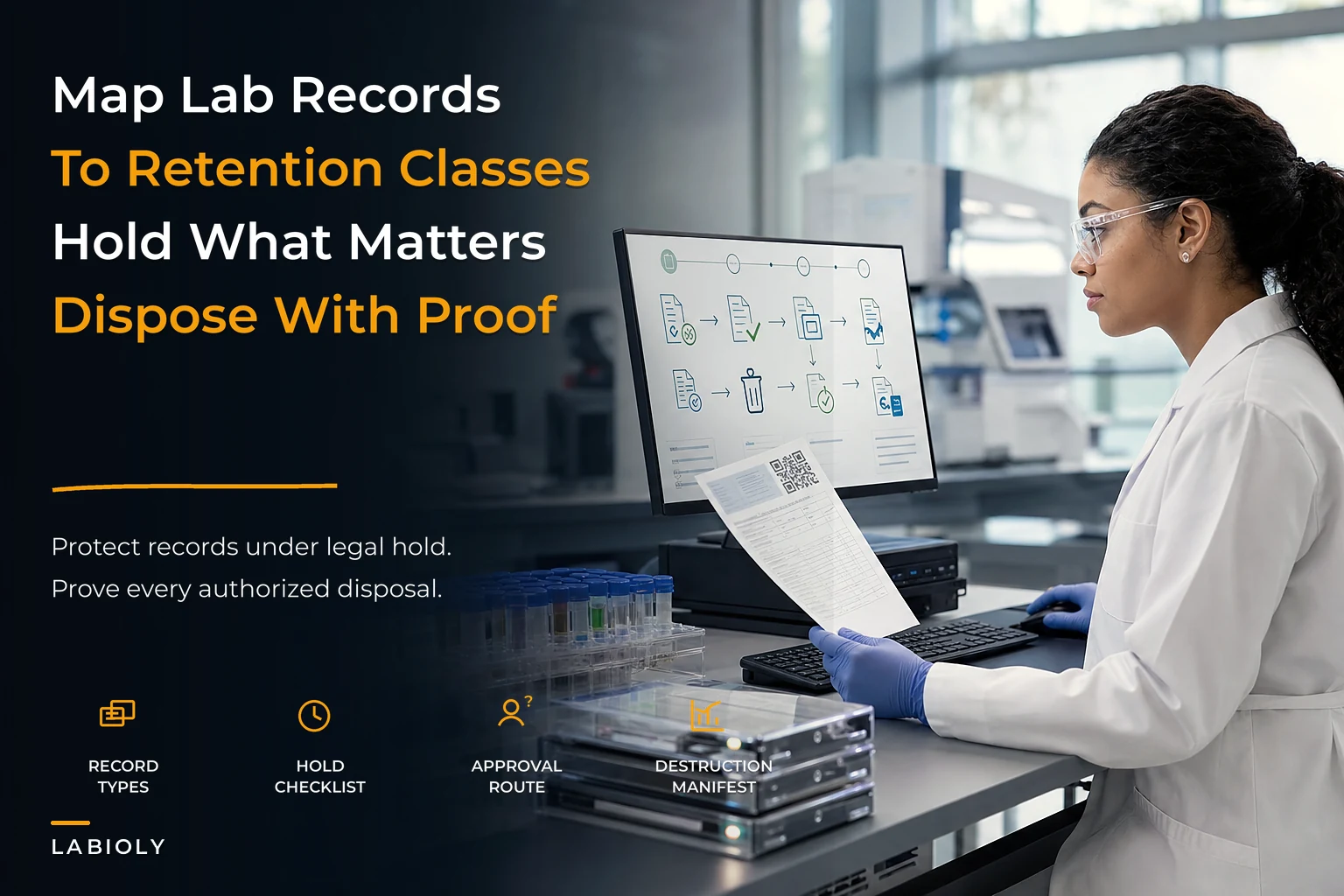
The disposal process as a sequence:
-
Enforcement flags eligible records — clock expired, no hold active.
-
Generate a pre-disposal manifest — capture checksums, class, authorizing rule, custodian.
-
Route for authorization — a named approver confirms scope and confirms no hold applies.
-
Execute disposal — method appropriate to the class (cryptographic erase for source-of-record media, secure delete for the rest).
-
Verify destruction — confirm the records are gone and, where possible, unrecoverable.
-
Seal and archive the manifest — the manifest itself becomes a compliance-evidence record with its own long retention.
That last point catches people off guard. The manifest outlives the data by design. Ten years after you've legitimately destroyed a raw file, the only thing standing between you and an auditor's raised eyebrow is the manifest proving you did it correctly. You keep the proof of destruction far longer than the data itself — which feels counterintuitive until you've sat in a room where someone needs to account for a file that no longer exists.
The disposal process workflow looks like this:
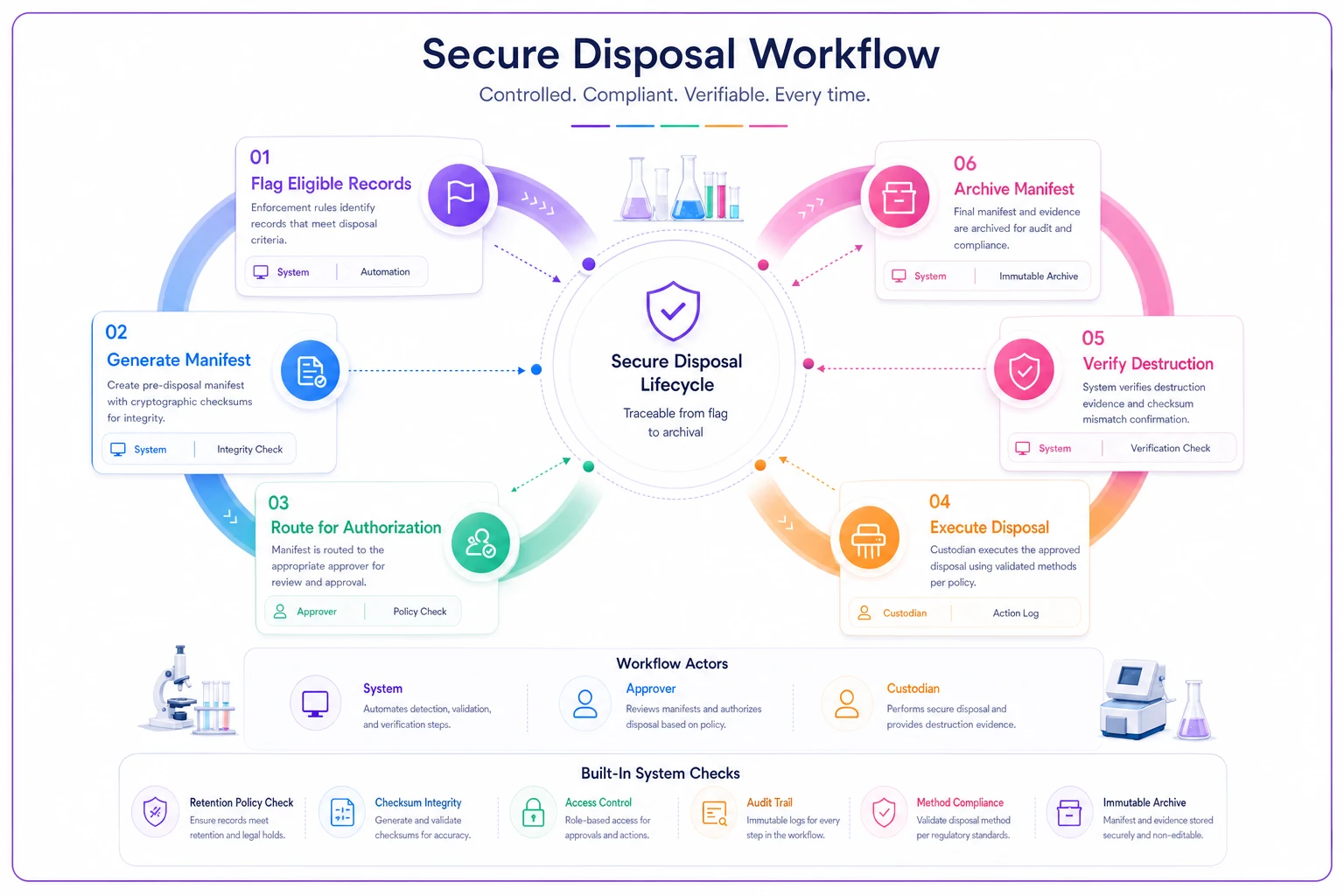
The manifest itself becomes a compliance record and must be sealed and archived according to your retention rules.
A short real scenario
A mid-size contract analytical lab — around a dozen instruments, mostly LC-MS and GC — was carrying close to 60 TB of instrument data, growing roughly 1.5 TB a month. Nothing had ever been deleted. Their stated policy was "seven years," but no enforcement existed, so effective retention was infinite.
When a sponsor dispute triggered a legal hold on two studies, it took the team the better part of three weeks to isolate the scoped files, because held-study output was interleaved with everything else in shared acquisition folders. During that scramble they also realized they couldn't prove the integrity of the held files at hold-onset — no baseline checksums existed.
The fix wasn't dramatic. They classified their data into five classes, keyed retention clocks to study-close events pulled from their LIMS, and stood up a disposal workflow that generated manifests. Over the following two quarters, once past-retention transient and derived files started aging out with proper evidence, storage growth flattened and they recovered somewhere in the range of 12–15 TB — data they could now prove they were authorized to remove. More importantly, the next hold took an afternoon instead of three weeks, because scope was queryable and baselines were automatic.
The recovered storage was nice. The queryable hold scope was the thing that actually let them sleep.
Where automation earns its place
You can run all of this manually, and small labs should — a spreadsheet and discipline will carry you further than people admit. The question is where manual review stops scaling, and the honest answer is roughly when retention decisions become too numerous to make by hand and too consequential to skip.
Enforcement is the part that genuinely needs a system rather than a person. A retention rule that depends on someone remembering to run a quarterly cleanup isn't a rule — it's a hope. Where AI-assisted operational platforms help is in the connective work that's tedious and error-prone by hand: watching lifecycle events fire, matching files to their retention class, checking every candidate against active holds before anything gets flagged, and assembling manifests automatically from data already captured at ingest. The same discipline underpins automated QC reporting that passes audits — the goal isn't to remove human judgment from disposal authorization, it's to make sure a human is deciding on clean, complete, hold-checked information instead of eyeballing a folder.
The line worth drawing: let automation propose and prepare, keep a human on the authorize and release. Disposal and hold-release are exactly the decisions where a wrong automated action is unrecoverable, so those stay gated.
Let automation prepare manifests and flag eligible records, but gate final disposal and hold-release behind a named approver.
When a full retention system makes sense
Build the whole thing out when you're running regulated work, holding sponsor data, storing more than you can review by hand, or when a single person leaving would collapse your retention knowledge. Any of those alone justifies formalizing.
When it's overkill
A single-instrument academic lab generating modest data volumes with no external compliance obligations — a documented classification and a quarterly manual cleanup is genuinely enough. Don't build hold-aware enforcement machinery for a system a spreadsheet can run. The cost of the system should track the cost of getting it wrong.
Pulling it together
Retention isn't a number you write down once. It's a living mapping between what kind of data you have, what event starts its clock, what stops that clock cold, and what proof you generate when it finally ages out.
Start with classification, because every other layer inherits its mistakes. Get your clocks tied to lifecycle events, not file dates. Make sure a legal hold can freeze a scope faster than any cleanup job can touch it. And treat your disposal manifests as records worth keeping longer than the data they describe — because one day, that manifest is the only thing that proves you did this right.
Start with classification, because every other layer inherits its mistakes. Get your clocks tied to lifecycle events, not file dates. Make sure a legal hold can freeze a scope faster than any cleanup job can touch it. And treat your disposal manifests as records worth keeping longer than the data they describe — because one day, that manifest is the only thing that proves you did this right.
Ready to upgrade your lab operations?
Join 500+ labs using Labioly to save time, reduce errors, and enhance productivity and compliance.