
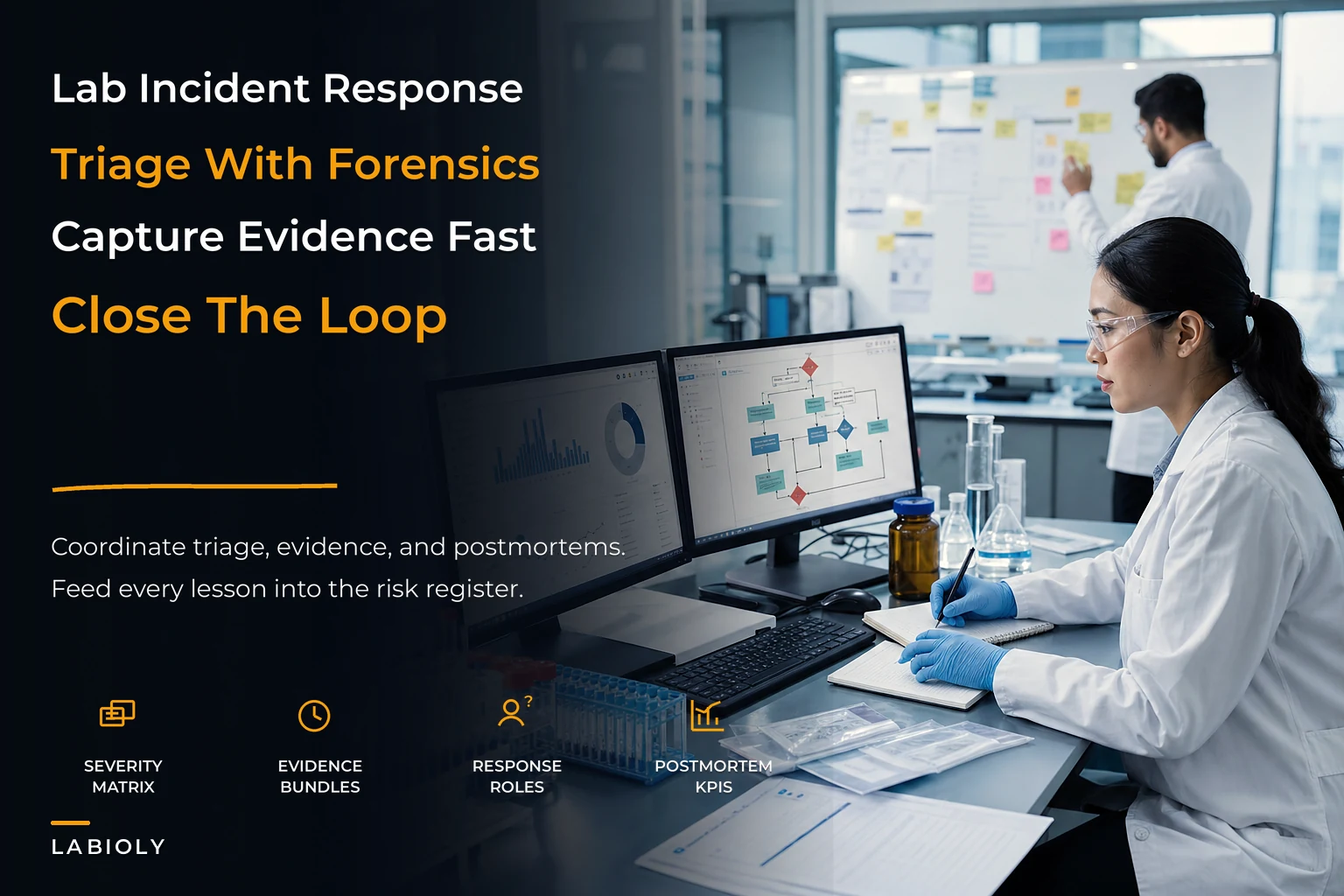

Most labs don't have an incident response program. They have reactions. Something goes wrong — a freezer alarms at 2 a.m., a result gets reported off a miscalibrated instrument, a technician realizes two sample sets were cross-labeled — and a handful of people scramble, fix it, and move on. The fix gets remembered for a few weeks and then institutional memory fades. Six months later a nearly identical failure happens and nobody connects the dots.
The difference between a reaction and a program comes down to one thing: whether the incident leaves behind structured artifacts that change how you operate. A real program has named roles people can actually fill, evidence bundles that survive the chaos, communications that go out without someone improvising under pressure, and a postmortem loop that pushes findings back into your risk register and resilience plans. Without that loop, you're just paying the cost of incidents without buying any of the learning.
This is a systems article. The point isn't "here are five tips for handling emergencies." It's about how the whole machine fits together — detection, triage, forensics, containment, communications, recovery, and the feedback that makes the next incident less likely or less expensive.
Why most lab incident response quietly falls apart
The failure mode is almost never the technical fix. Labs are full of smart people who can diagnose a contaminated reagent lot or a corrupted instrument file. The failure is in the connective tissue around the fix.
A few patterns show up over and over:
Nobody owns the incident, so everyone half-owns it. When a temperature excursion hits, the person who notices isn't necessarily the person who can authorize a sample transfer, who isn't the person who has to notify the PI, who isn't the person who documents chain-of-custody. Without clear roles, the most conscientious person in the room absorbs all of it — and does three of the four jobs badly because they're overloaded.
Evidence evaporates in the first hour. The most important forensic information in any incident exists in the first 30–60 minutes and degrades fast. Instrument logs roll over. Someone "helpfully" restarts the system. Freezer door-open events get overwritten. By the time anyone decides this is serious enough to investigate properly, half the evidence is gone.
Communications are improvised. Who do you tell, when, and what exactly do you say? If the answer depends on who's in the room and how stressed they are, you'll get inconsistent messaging — overcommunicating trivial events and undercommunicating the ones that matter, sometimes in the same week.
Postmortems, if they happen at all, go into a document nobody reads. The lab writes up what happened, lists some action items, and the file disappears into a shared drive. The risk register doesn't change. The resilience plan doesn't change. The controls don't change. So the next incident is a surprise again.
What breaks at scale is coordination, not competence. A single-PI lab with six people can run on tribal knowledge. A core facility with 40 staff across three buildings, dozens of instruments, and shared freezers serving multiple research groups cannot. The number of handoffs explodes, and every handoff is a place where ownership, evidence, or communication can drop.
The incident lifecycle, stage by stage
Think of an incident as moving through defined stages, each with an owner, required outputs, and a decision about whether to escalate. The stages aren't bureaucracy for their own sake — each one exists to prevent a specific failure.
Eliminate lab bottlenecks and errors.
Labioly helps you monitor, manage, and report lab activities efficiently and compliantly.
- Real-time sample tracking
- Inventory and supply alerts
- Staff workflow coordination
No credit card required
Here's the backbone most functioning lab programs converge on:
| Stage | Primary owner | Core output | What it prevents |
|---|---|---|---|
| Detection & logging | Whoever notices | Timestamped initial report | Silent incidents that never get recorded |
| Triage & severity call | Incident Lead | Severity tier + activation decision | Over-reacting to trivia / under-reacting to disasters |
| Containment | Technical Responder | Stabilized state, no further spread | Damage compounding while people investigate |
| Evidence capture | Evidence Custodian | Sealed evidence bundle | Forensic data evaporating |
| Communications | Comms Coordinator | Templated notifications sent | Inconsistent or missing stakeholder messaging |
| Investigation & forensics | Investigation Lead | Root-cause analysis | Fixing symptoms instead of causes |
| Recovery & verification | Technical Responder | Verified return to normal ops | Declaring "fixed" when it isn't |
| Postmortem & feedback | Incident Lead | Postmortem + register updates | Learning nothing, repeating the incident |
One person can hold multiple roles in a small incident. That's fine. What matters is that for any given incident, you can name who holds each role right now — not in theory, in the actual moment.
The lifecycle flow:
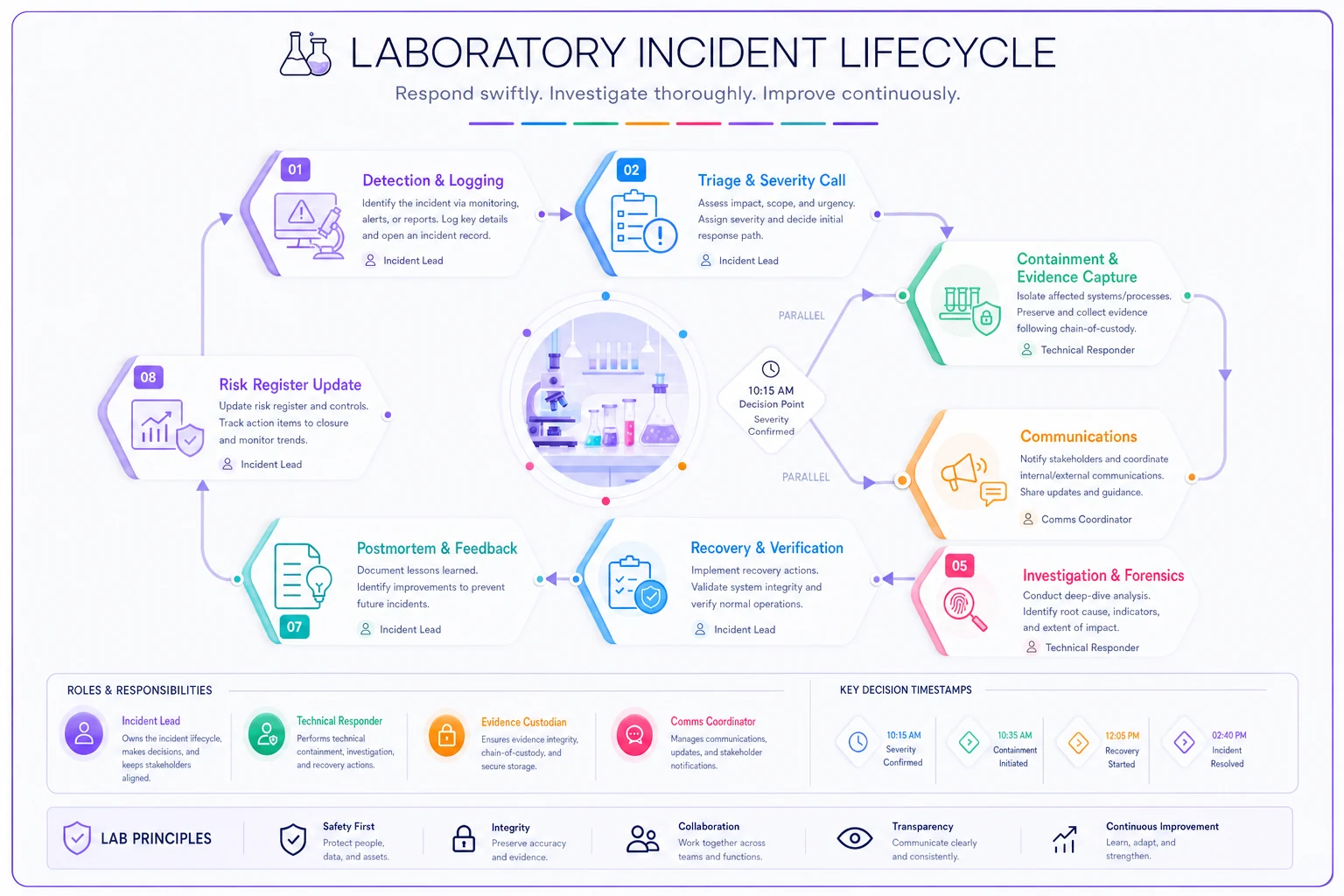
The diagram highlights the parallel containment/evidence capture step and the feedback into the risk register that closes the loop.
Named roles that survive 2 a.m.
The most common mistake is assigning roles by job title instead of by availability and skill. "The lab manager runs all incidents" sounds clean until the incident happens on a Saturday and the lab manager is at a wedding three hours away.
-
Incident Lead — owns the overall response, makes the severity call, decides on activation and stand-down. This is a coordination role, not a technical one. The Lead should not be elbow-deep in the instrument; they should be managing the room.
-
Technical Responder — the hands-on person doing containment and recovery. In a freezer failure, this is whoever is physically moving samples. In a data corruption event, this is whoever understands the instrument's file system.
-
Evidence Custodian — responsible for capturing and preserving everything before it changes. This role is wildly underrated and almost always skipped. It needs to be a named person because evidence capture competes with containment for attention, and if nobody owns it, containment always wins and evidence always loses.
-
Comms Coordinator — handles notifications to PIs, institutional stakeholders, affected collaborators, and where relevant, regulatory or compliance contacts.
For each role, write down two deep: a primary and a backup, with contact methods and a rule for when the backup takes over (usually "no acknowledgment within 15 minutes"). The single most useful artifact in your whole program is a one-page activation card listing who's on call for each role this week and how to reach them. Keep a laminated copy somewhere physical, because the night you need it most is often the night the network is down.
When a single-person incident team makes sense: low-severity events — a minor label mismatch caught before anything shipped, a non-critical instrument throwing a recoverable error. Spinning up a four-role response for these is theater, and theater burns out your people. Reserve full activation for severity tiers that actually warrant it.
Triage: the severity call that drives everything
Every downstream decision depends on the severity tier. Get it wrong and you either flood everyone with noise or let a serious event simmer unattended. Severity shouldn't be a gut feeling — it should be a short, honest rubric.
A practical triage model scores an incident across a few dimensions:
-
Sample impact — Are irreplaceable or high-value samples at risk? A patient-derived xenograft line is not the same as a routine buffer.
-
Data integrity impact — Could reported or soon-to-be-reported results be wrong?
-
Regulatory / compliance exposure — Controlled substances, human samples, chain-of-custody breaks, reportable events.
-
Scope — One instrument, one project, or lab-wide / multi-group?
-
Reversibility — Can this be undone, or is the clock running on permanent loss?
Map those to three or four tiers. The tier determines who gets activated, how fast, and what communications fire. The useful discipline here is that triage is a decision with a timestamp and an owner, not a vibe. Write down who made the call, when, and on what information — because sometimes the triage was reasonable given what was known, and that distinction matters enormously in the postmortem.
A pattern worth naming: labs tend to under-triage data-integrity incidents because nothing is visibly on fire. A freezer alarm feels urgent. A suspicion that an instrument's clock drifted and misordered a batch of results feels abstract — right up until you realize three weeks of runs are now in question. The abstract ones are often the expensive ones.
Evidence bundles: capturing forensics before they vanish
This is where most programs are weakest and where a disciplined approach pays off the most. An evidence bundle is a structured, timestamped, tamper-evident collection of everything you'd need to reconstruct what happened and defend your conclusions later.
The core of a good bundle:
-
Raw instrument/system logs pulled before any restart or reset
-
Checksums of relevant data files captured at discovery, so you can later prove files didn't change during the investigation
-
Environmental data — temperature traces, door-open events, power logs
-
Photos of physical state, with timestamps and context
-
The initial report and the triage decision with who/when
-
Chain-of-custody records for any samples that moved
-
A running timeline that everyone contributes to as the incident unfolds
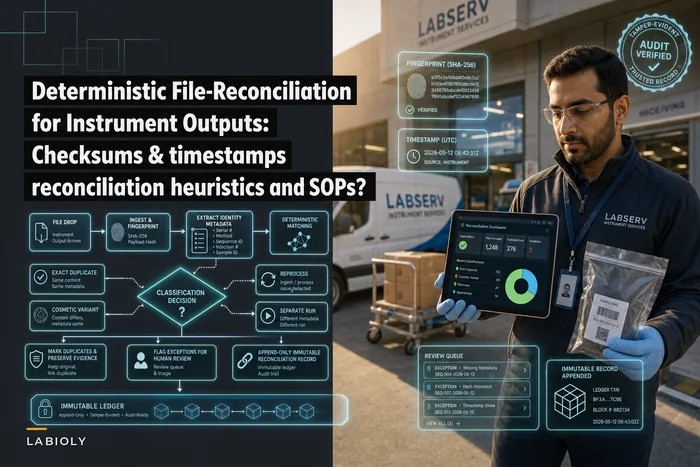
Capture cryptographic hashes at the moment of discovery and log who took them.
The checksum discipline deserves emphasis. If your incident involves instrument output — a corrupted run, a suspected overwrite, a reconciliation mismatch — capturing cryptographic hashes at the moment of discovery is what separates a defensible investigation from a he-said-she-said. The mechanics of doing this properly are worth studying in detail; the approach laid out in this data-loss forensics checklist for preserving files and capturing checksums maps almost directly onto the Evidence Custodian role.
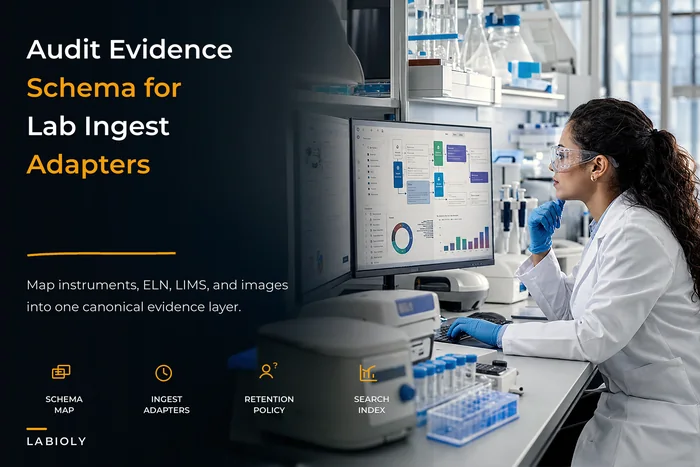
For this to work at all, the evidence has to land somewhere consistent. If every incident's artifacts get dumped into a different folder with a different naming scheme, your bundles are useless six months later when an auditor or a new investigator tries to reconstruct the event. That's exactly why a canonical audit-evidence architecture with defined schemas and retention patterns matters — your incident bundles should slot into the same evidence backbone you use for everything else, not live in a parallel universe.
The single biggest evidence mistake: letting the Technical Responder "clean up" before the Evidence Custodian has captured state. Restarting the instrument, reseating the sensor, moving the samples — all of it destroys information. The fix is procedural and simple: containment and evidence capture run in parallel, by different people, and when they conflict in the first few minutes, evidence wins unless samples are actively dying.
Communications templates: saying the right thing without improvising
Under stress, people communicate badly. They either flood everyone with panicked half-information or go silent because they're not sure what they're allowed to say. Pre-written templates solve both problems by making the right message the easy message.
You need a small set, keyed to severity tier and audience:
-
Internal activation notice — short, factual, to the response team. What happened, severity, who's on it, where the coordination is happening.
-
PI / stakeholder notification — for owners of affected samples or data. What's at risk, what you're doing, when they'll hear more. Resist the urge to speculate on cause; stick to status.
-
Escalation notice — for institutional leadership or compliance when a tier threshold is crossed.
-
Stand-down / resolution notice — the incident is closed, here's the summary, here's what comes next.
Each template should have blanks for the specifics and fixed language for everything else. The fixed language is where you encode good judgment once, when you're calm, so you're not making tone decisions at 2 a.m. A good PI notification doesn't promise outcomes it can't guarantee and doesn't downplay real risk — getting that balance right in a template beats getting it wrong live every time.
One under-appreciated detail: define the cadence of updates in the template itself. "You will receive an update by [time] even if there is nothing new to report." Silence during an incident is what makes stakeholders panic and start calling around, which generates its own chaos. A promised update at a known time keeps everyone off your back while you work.
The postmortem loop that actually changes something
A postmortem that lists action items and nothing more is essentially worthless. The loop only closes when findings become changes to your risk register, your controls, and your resilience plans.
-
Reconstruct the timeline from the evidence bundle — not from memory, from the artifacts.
-
Identify root cause and contributing factors — plural. Most incidents have one trigger and several enabling conditions.
-
Map each contributing factor to the risk register. Was this risk already listed? If yes, why didn't the controls catch it? If no, it's a gap — add it.
-
Update or create controls, each with an owner and a monitoring metric.
-
Feed KPIs back into monitoring so the control's effectiveness is actually measured, not assumed.
-
Revise the relevant resilience plan if the incident revealed that your recovery assumptions were wrong.
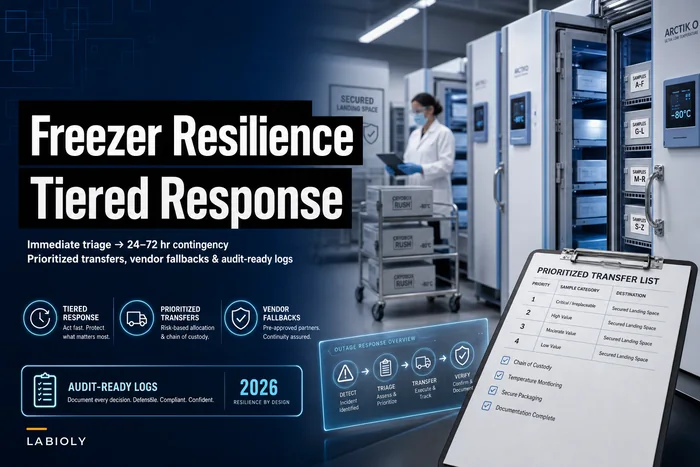
That KPI feedback is what makes the loop a loop instead of a line. If a freezer excursion revealed that your transfer plan took 90 minutes when your resilience plan assumed 30, that gap becomes a tracked metric and your recovery procedures get rebuilt accordingly. The tiered response thinking in this freezer resilience playbook on outage response and prioritized transfers is exactly the kind of resilience plan a postmortem should be updating when reality doesn't match the assumptions.
A pattern worth watching: labs love "retrain staff" as an action item because it's cheap and feels responsible. It's almost always the weakest possible control. If an incident was possible given the current system, retraining rarely prevents recurrence — the next person under time pressure makes the same reasonable-seeming mistake. Stronger controls change the system so the mistake becomes hard or impossible, not just discouraged.
A real scenario: mid-size core facility, cross-labeled sample sets
A university core facility running sample prep for roughly a dozen research groups had a recurring, low-grade problem: occasional sample mislabeling discovered downstream, usually weeks later. Each instance meant re-running work, awkward conversations with PIs, and a vague sense that "we need to be more careful."
Before any program existed, these events were handled ad hoc. The person who found the error fixed what they could, mentioned it to the manager, and that was roughly the end of it. Over about a year they had somewhere around eight or nine of these, each costing a few days of rework and some amount of lost trust with the affected groups.
When they built an actual incident program, the mechanics changed. Every mislabel event — even the "minor" ones — got logged and triaged. The evidence bundles started showing a pattern the ad-hoc handling had completely hidden: a disproportionate share clustered around one shared prep bench during two specific overlapping shifts, when two groups' samples were physically staged next to each other.
That's not a training problem. That's a layout and scheduling problem. The postmortem loop pushed a new risk into the register ("concurrent multi-group staging at shared bench"), the control became a physical and scheduling separation, and the monitoring KPI became mislabel events per quarter tracked against that bench.
Over the following two quarters the mislabel incidents dropped to one. Not zero — programs aren't magic — but roughly an 80% reduction, and the remaining event was a genuinely different cause, which meant the first fix had worked. The real win wasn't the single fix. It was that the facility could finally see the pattern, because the incidents were leaving structured artifacts behind instead of evaporating.
When a heavyweight program is overkill
Not every lab needs this, and bolting a nine-stage lifecycle onto a five-person group will just generate paperwork nobody maintains. The program should scale to the operation.
Keep it lightweight when:
-
You're a small single-PI lab with few handoffs and shared context
-
Incident volume is genuinely low and patterns are easy to see informally
-
The cost of a worst-case incident is bounded and recoverable
Invest in the full program when:
-
You're a shared facility serving multiple groups with competing priorities
-
You handle irreplaceable samples, human material, or controlled substances
-
You operate across multiple sites or shifts where tribal knowledge can't travel
-
Regulatory or audit exposure means your response has to be defensible, not just effective
The honest middle path for most growing labs: start with the three things that fail first — named roles with backups, a disciplined evidence-capture habit, and a postmortem loop that touches the risk register. You can add the full stage model and communications template library as volume and complexity justify it.
Where tooling fits — and where it doesn't
A program like this generates a lot of connected information: reports, timelines, evidence bundles, triage decisions, notifications, postmortems, and register updates. At small scale you can run it on documents and discipline. As incident volume and handoffs grow, the manual coordination becomes its own failure point — someone forgets to capture a checksum, a notification doesn't go out, a postmortem action item never makes it into the register.
This is where operational software earns its place, not as a replacement for judgment but as the connective tissue. A workflow platform that timestamps the detection, routes the triage decision to the right owner, prompts the Evidence Custodian for the specific artifacts a given incident type requires, fires the right communication template at the right tier, and automatically links the postmortem's findings back to the risk-register entry — that removes the quiet drops where human coordination fails under stress. AI-assisted automation can flag when a new incident resembles a past pattern, or nudge when a promised stakeholder update is overdue. The goal is narrow and practical: make sure nothing falls through the cracks during the exact moments when people are too busy to catch it themselves.
The tool is downstream of the design, though. Software can't tell you who should be Incident Lead, what your severity tiers mean, or which controls are worth building. Automate a broken process and you get a faster broken process. Get the lifecycle, the roles, and the feedback loop right first — then let tooling handle the coordination overhead so your people can focus on the actual response.
The test of a lab incident response program isn't how well it handles the incident in front of you. It's whether next year's incidents look different from this year's — fewer of the old kinds, caught faster, with the surprises genuinely new instead of embarrassingly familiar. That only happens when every incident leaves behind evidence you can trust, decisions you can trace, and findings that actually move your risk register and resilience plans. Everything else is just cleaning up the same mess on a loop.
Ready to upgrade your lab operations?
Join 500+ labs using Labioly to save time, reduce errors, and enhance productivity and compliance.