


Most labs don't lose control of their experiments in a dramatic way. It happens quietly. A PI tweaks a buffer concentration in their own copy of a protocol, emails it to a postdoc, and six months later three people are running "the same" assay with meaningfully different parameters. Nobody did anything wrong on purpose. The template just stopped being a single source of truth somewhere along the way, and now you've got drift that only surfaces when a reviewer asks why run 14 and run 22 don't reconcile.
Experiment templates in most research groups are treated like documents, not like controlled artifacts. A document gets copied, edited, renamed finalv2USE_THIS.docx, and scattered across OneDrive, shared folders, and three people's laptops. An artifact has a version, an owner, an approval state, and a record of what evidence justified every change. The gap between those two modes of operation is where most of the irreproducibility and audit pain actually lives.
This piece is about closing that gap: how to author templates in a way that scales, how to tier approvals so you don't drown every minor edit in bureaucracy, how to define allowed deviations so bench scientists aren't forced to either rigidly comply or silently cheat, and how to link every experimental run back to the exact template version and the evidence that approved it.
Why template governance breaks down as a group grows
A two-person lab doesn't need governance. The PI knows every protocol in their head and can spot a bad deviation across the bench. The problem is that nothing about how that lab manages protocols survives contact with growth.
The progression is pretty consistent. At three or four people, templates live in a shared drive and mostly work because everyone talks daily. At eight to twelve, you add a second project, a rotating cast of students, and suddenly two versions of the "standard" extraction exist and nobody can say which is current. Past fifteen, with multiple funding streams and maybe a second site, the shared-drive model collapses entirely. You get:
-
Multiple "current" versions with no authority ranking
-
Edits made by whoever opened the file last, with no change justification
-
Deviations happening on the bench that never get documented
-
No reliable way to answer "which template version produced this dataset?"
The root cause isn't carelessness. It's that the authoring, approval, and execution of templates are three separate activities, and in an ungoverned system they're glued together by informal memory. Memory doesn't scale. The moment the person who "just knows" goes on leave or graduates, the whole informal system has a hole in it.
What actually breaks is linkage. In a healthy system, every experimental result points back to a specific, frozen template version, and that version points back to the approval and evidence that authorized it. When linkage breaks, you can't reconstruct what happened — and reconstruction is exactly what audits, investigations, and reproducibility all depend on.
The three states every template moves through
If you only take one structural idea from this article, make it this: a template is never just "a protocol." At any moment it's in one of three states, and the whole governance system is about controlling the transitions between them.
Eliminate lab bottlenecks and errors.
Labioly helps you monitor, manage, and report lab activities efficiently and compliantly.
- Real-time sample tracking
- Inventory and supply alerts
- Staff workflow coordination
No credit card required
| State | What it means | Who can touch it | What's allowed |
|---|---|---|---|
| Draft | Being authored or revised | Author + named collaborators | Free editing, no runs allowed |
| Approved / Published | Frozen, released for use | Nobody edits; read-only | Runs execute against this exact version |
| Retired | Superseded or withdrawn | Locked, archived | No new runs; historical linkage preserved |
The critical rule is that a published version is immutable. You never edit an approved template. You branch a new draft from it, make changes there, route that draft through approval, and publish it as a new version. The old version stays frozen forever so that every run that ever used it keeps pointing to something real.
Labs that skip this rule end up with the worst situation in records management: a result that references "Protocol 4.2" where Protocol 4.2 has silently changed three times since the run happened. The paper trail exists, but it lies. Immutability is what makes the trail honest.
Authoring flows that don't create bottlenecks
The instinct when you first impose governance is to route everything through the PI or quality lead. That feels safe and it's a mistake. Within a few weeks you've created a queue, people start working around it, and your governance system is being quietly bypassed by the exact deviations it was supposed to catch.
A workable authoring flow separates who can start a change from who can approve it, and lets most of the early work happen without heavyweight oversight.
-
Branch — Author creates a new draft from the current published version. The system records parent version, author, and timestamp automatically.
-
Draft and annotate — Changes are made in the draft. Every modified field requires a short rationale note (one line is fine: "increased incubation to 45 min based on pilot run 112").
-
Internal review — A peer or the protocol owner reviews the draft against the parent version, seeing a clean diff rather than re-reading the whole document.
-
Evidence attachment — Supporting evidence is linked
pilot data, instrument validation, a calibration record, a literature reference. This is where the change stops being an opinion.
-
Route for approval — The draft enters the approval tier appropriate to the scope of change (more on tiers below).
-
Publish — On approval, the draft is frozen as a new version number and the old version is retired.
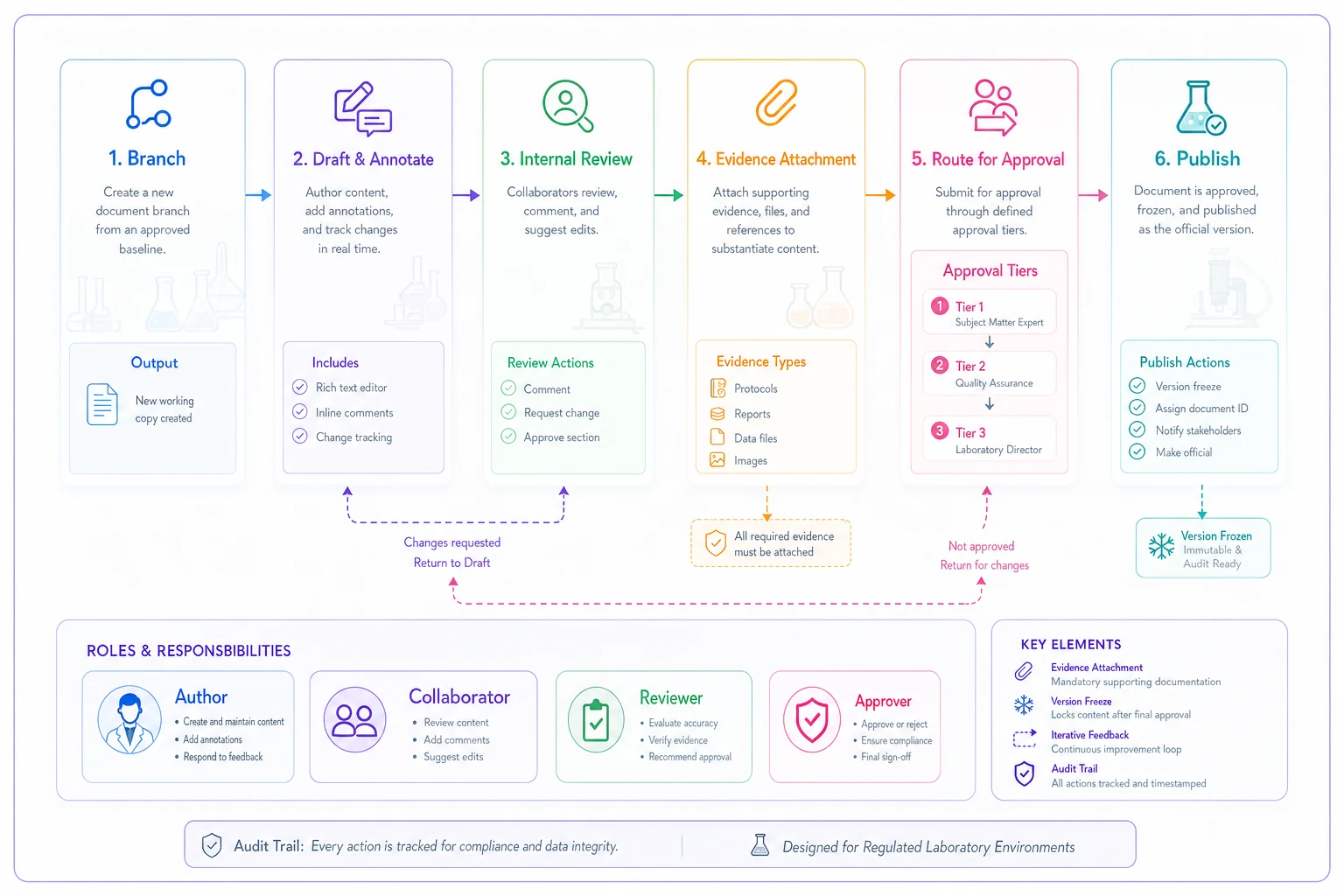
The single biggest improvement most groups can make is step 2: requiring a rationale on every changed field. It costs the author ten seconds and turns a mysterious edit into a reviewable decision. When someone later asks "why 45 minutes?", the answer is sitting right there attached to the version — not buried in a Slack thread from last spring.
This authoring discipline overlaps heavily with how you handle SOP revisions generally. If you've already built a system for mapping change triggers to required evidence and approval bundles, your experiment templates should ride on the same rails rather than inventing a parallel process nobody remembers to use.
Tiered approvals: match the oversight to the risk
Not every change deserves the same scrutiny. Fixing a typo in a reagent name and changing the primary antibody dilution are not the same risk, and treating them identically is how you train people to resent the process.
| Change tier | Examples | Approver | Evidence required |
|---|---|---|---|
| Tier 0 — Editorial | Typo, formatting, clarified wording | Protocol owner, single sign-off | None beyond the rationale note |
| Tier 1 — Minor operational | Swapping to an equivalent consumable lot, reordering non-critical steps | Protocol owner + one peer | Equivalence note or vendor cert |
| Tier 2 — Parameter change | Incubation time, concentration, temperature within a validated range | Lab manager or technical lead | Pilot/supporting data linked |
| Tier 3 — Method-altering | New instrument, changed detection method, altered critical reagent | PI + quality/QA review | Validation runs, full evidence bundle |
The trick is to classify changes by their potential to affect results, then route each tier to the lightest approval that's still defensible.
The point of tiering isn't to be bureaucratic about the heavy stuff. It's to be fast about the light stuff so people stop routing around the system. A lab that forces Tier 3 rigor onto Tier 0 typos will watch its scientists quietly make changes in private copies — which is exactly the drift you were trying to prevent.
One pattern worth flagging: the most dangerous changes are often the ones that look minor. "We just switched antibody vendors, it's an equivalent clone" sounds like Tier 1 but can silently shift your results. Your classification rules should name a short list of parameters that are always Tier 2 or higher regardless of how routine they seem — critical reagents, detection methods, anything that feeds a reported metric.
Allowed deviations: the part most systems get wrong
Here's something nobody likes to admit: bench scientists deviate from protocols constantly, and most of those deviations are reasonable. A sample came in degraded, so they adjusted. The incubator was occupied, so they used a different one at a slightly different temperature. If your system only has two outcomes — perfect compliance or a formal deviation report — you've built something that generates lies, because people will quietly adjust and not report it.
A governed template should define, up front, a band of allowed deviation for its parameters. Think of it as three zones:
-
Within spec — The parameter range the template considers normal. No documentation beyond the run record.
-
Allowed deviation — A defined tolerance band that's acceptable but must be logged. A note on the run, flagged but not escalated.
-
Out of bounds — Beyond the allowed band. Triggers a formal deviation record and may invalidate the run or require sign-off before results are used.
A practical example: a template specifies incubation at 37°C for 30 minutes. The allowed-deviation band might be 36–38°C and 28–33 minutes. Run at 37.5°C for 31 minutes? Logged automatically, no drama. Run at 42°C? That's out of bounds, flagged loudly, and routed to review.
Defining these bands is real work, and it's also the most valuable thing you can do for reproducibility. It forces the protocol author to actually state what matters and how much. The quieter benefit is cultural: when the system acknowledges that reasonable deviations exist and gives people a low-friction way to log them, the under-the-table adjustments mostly stop. You get visibility you never had before.
The failure mode to avoid is setting bands so tight that everything lands out of spec, or so loose they're meaningless. Base them on actual validation data where you have it, and experienced judgment where you don't — then tighten them as evidence accumulates.
Automated linkage: connecting runs to versions to evidence
All of the above is worth little if you can't trace it later. The governance payoff shows up when someone asks a backward-looking question:
-
Which template version produced this dataset?
-
What evidence approved that version?
-
Which runs used a parameter that we later found was wrong?
-
Who approved this change and when?
In an ungoverned lab these questions take days of archaeology, if they're answerable at all. In a governed system they're a lookup, because every run is stamped at execution time with the frozen template version it ran against, and every version carries its approval record and attached evidence.
In plain terms: when a scientist starts a run, the system binds that run to the currently published template version — not "Protocol 4" but "Protocol 4, version 4.2.1, published March 3." Any allowed deviations get logged against the run. The result record inherits that binding permanently. Later, if version 4.2.1 is found to have a problem, you can pull every run bound to it in seconds and know exactly which data is affected.
This is the same discipline that makes audit evidence trustworthy during a system migration. Teams that have gone through a careful LIMS and ELN rollout without losing audit evidence already understand why binding records to immutable versions matters — the template-to-run linkage is just that same principle applied one layer up.
Where AI-assisted operational platforms earn their keep here is in catching the linkage failures humans miss: flagging a run that executed against a retired template, surfacing a deviation that was logged but never reviewed, or noticing that three runs this month drifted toward the edge of an allowed band in the same direction — an early signal that the spec might be wrong. None of that replaces judgment. It just removes the manual watching that nobody has time to do consistently.
A real scenario: a mid-size core facility
Consider a university core running proteomics for a dozen PI groups — roughly 40–50 active protocols, four staff, and a steady stream of rotating students. Before putting any governance on their templates, their situation was typical: protocols lived in a shared drive, "current" was a matter of opinion, and when a reviewer questioned a batch of results, reconstructing which version had been used took the better part of a week.
The specific failure that pushed them to change: a reagent supplier changed a formulation, several staff updated their own copies of the affected protocol at different times, and for about two months some runs used the old formulation and some the new — with no clean way to tell which was which after the fact. They had to flag an entire quarter's worth of results as uncertain.
After moving templates into a versioned, approval-gated system with defined allowed-deviation bands, the day-to-day didn't feel dramatically different, but the parts that mattered changed a lot. Tracing a dataset back to its exact template version went from days to minutes. Undocumented bench deviations dropped sharply once logging a reasonable deviation took a few seconds instead of filing a formal report. And the next time a reagent changed, the parameter was flagged as Tier 2, the change was branched, approved with equivalence evidence attached, and every affected run was identifiable immediately. No more quarantining a quarter of the lab's output on a guess.
The cost was mostly up-front: a few weeks of classifying existing protocols into tiers and defining deviation bands, which is tedious and requires the PIs to actually commit to what matters in their methods.
When this level of governance makes sense — and when it doesn't
Governance has a cost, and pretending otherwise is how you end up with a system people hate. Be honest about where it pays off.
This makes sense when:
-
You're running more than a handful of protocols across multiple people
-
Results feed regulated submissions, clinical decisions, or published claims
-
Protocols change often enough that version confusion is a real risk
-
You have rotating staff or students who won't absorb informal knowledge
-
You've already been burned by not being able to reconstruct what happened
This is a bad idea — or at least premature — when:
-
You're a two- or three-person group where everyone genuinely knows every protocol
-
Your protocols are stable and rarely change
-
The overhead would exceed the risk you're actually carrying
Who should NOT do this (yet): a brand-new lab still figuring out its core methods. If your protocols are changing weekly because you're still developing them, heavy approval gates will strangle you. Govern templates once the methods stabilize enough that "the official version" is a meaningful concept. Governing a moving target is just friction.
One more honest caveat: governance only works if the people who approve things actually have the competence to evaluate the evidence. Tiered approvals assume your approvers can tell a good equivalence argument from a hand-wave. That's a training and role-clarity question as much as a process one — the same ground covered in building role-based competency programs with matrices and audit-ready evidence. An approval from someone who can't judge the change is just a rubber stamp that looks like governance.
Getting started without boiling the ocean
Don't try to govern all 50 protocols at once. Pick the five or six that matter most — the ones feeding reported results or regulated work — and bring those under version control first. Classify their changes into tiers, define allowed-deviation bands for their critical parameters, and get the authoring flow working on that small set. Expand once the pattern is familiar.
The mindset shift is the whole game: stop thinking of your protocols as documents you edit and start thinking of them as artifacts you version, approve, and bind to evidence. Documents drift silently and lie to you later. Artifacts carry their own history and tell you the truth when you need it most — which, almost always, is the moment someone questions your results and you need to prove exactly what you did.
The mindset shift is the whole game: stop thinking of your protocols as documents you edit and start thinking of them as artifacts you version, approve, and bind to evidence. Documents drift silently and lie to you later. Artifacts carry their own history and tell you the truth when you need it most — which, almost always, is the moment someone questions your results and you need to prove exactly what you did.
Ready to upgrade your lab operations?
Join 500+ labs using Labioly to save time, reduce errors, and enhance productivity and compliance.