

Most labs handle the first use of data reasonably well. Someone consents to a study, the sample gets collected, the project runs, and the analysis stays inside the scope everyone agreed to. The mess starts later — usually eighteen months down the line — when a postdoc from a different group asks, "Can I pull those genomic files for a new project? It's basically the same population."
That single request is where data ethics either holds up or quietly falls apart. In most labs, it collapses not because anyone is careless, but because the consent governing that data lives in a PDF while the data itself lives in a system that has no idea the PDF exists. Policy and control are in two different worlds, with no bridge between them.
This article is about building that bridge — mapping consent classes to actual access checks so that "what someone agreed to" becomes something your systems can enforce, log, and prove during an audit.
The gap between what people signed and what your systems know
The structural problem is pretty straightforward. Consent is written in human language. It says things like "may be used for cardiovascular research" or "data may be shared with academic collaborators but not commercial entities" or "de-identified data may be retained indefinitely." Rich, nuanced, full of conditions.
Your LIMS, on the other hand, stores a boolean somewhere. consent = Y. Maybe a free-text notes field if you're lucky.
So when a secondary-use request comes in, whoever's fielding it has to manually dig up the consent form, re-read it, interpret whether "cardiovascular research" covers this new metabolic study, decide whether the new PI qualifies as an "academic collaborator," and then make a judgment call — often under time pressure, often without the original IRB protocol in front of them. That judgment gets made hundreds of times across a busy lab, by different people, with no real consistency.
What tends to happen is that interpretation drifts. The first person to field these questions sets an informal precedent, the next person copies it, and within a year the practical consent scope has quietly expanded well beyond what any participant actually agreed to. Nobody decided this. It accumulated.
The fix isn't more careful reading. It's turning consent from prose into structured consent classes that your systems can actually reason about.
Consent classes: the layer everything else hangs on
A consent class is a machine-readable summary of what a given record's consent actually permits. Not the full legal text — that stays in the document of record — but the operational parameters a system can check against a request.
Eliminate lab bottlenecks and errors.
Labioly helps you monitor, manage, and report lab activities efficiently and compliantly.
- Real-time sample tracking
- Inventory and supply alerts
- Staff workflow coordination
No credit card required
A workable consent class captures things like:
-
Permitted research domains (specific, not "biomedical research generally")
-
Recipient categories allowed — internal, academic external, commercial, none
-
Identifiability level the consent permits (fully identified, coded, de-identified only)
-
Re-contact permission — yes/no, and for what
-
Geographic/jurisdictional limits on data movement
-
Expiry or review triggers — some consents are time-bounded or study-bounded
When consent language is ambiguous, default to the narrower interpretation and flag the record for human review.
One important design decision: consent classes should be conservative by default. When the original form is ambiguous, the class should encode the narrower interpretation and flag the record for human review rather than auto-approving. Ambiguity resolved toward permission is exactly how labs end up in front of an ethics board trying to explain a breach.
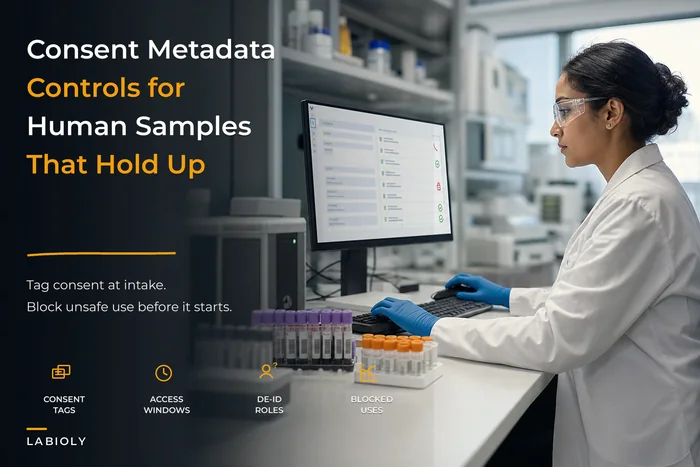
If you've already built out consent metadata structures, this extends naturally from the work described in the Operational Framework for Human-Sample Privacy: Consent Metadata, Access Controls and De-identification SOPs. Consent classes are essentially that metadata elevated from "stored" to "enforceable."
Mapping consent classes to system controls
This is where the value actually lives — translating policy into enforcement at the points where data gets touched.
| Consent parameter | System control it drives | What happens when violated |
|---|---|---|
| Permitted research domain | Query-scope check against project's registered domain | Request blocked, routed to ethics review |
| Recipient category | Export/share permission tied to requester's org type | Export disabled for disallowed recipients |
| Identifiability level | Field-level masking / de-id pipeline enforcement | Identified fields stripped or access denied |
| Re-contact permission | Contact-detail visibility toggle | Contact fields hidden from non-permitted users |
| Jurisdictional limit | Storage/transfer location check | Cross-border transfer halted |
| Expiry/review trigger | Time-based access lock | Access suspended pending re-review |
Every row in that table represents a place where a human judgment call used to happen and now happens as an enforced rule with a logged outcome. The judgment moves upstream — into how you define the class — and gets made once by the right people instead of repeatedly by whoever's available.
Where AI-assisted tooling genuinely helps is in that first translation step: parsing consent forms and IRB protocols into draft consent classes at scale. If you're sitting on 4,000 legacy consent documents in three different formats, no one is hand-coding those into classes. A workflow platform with automation can propose the classification, surface the ambiguous ones for human sign-off, and leave a record of who confirmed each. The automation drafts; the ethics-responsible human decides. That division matters — you never want the system making the ethical call, only preparing the decision cleanly.
The secondary-use request workflow, end to end
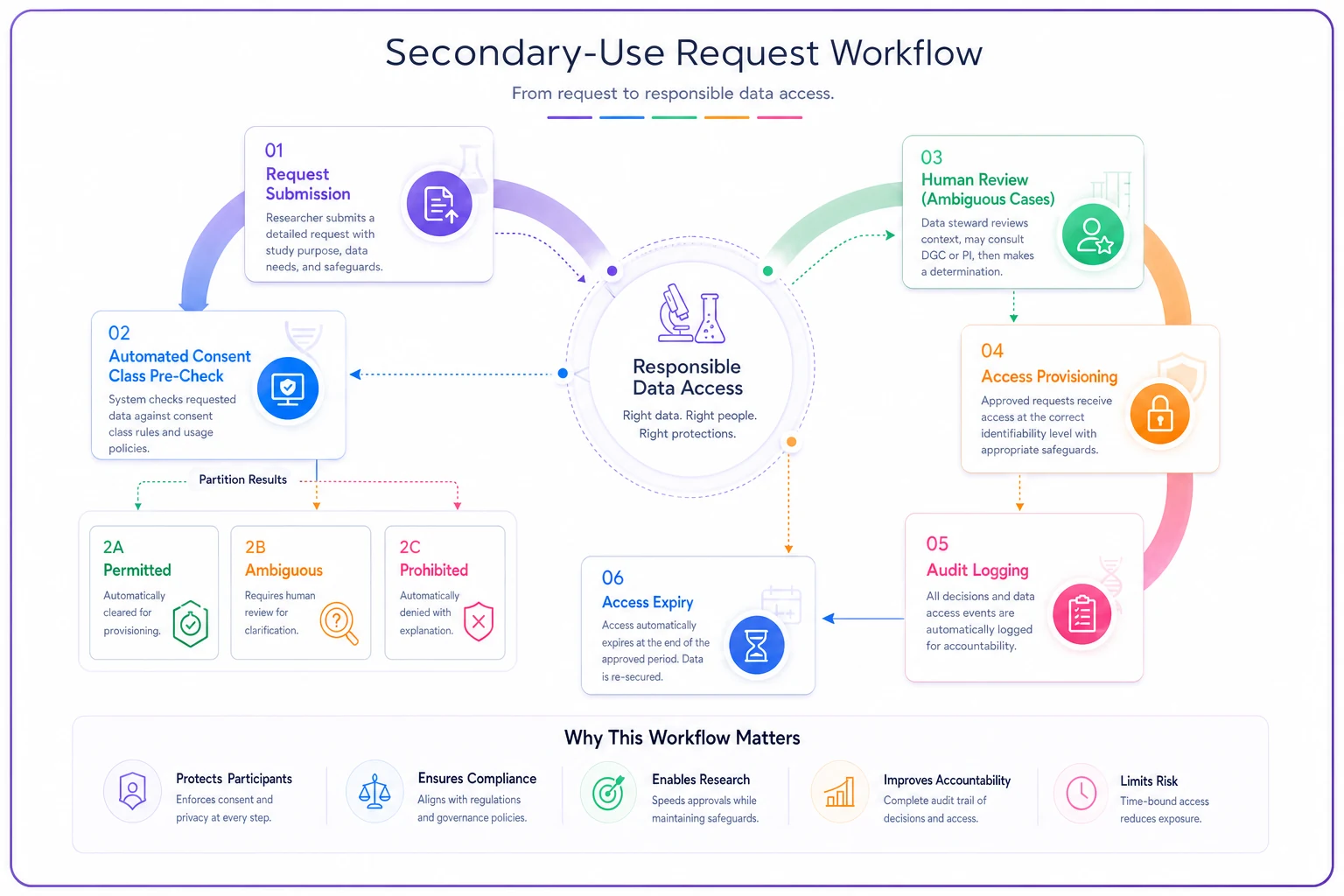
Here's how a secondary-use request should actually move once consent classes are enforced, because the sequence is where most labs have gaps.
The diagram below outlines the end-to-end flow.
-
Request submitted with a defined scope
what data, for what purpose, by whom, with what identifiability. Vague requests ("access to the cohort") get rejected at intake — scope has to be specific enough to check.
-
Automated pre-check runs the request against the consent classes of every record in scope. This produces a partition: records clearly permitted, records clearly prohibited, records ambiguous.
-
Ambiguous set routed to review — usually the IRB liaison or data-governance owner. They see the specific parameter causing the flag, not the whole form.
-
Access provisioned only for the permitted set, at the identifiability level the consent allows. This often means the requester gets a de-identified extract of 2,800 records rather than the full identified 3,400 they asked for.
-
Every step logged as audit evidence — the request, the partition, the reviewer decision, the exact records released, the transformations applied.
-
Access expires on the schedule set at provisioning, not left open indefinitely.
The failure most labs have is skipping straight from step one to step four. A request comes in, someone with admin rights grants access to the whole dataset, and steps two, three, five, and six simply don't exist. Access is binary and permanent. That's the setup that looks fine until an auditor asks, "Show me which of these 3,400 participants consented to this specific use," and the honest answer is "we'd have to check them one at a time."
Access checks that respect the requester, not just the data
A control layer that only looks at consent classes is only half built. The other half is who is asking. The same query for the same data can be legitimate from one person and a violation from another.
Access checks need to combine three things at query time:
-
The consent class of the records (what the data permits)
-
The requester's authorization (their role, their affiliation, their approved projects)
-
The request context (the stated purpose, whether it matches an active approved protocol)
The mistake we see regularly is labs building strong role-based access — good, granular roles — and treating that as the whole answer. Role-based access asks "is this person allowed to use the system," not "is this person allowed to use this data for this purpose." A researcher can be fully authorized to use the LIMS and still have no business pulling records whose consent excludes their project. The consent check and the identity check have to happen together, or you've built a lock with the key taped to it.
Audit evidence: proving compliance, not just claiming it
An ethics review or regulatory audit doesn't ask whether your controls exist. It asks you to demonstrate they worked, on specific records, on specific dates. That's a different standard, and it's the one that catches labs off guard.
The evidence you want to be able to produce on demand:
-
For any released dataset
the exact records, their consent classes at time of release, and why each qualified
-
For any denied request
what was requested and which parameter blocked it
-
For any ambiguous case
who reviewed it, when, and what they decided
-
For any de-identification applied
which fields were transformed and by what method
-
A chain showing the consent class in force at the time of the decision, since consent scope can change
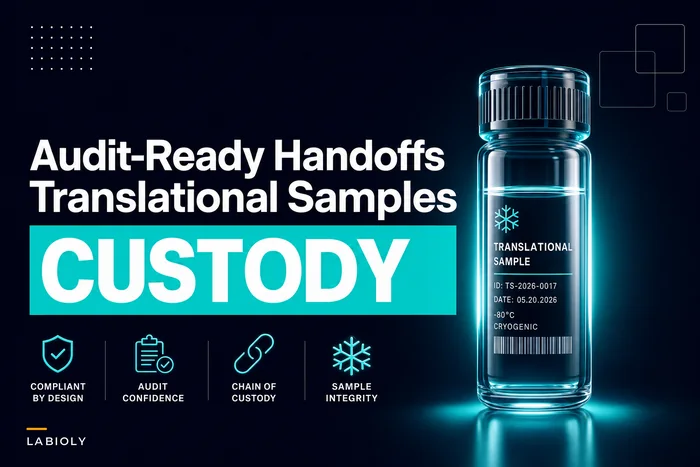
That last point trips people up. If a participant withdraws or narrows consent in March, and you released their data under the old class in January, you need to show the class as it stood in January — not as it stands now. Your evidence has to be versioned and time-stamped, not just current-state. This overlaps with building a proper evidence trail for samples covered in the Minimal Audit-Ready Chain-of-Custody Documentation for Translational Samples — same principle, applied to consent decisions instead of physical custody.
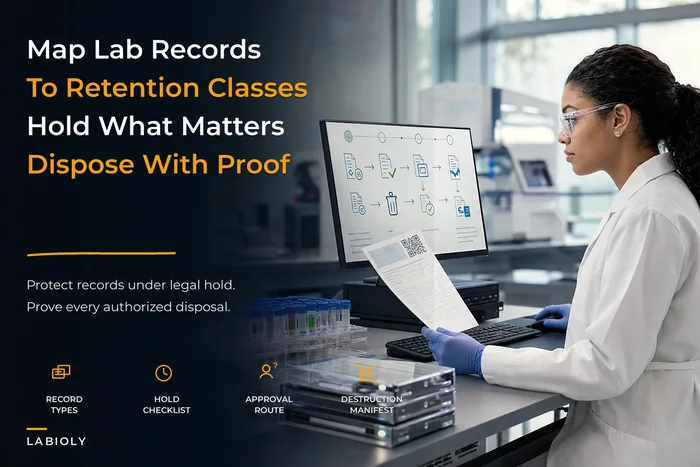
And when consent expires or a record hits a disposal trigger, the secondary-use controls have to talk to your retention rules, which connects directly to how you Map Lab Records to Retention Classes: Legal-Hold Checklists and Secure-Disposal SOPs with Evidence Manifests. Consent scope and retention scope are two clocks running on the same record, and they need to be aware of each other.
A real scenario
A mid-sized translational research group — roughly a dozen active projects, a shared biobank of around 6,000 human-derived samples — kept fielding internal secondary-use requests. Maybe two or three a month. Each one went to the lab manager, who'd pull the relevant consent forms, read through them, and email back an approve/deny. It took her the better part of a day each time, and interpretation varied depending on how busy things were.
The breaking point came during a routine IRB continuing review. The board asked for evidence on twelve past secondary uses — which records, under what consent basis. Reconstructing it took nearly three weeks of digging through email threads and form scans, and two of the twelve turned out to have included records whose consent was, on closer reading, genuinely questionable. Not malicious. Just drift.
They moved to structured consent classes over about four months. Legacy forms got parsed into draft classes through automation, with human sign-off on the ambiguous ones — around 15% of records needed manual review, which was manageable spread over a quarter. New requests now run through an automated pre-check that partitions records in seconds. The lab manager's per-request time dropped from most of a day to under an hour, and that hour is spent only on genuinely ambiguous cases.
The number that actually mattered to them wasn't the time saved. It was the next IRB review, where producing evidence for every secondary use in the period took an afternoon instead of three weeks — and there were no questionable inclusions to explain.
When this level of rigor makes sense — and when it doesn't
Build this out when: you handle human-derived data or samples with meaningful consent conditions, you get secondary-use requests with any regularity, or you're subject to IRB/ethics oversight that can audit specific decisions. If any of those are true, the informal approach is a liability waiting for the wrong audit.
It's overkill when: your data has no consent dimension — purely instrument or environmental data with no human subjects — or when your consent is genuinely uniform across every record. If every participant signed the identical open-ended consent, consent classes collapse to a single class and most of this machinery is unnecessary. Don't build a partitioning engine for a dataset that only has one partition.
Who should be careful: small labs with one or two data-touching people sometimes assume they don't need formal controls because "we all know the rules." That works right up until one of those people leaves, taking the undocumented interpretation with them. The rigor here isn't really about volume — it's about whether the knowledge survives staff turnover. If your consent interpretation lives only in someone's head, that's the risk regardless of lab size.
The system view
Consent doesn't sit still. Records get added, consent gets withdrawn, projects change scope, staff turn over — and every one of those events should ripple through your access controls automatically. A lab that treats consent as a one-time gate at collection will always drift, because the world keeps moving and the gate doesn't.
The labs that hold up over time are the ones where consent classes, access checks, and audit evidence operate as three parts of one connected loop. A change to what someone permitted flows through to what any system will let anyone do with their data, and leaves proof behind at every step. That's the real bar for data ethics in a working lab: not good intentions, but controls that make the wrong action inconvenient and the evidence automatic.
The labs that hold up over time are the ones where consent classes, access checks, and audit evidence operate as three parts of one connected loop. A change to what someone permitted flows through to what any system will let anyone do with their data, and leaves proof behind at every step. That's the real bar for data ethics in a working lab: not good intentions, but controls that make the wrong action inconvenient and the evidence automatic.
Ready to upgrade your lab operations?
Join 500+ labs using Labioly to save time, reduce errors, and enhance productivity and compliance.