

Most labs don't have an SOP writing problem. They have an SOP adoption problem. You can have a beautifully controlled document library, version-stamped and signed off, and still watch three different analysts run the same assay three different ways. The document exists. Nobody argues it exists. It just isn't the thing that governs what happens at the bench.
That gap — between the written procedure and the practiced procedure — is where most quality events actually originate. And it widens predictably as a lab grows. One bench, one PI, five people: adoption is enforced by proximity. Someone notices the shortcut. At three benches across two floors with rotating students and contract staff, proximity stops working, and you're left with whatever system you built to replace it. Usually that system is "hope and the annual audit."
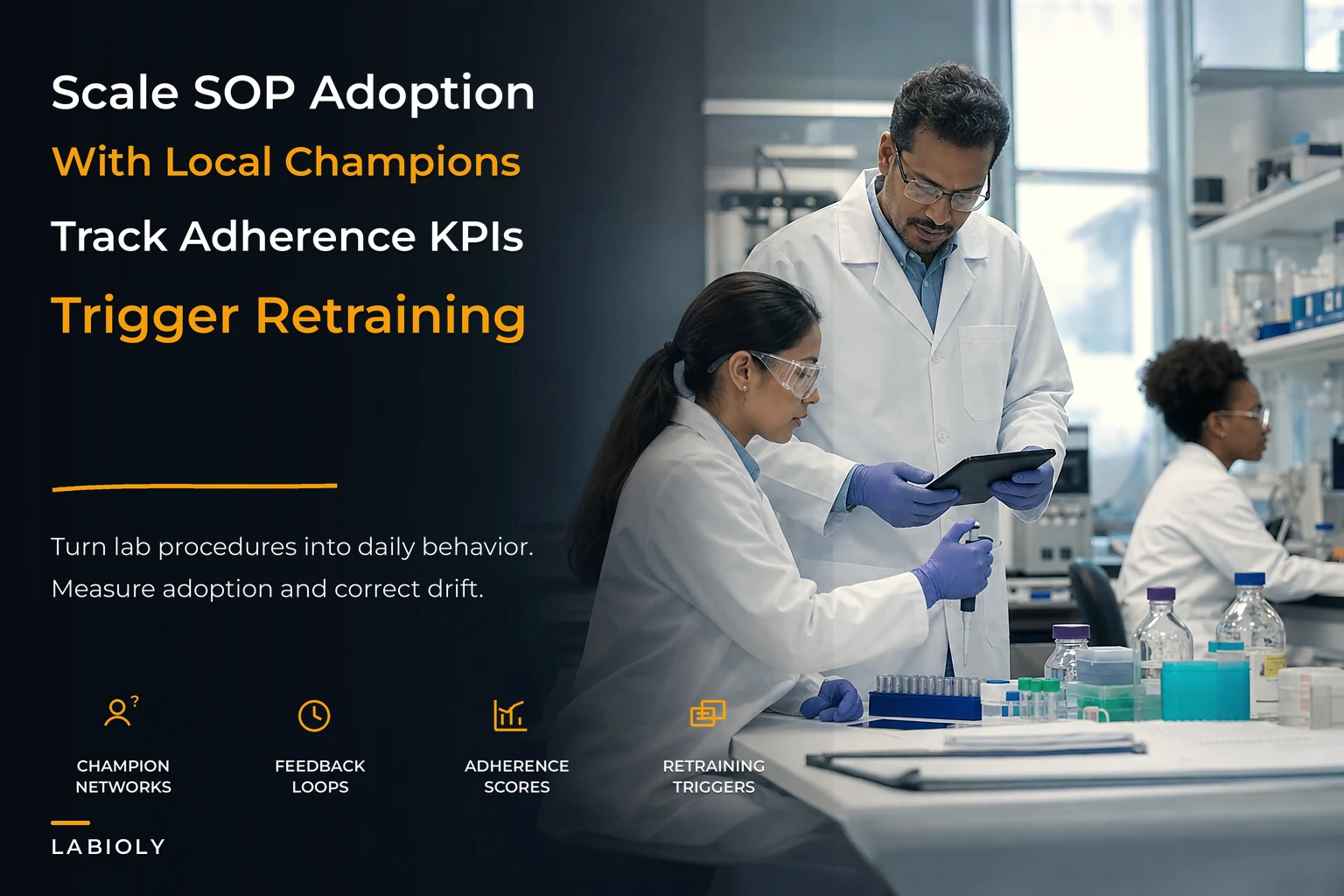
This article is about building the replacement system. Not writing better SOPs — assuming you already can — but getting them lived. Local champions, tight feedback loops, adherence KPIs that mean something, and clear triggers for when you pull someone back for retraining. The pieces have to connect, because adoption fails at the seams, not in the middle.
Why adoption decays, and why it decays faster at scale
Walk the chain backwards from any deviation and you'll usually land on one of a few failure modes. The SOP was technically findable but practically invisible — buried in a document system nobody opens mid-task. Or it was followed correctly six months ago, then a reagent supplier changed and the procedure quietly drifted without anyone updating the doc. Or the person doing the work was never genuinely trained on this version; they were trained on the previous one and absorbed the delta by osmosis.
The common thread: adoption isn't a one-time event you complete at rollout. It's a state you have to actively maintain against constant decay. Staff turnover erodes it. Procedure revisions erode it. Time pressure erodes it — the shortcut that saves four minutes per run becomes the de facto method within a month if nobody's watching.
At small scale, a single conscientious supervisor holds the whole thing together through sheer attention. This is why small labs often run clean on charisma alone and then fall apart the moment they add a second site or double headcount. The informal enforcement didn't scale because it was never a system — it was a person. The transition from 8 to 20 people is typically where "everyone just knows how we do it" stops being true, and nobody notices until a run gets invalidated.
So the real design question isn't "how do we train people once." It's "what mechanism keeps adoption above threshold while people, procedures, and pressures keep changing underneath it."
The four load-bearing components
A durable adoption program rests on four parts that each do a different job. Miss one and the others compensate badly.
Eliminate lab bottlenecks and errors.
Labioly helps you monitor, manage, and report lab activities efficiently and compliantly.
- Real-time sample tracking
- Inventory and supply alerts
- Staff workflow coordination
No credit card required
| Component | What it does | What breaks if it's missing |
|---|---|---|
| Local champions | Owns adoption at the bench level; translates SOPs into daily reality | Enforcement reverts to one central person; doesn't scale past ~15 staff |
| Rapid feedback loops | Surfaces drift and confusion within days, not at audit | Problems compound silently until a deviation forces discovery |
| Adherence KPIs | Makes "are we actually following this?" measurable and visible | You manage on anecdote; can't tell improvement from luck |
| Retraining triggers | Defines when intervention happens, before quality fails | Retraining becomes punitive, reactive, and tied to blame |
These reinforce each other in a specific way. Champions generate the feedback. Feedback feeds the KPIs. KPIs cross thresholds that fire the retraining triggers. Retraining resets adherence, which the champions then monitor. It's a loop, not a checklist — and when one link is weak, the whole cycle stalls in a predictable place.
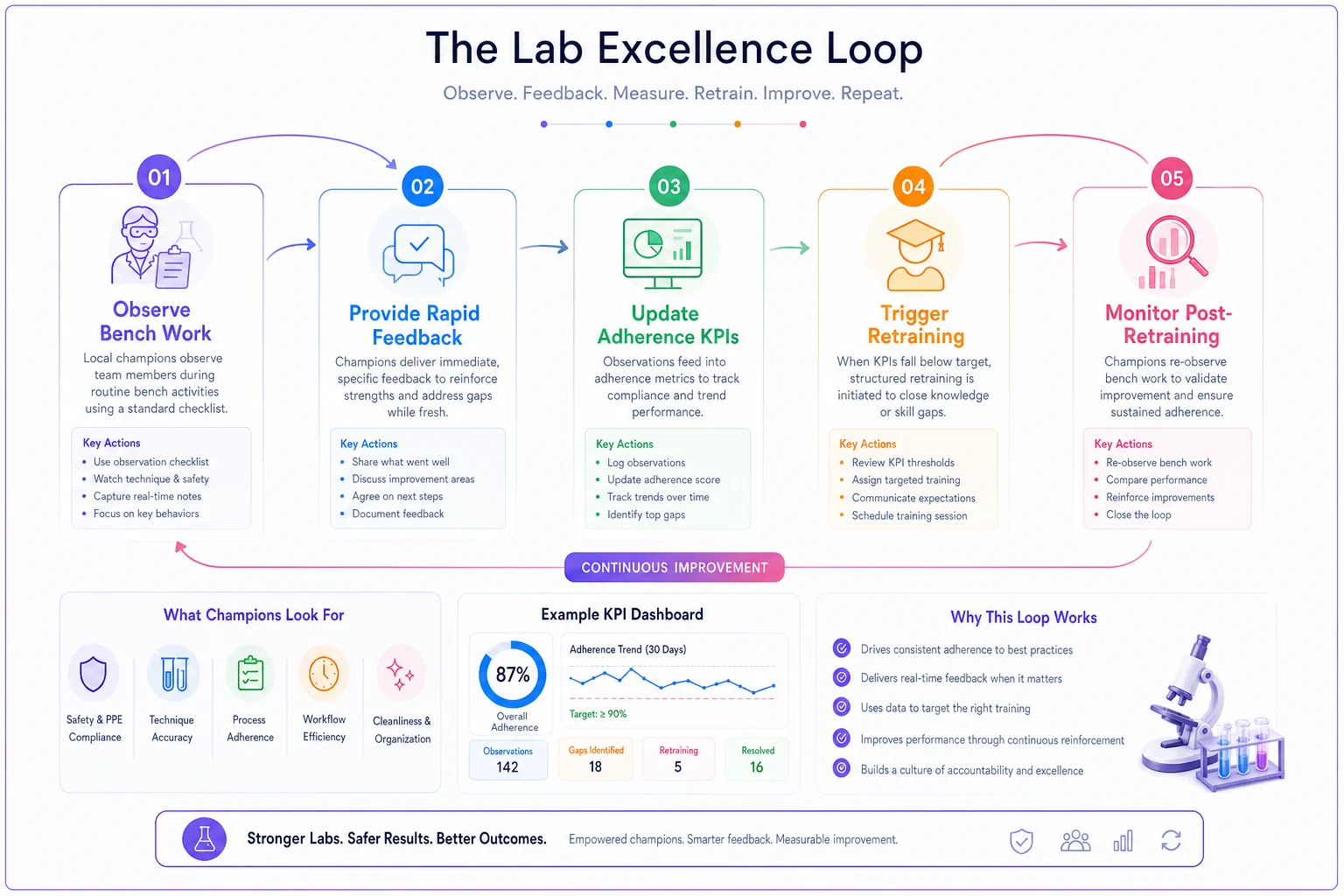
This diagram shows how the four components form a continuous loop.
Local champions: the part everyone underestimates
A champion is not a quality manager with a new title. The whole point is that they work the bench, they're trusted by the people around them, and they catch the small stuff — the undocumented workaround, the "oh we stopped doing that step months ago" — long before it reaches a formal review.
The mistake labs make is picking champions for seniority instead of fit. Your most senior analyst is often the worst choice, because they're frequently the person with the most entrenched personal shortcuts and the least patience for process. The better champion is usually someone mid-career, well-respected, slightly obsessive about doing things right, and present on the floor most days. One champion per roughly 6–10 bench staff is a workable ratio. Fewer and they can't see enough; more and the role dilutes into another committee.
Give the role real structure or it evaporates. A functioning champion setup usually includes:
-
A defined scope — which SOPs and which bench area they own, not "quality in general"
-
Protected time — even two or three hours a week, explicitly carved out, or the role loses to pipetting every single time
-
A direct escalation path — they can flag a broken SOP and get it into change control without a three-week detour
-
Visible authority — leadership publicly backs their calls, so "the champion said to redo it" isn't something staff can quietly ignore
That escalation path matters more than people expect. If a champion spots that an SOP no longer matches reality, there has to be a fast, legitimate route to fix it. This is where your champion program has to plug directly into your change-approval matrix — otherwise champions learn that raising issues produces nothing but friction, and they stop raising them. A champion who's been ignored twice becomes a very expensive bystander.
Rapid feedback loops: catching drift while it's still cheap
The cost of a drift problem scales with how long it hides. A technique that quietly diverged from SOP last Tuesday is a coaching conversation. The same divergence discovered at an audit nine months later is a batch of questionable results, a deviation investigation, and possibly a re-run of work that can't be re-run.
So the loop has to be short. The target isn't "monthly QA review." It's something closer to a few days between a deviation happening and someone who can act on it seeing it. That's only achievable if observation is built into normal work rather than bolted on as an extra task.
In practice the feedback comes from a handful of sources that layer on top of each other:
-
Champion spot-observations — informal, frequent, low-ceremony. The champion watches a procedure run two or three times a week and notes divergences without turning it into an inspection.
-
Self-reported friction — a lightweight, blame-free way for staff to say "this step doesn't make sense" or "I couldn't do X because Y." The volume of friction reports is itself a signal; silence usually means people stopped bothering, not that everything's fine.
-
System-captured signals — out-of-sequence steps, missing sign-offs, timestamps that suggest a step was skipped. Your LIMS and instrument logs already hold a lot of this if someone's looking.
-
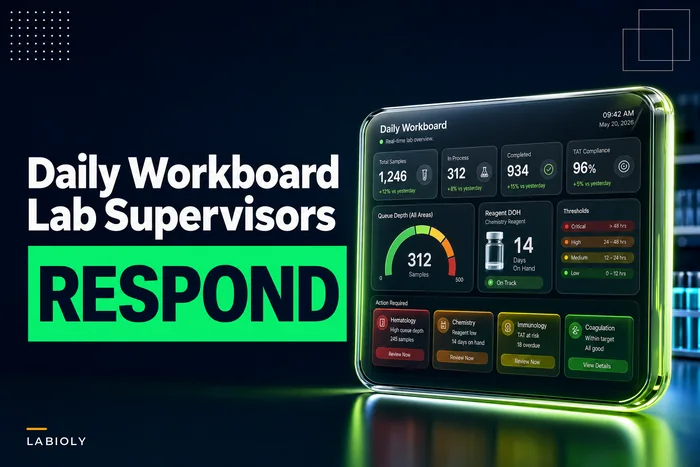
Short-interval review at the supervisor level — rolling the day's or week's signals into something a supervisor acts on quickly. The daily workboard approach is the natural home for this, with adherence exceptions sitting right next to the other short-interval KPIs a supervisor already watches.
A feedback loop that only runs during audits isn't a feedback loop, it's a reckoning. You want the drip of small corrections, not the flood of a once-a-year discovery.
Adherence KPIs that aren't theater
A lot of programs quietly die here. Labs reach for whatever's easy to count — "percent of staff who've acknowledged the SOP" — and then wonder why adherence doesn't improve. Acknowledgment measures that someone clicked a button. It tells you nothing about whether the procedure is being followed.
Good adherence KPIs measure practiced behavior, which is harder to collect and far more honest. A workable set usually looks like this:
| KPI | Rough definition | Healthy range (indicative) |
|---|---|---|
| Observed adherence rate | % of observed procedure runs performed per current SOP | >92% |
| Current-version compliance | % of staff trained on the active revision, not a prior one | >95% |
| Deviation rate per 100 runs | Documented deviations normalized to volume | Tracked for trend, not absolute |
| Time-to-correction | Days from drift observed to drift resolved | <7 days |
| Friction report volume | Self-reported SOP problems per period | Watched for sudden drops |
A few things worth noting. First, the number matters less than the trend. A lab that holds steady at 88% observed adherence and climbs toward 94% over a quarter is healthier than one sitting at a flat 96% that nobody's actually verifying. Second, normalize everything to volume — raw deviation counts punish your busiest bench and flatter your idle one, which is exactly backwards. Third, a falling friction report volume is often bad news. It usually means people gave up on reporting, not that the SOPs got better.
Who owns these numbers? The champions collect the observational data, supervisors act on the short-interval signals, and quality leadership watches the portfolio-level trend. If the same person is doing all three, you don't have a system, you have a bottleneck wearing three hats.
Retraining triggers: define them before you need them
The most consequential design decision in the whole program is when retraining fires. Get this wrong and retraining becomes a punishment — something that happens to you after you've already caused a problem, which guarantees people will hide problems to avoid it.
The fix is to define triggers in advance, tie them to the KPIs, and make them automatic enough that nobody has to decide "is this bad enough to act on" in the moment. When the threshold is crossed, the trigger fires. No debate, no blame, just a defined response.
-
Tier 1 — Coaching touch. A single observed divergence, or one friction report on a step. Response: the champion walks through the step with the person, same week. No formal record beyond a note. This catches most drift before it's anything.
-
Tier 2 — Targeted retraining. Observed adherence for an individual or procedure drops below threshold, or two deviations cluster on the same step within a short window. Response: a structured retraining on the specific procedure, with a competency re-check afterward.
-
Tier 3 — Full requalification. A deviation that affected results, or repeated Tier 2 failures. Response: pull the person off that procedure until they requalify against the current SOP, with documented evidence.
Procedure revisions are their own trigger, separate from performance. When an SOP changes materially, everyone who runs it needs retraining on the delta — not a re-read, a verified retrain. This is the single most neglected trigger in most labs: the document gets updated, change control signs off, and the actual humans at the bench absorb the change informally or not at all. Tie your retraining triggers into the same engine that drives your role-based competency program, so a revision automatically flags everyone whose qualification is now stale.
The governing principle: triggers should fire before quality fails, not after. If your only trigger is "we had a deviation," you've designed a system that waits for damage.
Governance cadence: who meets, how often, about what
Without a rhythm, all of this degrades into good intentions. The cadence doesn't need to be heavy — it needs to be consistent and put the right signal in front of the right person at the right interval.
-
Weekly (champions + supervisor) Review the week's spot-observations and friction reports. Resolve Tier 1 items. Flag anything heading toward Tier 2. Fifteen minutes, standing up, not a meeting that needs an agenda doc.
-
Monthly (supervisors + quality lead) Review adherence KPI trends by procedure and bench. Confirm retraining triggers that fired were acted on. Identify SOPs generating repeat friction — those are usually broken procedures, not broken people.
-
Quarterly (quality leadership) Portfolio view. Which procedures are chronically low-adherence? Which champions are overloaded? Is the whole program trending up or just holding? This is also where you decide if a persistently problematic SOP needs rewriting rather than re-enforcing.
The monthly review is where the most valuable insight usually surfaces: a cluster of friction reports and deviations on the same step almost always means the SOP is wrong, unclear, or impractical — not that your staff are careless. Labs that treat every adherence gap as a training problem end up retraining people on procedures that genuinely don't work at the bench, which breeds exactly the cynicism that kills adoption.
A rollout you can actually run
You don't deploy this across the whole lab on day one. Pilot it on one bench area and one cluster of related SOPs, prove the loop closes, then expand.
-
Pick the pilot scope. One bench, one family of 3–5 related SOPs. Ideally procedures with enough run volume that you'll generate real signal within weeks.
-
Name and equip the champion. One person, protected time, defined scope, visible leadership backing.
-
Set baseline adherence. Before you change anything, observe and record current adherence. You need the "before" or you'll never prove the program did anything.
-
Stand up the feedback loop. Spot-observations, a friction-reporting channel, and whatever system signals you can pull cheaply.
-
Define triggers and thresholds in writing. Agree them before anyone trips one, so the first retraining isn't negotiated under pressure.
-
Run the weekly cadence for 6–8 weeks. Let the loop cycle several times. Expect the baseline to look worse before it looks better — you're now seeing drift that was always there.
-
Review, adjust, expand. Take the KPI trend to the monthly review, tune the thresholds, then roll to the next bench with a trained champion.
A real scenario
A mid-size university core facility — around 18 bench staff across two labs, heavy sample-prep workload — kept catching the same class of problem at quarterly review: analysts running a prep protocol with small undocumented variations that occasionally produced out-of-spec QC. Nothing catastrophic, but enough re-runs that it was eating real hours, somewhere in the range of 20–30 redone preps a quarter.
They ran this program on the prep SOP family first. Two champions, roughly two hours a week each, weekly fifteen-minute review with the supervisor. The baseline observation was uncomfortable: observed adherence on the key protocol sat around 84%, well below what everyone assumed. Most of the gap traced to one genuinely ambiguous step — the SOP said one thing, the practical reality required another — which the friction reports surfaced within the first two weeks. That step got rewritten through change control fast.
By end of quarter, observed adherence on that protocol was sitting in the low-to-mid 90s, re-run volume had dropped to a handful, and — maybe the most telling part — the champions were catching and coaching divergences within days instead of quality finding them at the quarterly reckoning. The program didn't make the staff more careful. It made the process visible enough to fix the step that was quietly setting everyone up to fail.
When this makes sense — and when it doesn't
This whole apparatus is overkill for a five-person lab where one supervisor genuinely sees everything. If proximity still works, don't build governance you don't need.
It starts paying for itself somewhere past 12–15 staff, or the moment you add a second physical location, or when turnover gets high enough that informal knowledge transfer can't keep up. Rotating students, contract staff, multi-shift operations — all of these break proximity-based enforcement and are the signal that you need a system instead of a person.
Who should not do this: anyone treating it as a surveillance program. If staff perceive champions as informants and KPIs as a way to assign blame, you'll get the number you're measuring — acknowledgments, box-ticking, hidden deviations — and none of the behavior you actually want.
The entire thing runs on the premise that catching drift early is a shared win, not a prelude to punishment. Labs that get the culture wrong would be better off not starting, because a cynical adoption program is worse than an honest absence of one.
Where the tooling actually earns its place
None of this requires software to exist — you can run a credible version with spreadsheets, a shared observation log, and disciplined meetings. But it gets heavy fast. Keeping each person's current-version qualification in sync with every SOP revision, normalizing deviation rates by volume, firing retraining triggers automatically when a document changes, surfacing the week's adherence exceptions to the right supervisor — that bookkeeping is exactly where manual systems quietly fall apart, usually right when the lab grows past the point where it mattered most.
That's the practical case for an operational platform that ties the SOP library, competency records, deviation signals, and KPI trends into one connected view: not because it's novel, but because the links between components are where adoption decays, and those links are tedious to maintain by hand. When a revision automatically flags every stale qualification, and adherence exceptions land on a supervisor's board the same day, the loop stays short without someone babysitting it.
Getting SOPs written is a document exercise. Getting them lived is an operations problem — and like most operations problems, it's solved with the right people in the right roles, short feedback loops, honest measurement, and a clear rule for when to step in. Build that loop once, prove it on one bench, and expansion becomes a matter of adding champions, not reinventing the system each time you grow.
Ready to upgrade your lab operations?
Join 500+ labs using Labioly to save time, reduce errors, and enhance productivity and compliance.