

VMI and consignment look great on paper. A vendor stocks your shelves, you only pay for what you consume, your cash isn't tied up in boxes of pipette tips and antibody lots sitting in a cabinet. For a lab running tight on operating budget, that pitch is hard to ignore.
The trouble shows up later — usually during an audit, or when a lot gets recalled, or when the vendor's rep restocks a shelf and nobody records what moved. That's when you find out your inventory arrangement has a hole in its traceability chain big enough to sink a finding.
This isn't an argument against vendor managed inventory for labs and reagents. It's a decision framework for figuring out whether it fits your operation — and if it does, how to run it without surrendering the audit controls you're legally and scientifically responsible for. The labs that get burned by VMI aren't the ones who chose it. They're the ones who chose it without rewriting their reconciliation and segregation rules first.
The core tension: who owns the reagent vs. who owns the record
In a VMI or consignment model, ownership of the physical reagent and ownership of the record of custody get separated — and labs often don't notice until it causes a problem.
Under consignment, the vendor technically owns the material until you consume it. But your lab is still responsible for every traceability claim you make about samples processed with that material. If an auditor asks what lot of a reagent touched a specific sample on a specific date, "the vendor manages that shelf" is not an answer. It's a gap.
What tends to happen is the VMI arrangement quietly shifts data-entry responsibility to someone who has no stake in your audit outcomes. The vendor rep's job is to keep shelves full. Your job is to keep records defensible. Those are not the same job, and a VMI contract that doesn't explicitly address the second one will let it fall through the cracks.
So before anything else, understand this: you can outsource inventory. You cannot outsource traceability. Every decision below flows from that.
When VMI/consignment actually makes sense
Not every lab should do this, but some genuinely benefit. VMI tends to work when:
Eliminate lab bottlenecks and errors.
Labioly helps you monitor, manage, and report lab activities efficiently and compliantly.
- Real-time sample tracking
- Inventory and supply alerts
- Staff workflow coordination
No credit card required
-
You have high-volume, high-turnover consumables — tips, tubes, plates, common buffers — where stockouts are disruptive and overstocking wastes money and bench space.
-
Your consumption is reasonably predictable. VMI pricing and vendor restocking logic both assume stable demand. Spiky, grant-driven consumption makes it harder for the vendor to manage and easier for your records to drift.
-
The items are lower-risk from a traceability standpoint — commodity consumables where lot tracking matters for recalls but doesn't sit at the center of your scientific claims.
-
You have reliable connectivity and the physical setup for barcode scanning or weight-based bins at the point of consumption.
-
You're carrying enough working capital tied up in inventory that freeing it up actually matters to your budget.
A good fit example: a mid-size core facility spending roughly $18k–$22k a month on commodity consumables with fairly steady throughput. Moving the top 15 SKUs to consignment freed up shelf space and smoothed out the ordering chaos that was eating a tech's time every week. That's a clean fit.
When VMI is a bad idea
The flip side matters more, because the failures are expensive.
-
Low-volume, high-stakes reagents. A critical antibody you use twice a quarter, where lot-to-lot variation can wreck a study, does not belong in a vendor-managed bin. The traceability precision you need there is worth owning directly. If you're running multi-batch studies, your reagent expiration and lot-traceability rules have to stay under your direct control.
-
Highly variable demand. If your consumption swings with grant cycles, the vendor's restocking model will either overstock you (expired material, waste) or chronically under-serve you.
-
Regulated work with strict chain-of-custody requirements where every material movement needs a signed, timestamped record and you can't guarantee the vendor's process produces one.
-
Labs without barcode or scanning infrastructure at point of use. Manual consumption logging in a VMI model is where reconciliation goes to die.
Who should NOT do this at all
If you're a small lab with one or two people managing inventory informally — reconciliation relies on someone's memory and a shared spreadsheet — adding a third party who restocks shelves independently will make your records worse, not better. Fix your internal inventory discipline first. VMI amplifies whatever process you already have, good or bad.
The decision checklist
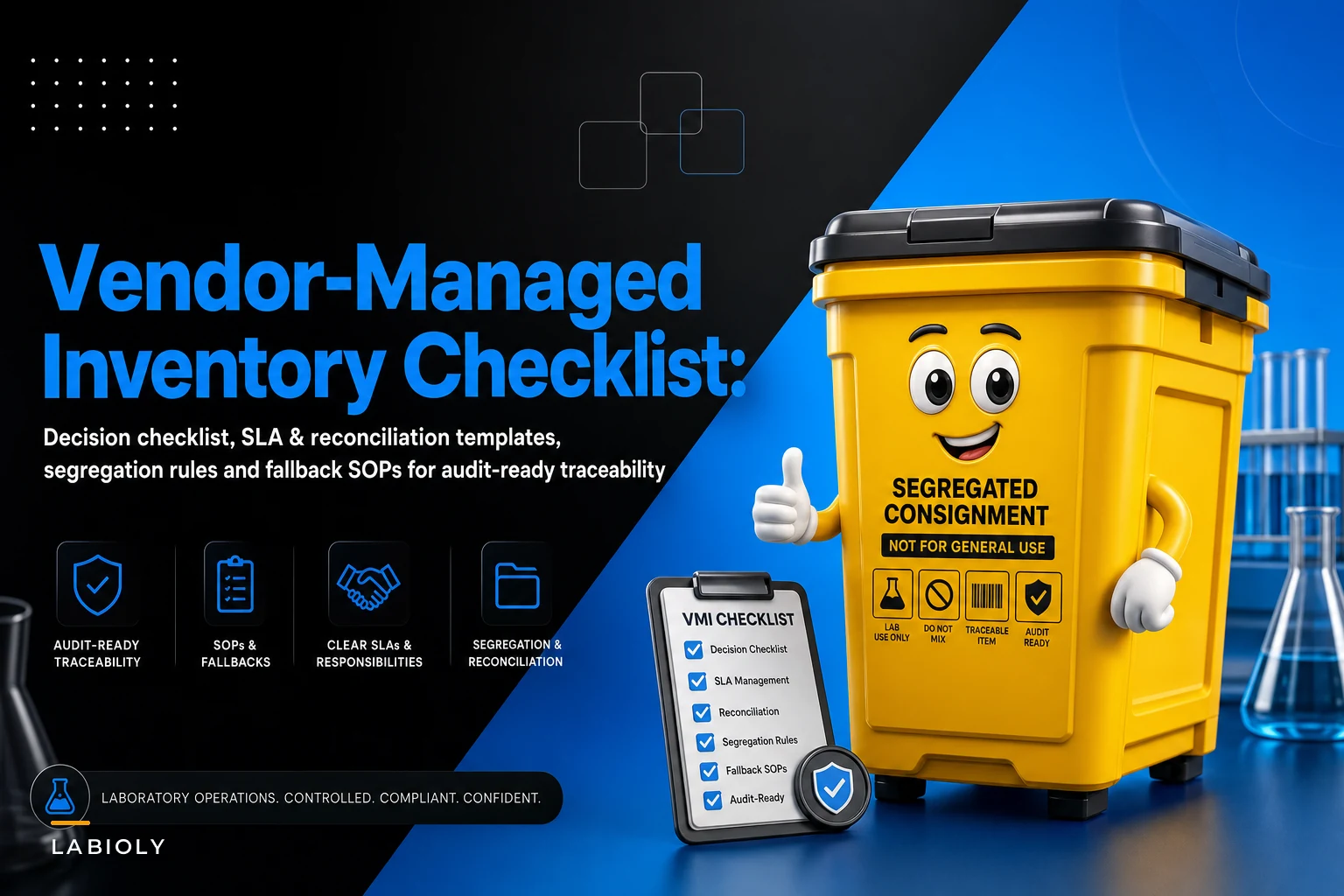
Run through this before you sign anything. If you can't answer "yes" to the traceability items, you're not ready regardless of the financial upside.
Financial and demand fit
-
[ ] Working capital currently tied up in this category justifies the arrangement
-
[ ] Consumption for these SKUs is predictable within a reasonable band
-
[ ] You've modeled waste/expiry risk under vendor restocking logic
-
[ ] Pricing terms are compared against your current direct-buy costs (including carrying cost)
Traceability and audit
-
[ ] Every consumption event can be captured at point-of-use (scan, weight, or log)
-
[ ] Lot/expiry data flows into your system, not just the vendor's
-
[ ] You retain the record of custody independent of the vendor
-
[ ] Recall traceback works even if the vendor relationship ends tomorrow
Physical and operational
-
[ ] You can physically segregate consigned stock from owned stock
-
[ ] Restocking events are logged and attributable to a person
-
[ ] A fallback procedure exists if the vendor can't deliver
Contractual
-
[ ] SLA defines fill rate, restock frequency, and response times with penalties
-
[ ] Reconciliation cadence and tolerance thresholds are written into the contract
-
[ ] Data ownership and export rights are explicit
-
[ ] Exit terms don't strand you without records
Run through this before you sign anything. If you can't answer "yes" to the traceability items, you're not ready regardless of the financial upside.
Physical segregation: the rule people skip
This is the part that gets ignored and then causes the worst audit findings. In a consignment model you have two categories of material sitting in the same lab: stock the vendor owns and stock you own. If they're mixed on the same shelf, you've created ambiguity about ownership, billing, and lot tracking.
-
Physically distinct zones. Consigned stock lives in a clearly labeled, separate location — a dedicated cabinet, shelf, or bin area. Not "the left side of the shelf." A real boundary.
-
Visual labeling at the zone level. Signage that says what's consigned, who the vendor is, and who to contact. New staff and auditors should understand the arrangement without having to ask.
-
One-direction flow. Material moves from consigned zone → consumed/invoiced. It does not drift back and forth. Once it's pulled and scanned, it's yours and it's recorded.
-
No commingling of lots. If you have both consigned and owned units of the same SKU, they stay separated even though they're technically "the same thing." Otherwise your lot records collapse into guesswork.
Label consigned zones with vendor name, contact, and date of last restock to make audits faster.
The underlying principle: an auditor walking your lab should be able to look at any container and know, without asking anyone, whose it is and whether its consumption was recorded. Segregation is what makes that possible.
SLA template: what to actually put in writing
A VMI SLA that only covers "vendor will keep shelves stocked" is the one that fails you. The SLA has to cover service and data obligations. Here's a breakdown of the clauses that matter and what good looks like for each.
| SLA Component | What to Specify | Example Target |
|---|---|---|
| Fill rate | % of restock requests met in full | ≥ 97% |
| Restock cadence | Frequency of vendor visits/replenishment | Weekly, or trigger-based at par level |
| Stockout response | Time to resolve a stockout on a critical SKU | Within 24–48 hrs |
| Lot/expiry data delivery | Format and timing of lot data to your system | Per restock, machine-readable |
| Reconciliation cadence | How often counts are jointly verified | Monthly |
| Count tolerance | Acceptable variance before investigation | ±2% by SKU value |
| Data ownership | Who owns consumption and lot records | Lab retains full rights + export |
| Expiry management | Who bears cost of expired consigned stock | Vendor, unless consumption data missing |
| Exit terms | Records handover and stock settlement on termination | Full data export within 30 days |
The two clauses labs forget most often: lot data delivery format and data ownership on exit. If the vendor delivers lot data as a PDF the rep emails once a month, that's not usable traceability. And if your consumption history lives only in the vendor's portal, ending the relationship can erase your audit trail. Both need to be contractual, not assumed.
For the broader framing on how to structure vendor obligations and penalties, our procurement and vendor governance guide covers the SLA and scorecard side in more depth — VMI SLAs should extend that same discipline, not replace it.
Reconciliation: where consignment lives or dies
The financial model of consignment depends on consumption being measured accurately, because consumption is what you get billed for. The audit model depends on the same measurement being traceable. Reconciliation does double duty here, and it has to be tighter than for owned stock.
-
Point-of-use capture. Every item pulled from the consigned zone is scanned or logged at the moment of use, tied to the lot and ideally the project or run.
-
Vendor restock logging. When the rep replenishes, the quantities and lots added are recorded — attributable to the rep, timestamped. This is the entry point most labs leave uncontrolled.
-
System-of-record consumption tally. Your system (not the vendor's) tallies consumption over the period from the point-of-use data.
-
Joint periodic count. On the agreed cadence, you and the vendor physically count the zone. Both figures get compared.
-
Three-way match. Opening count + restocked – consumed should equal closing count, within tolerance. When it doesn't, you investigate before settling the invoice.
-
Exception handling. Variances outside tolerance trigger a documented investigation — not a shrug and an adjustment.
That three-way match is the whole game. If your consumption records, the physical count, and the vendor's restock log don't reconcile, you have either a billing error or a traceability gap, and you need to know which. The sampling plans and tolerance logic in our cycle-count reconciliation guide apply directly here — the main difference with consignment is that reconciliation now has a money consequence attached to it, which tends to focus everyone's attention.
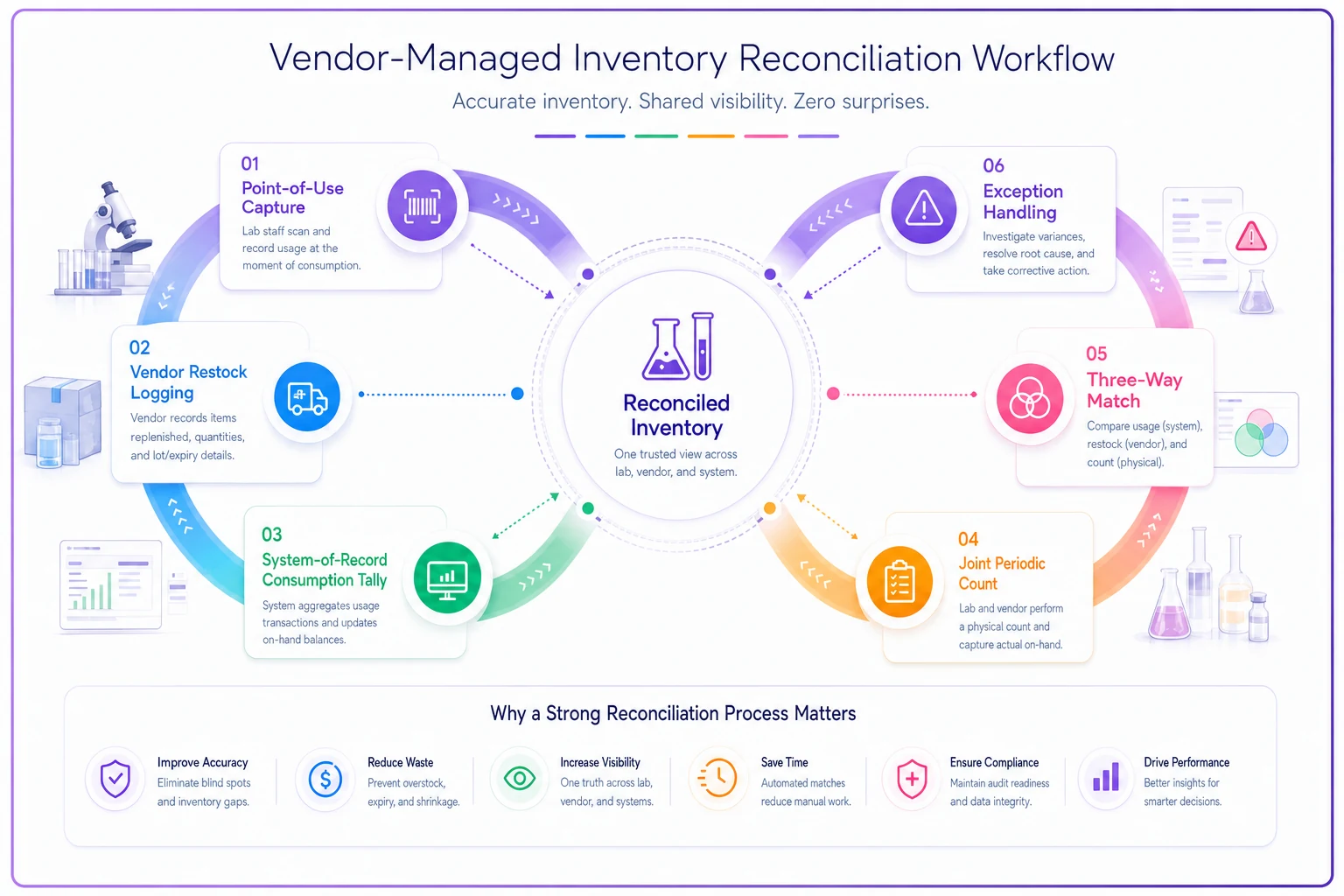
A simple diagram of the reconciliation steps in sequence.
A common variance pattern: physical count is lower than (opening + restock – recorded consumption). That almost always means consumption happened without being scanned — someone grabbed a box in a hurry. It's not theft, it's process. But it means your traceability is incomplete for whatever got used off-record, and that's the finding you don't want.
Fallback procedures that preserve the audit trail
Two scenarios break VMI arrangements, and both need a written fallback that doesn't sacrifice traceability under pressure.
Scenario one: the vendor can't deliver. Supply disruption, the rep leaves, the company has a backorder. Your lab still needs the consumable. The fallback is an emergency direct-purchase path — and anything bought and used during the gap has to be recorded in your own system with full lot/expiry data, not treated as off-books because "it wasn't the consigned stock." The temptation during a shortage is to use whatever's on hand and sort out the paperwork later. Later never comes, and now you have a traceability hole.
Scenario two: the system that captures consumption goes down. Scanner fails, portal is offline, connectivity drops. You still need to use reagents. The fallback is a manual capture form — paper or offline — that records SKU, lot, quantity, date, user, and project, to be entered into the system once it's back. The rule: no consumption without a record, even if the record is temporarily on paper. A reagent used without its lot captured is a reagent you can't defend in a recall.
Both fallbacks share one principle: degrade the convenience, never the traceability. You can switch to manual, switch to direct-buy, switch to paper — but the record of what lot touched what sample on what date has to survive every one of those switches intact.
A real scenario
A university core facility running protein work moved its commodity consumables and a couple of mid-volume buffers to consignment to free up roughly $25k in tied-up inventory and reclaim a cabinet they needed for equipment.
For the first few months it was fine. Then an internal audit pulled on a thread: a set of runs from the prior quarter had consumption recorded for a buffer, but the lot numbers didn't match anything in the vendor's restock log for that period. Turned out the vendor rep had restocked twice in one week during a busy stretch and only logged one visit. The second batch — a different lot — got consumed and partially captured with the wrong lot reference.
Nothing was contaminated, no samples were actually compromised. But the lab couldn't prove which lot touched which run for about three weeks of work. The fix wasn't dramatic: they added attributable restock logging (rep scans in what they add, every visit), moved to a monthly three-way match with a ±2% tolerance, and physically separated the consigned buffers into their own labeled bin. Reconciliation discrepancies dropped to near zero within two cycles, and the next audit passed clean on that category.
What they took from it: the money savings were real, but the arrangement only became safe once the restocking event itself was treated as a recordable, attributable transaction — not a background chore the vendor did on their own.
Bringing it together
VMI and consignment can genuinely help a lab — free up cash, cut the ordering grind, keep high-turnover shelves full. But the model separates physical ownership from record ownership, and that separation is exactly where audit failures breed if you don't design against it.
Work the decision checklist honestly. Say no for the reagents where traceability precision matters more than convenience. For the categories where it fits, write an SLA that treats lot data and record ownership as seriously as fill rate, segregate consigned stock physically and visibly, run a three-way reconciliation with real tolerances, and build fallbacks that keep the audit trail intact when the vendor or the system lets you down.
Get those right and VMI becomes a tool that saves money without costing you control. Skip them and you've handed part of your traceability chain to someone whose job doesn't include protecting it.
Ready to upgrade your lab operations?
Join 500+ labs using Labioly to save time, reduce errors, and enhance productivity and compliance.